For a small Central PA manufacturer, the automation that pays back fastest is almost never on the shop floor. It is in the office: quoting, order entry, and the status calls that interrupt everyone. Estimators routinely spend hours per RFQ retyping information before any actual pricing work begins, and that retyping is what automation removes.
There is a lot of noise about smart factories and predictive maintenance. That is real, and it is mostly not where a 30-person shop in Lebanon or Lancaster County should start. Machine-level projects are capital-heavy, slow, and demand data most small shops are not yet collecting.
The office is different. The processes are already digital, they are just digital in five places that do not talk, with a person in the middle acting as the connection.
Start With the Quote, Because Everything Else Waits On It
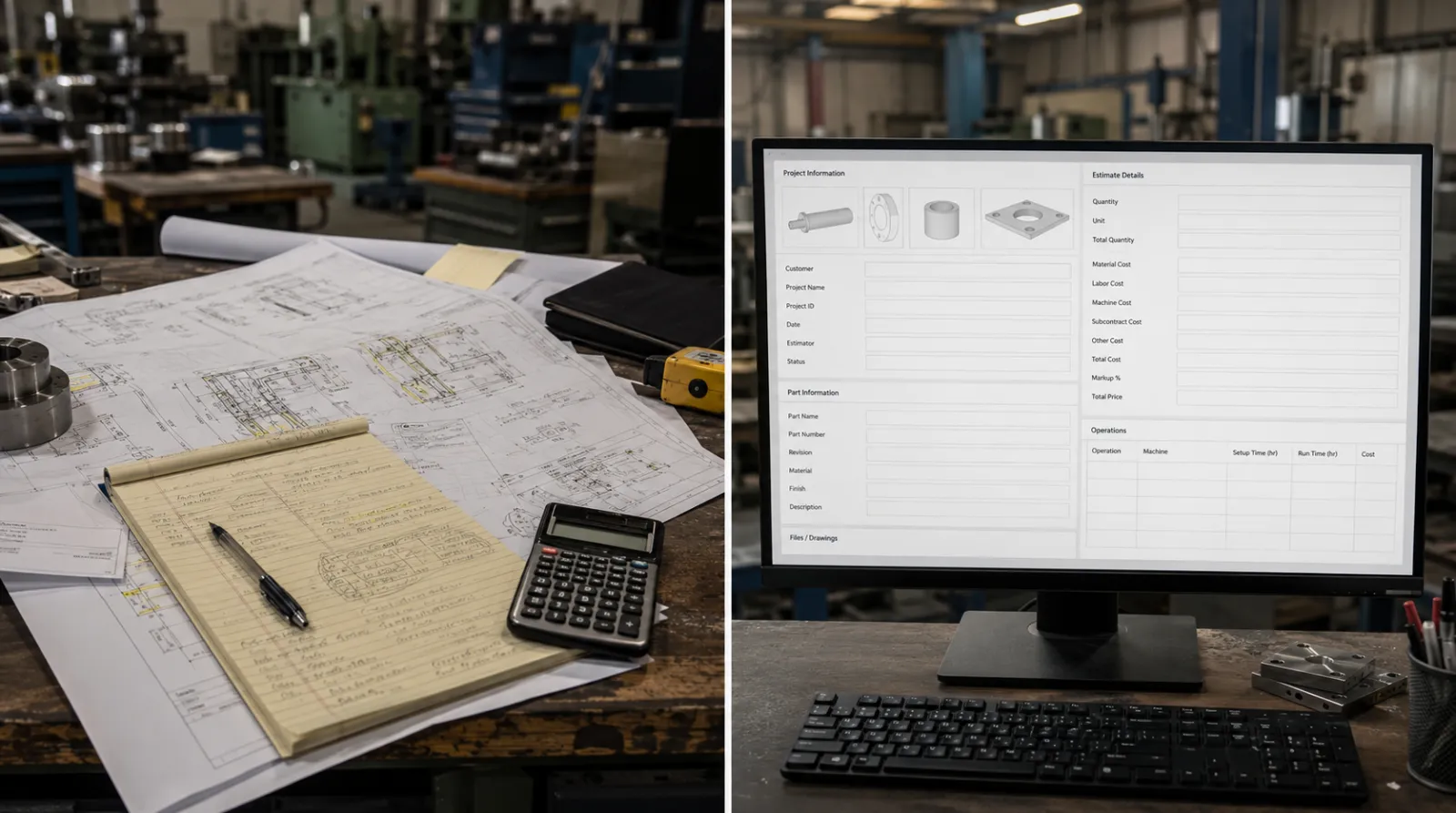
In most small shops, quoting is one or two people, and both of them are also doing something else. A request arrives as an email with a PDF drawing attached. Somebody opens it, reads dimensions, materials and tolerances, retypes them into a spreadsheet, looks up similar past jobs from memory, prices it, and writes a reply.
The pricing judgment is the valuable part and it is not automatable. Everything on either side of it is.
What can actually come out
- Extraction. Vision-capable models can read dimensions, materials, tolerances and title block data from a PDF drawing into structured fields. Human review stays in the loop, but reading and retyping becomes checking.
- Prior job lookup. Surfacing the three most similar jobs you have quoted before, with what you charged and whether you made money, turns an estimator's memory into a searchable asset that does not leave when they retire.
- The record. Every request becomes a tracked record automatically, so nothing sits unquoted in somebody's inbox and you can finally see your true win rate by customer and part type.
- Follow-up. Quotes over a week old with no response get a polite nudge without anyone remembering to send it.
Be honest about the threshold, though. Below roughly 15 RFQs a month, or where every job is a true one-off with no similarity to past work, the integration cost outweighs the hours saved. If your quoting lives in a shared spreadsheet with no ERP behind it, fix that first.
Order Entry: The Same Data, Typed a Third Time
The purchase order arrives and somebody types it into the ERP. The information was already in the quote, which was already in the drawing. That is the third time the same numbers have been keyed in, and each keystroke is a chance to transpose a dimension.
Connecting accepted quote to work order removes both the labor and the error class. It is unglamorous, it is usually a few weeks of work, and it is the change that shop floor supervisors notice first, because the jobs arriving on the floor stop containing surprises.
Kill the Status Call
Ask any small manufacturer what interrupts them most and the answer is customers calling to ask where their order is. Each call is short. There are a lot of them, they land unpredictably, and answering one means walking out to the floor to look.
Two fixes, in order of effort. The cheap one is proactive status updates: an automatic email or text when a job hits key stages. Most status calls exist because the customer has no information, so giving it to them before they ask removes the reason to call.
The larger one is a customer portal showing order status, drawings and past invoices. Worth it once you have enough repeat accounts, and it doubles as a retention feature since customers who can self-serve rarely shop around.
What About the Shop Floor?
Floor automation is real and it is a second phase. The prerequisite is data: if you are not capturing job times, scrap rates and machine utilisation reliably, no analytics layer will help, because it will be summarising guesses.
So the sensible sequence is to fix the office flow first, which incidentally starts producing clean job data, then use six months of that data to decide where floor investment actually pays. Shops that go the other way usually end up with a dashboard nobody trusts.
The Part Nobody Puts in the Brochure
Central PA manufacturing has a specific workforce problem: the people who know how everything works have been there 25 years and are retiring. The quoting logic, the customer quirks, the reason you always add a day for a particular material, all of it lives in a handful of heads.
Automating the quoting workflow forces that knowledge into writing, which is worth more than the hours saved. When the rules become explicit, a new estimator can be productive in months instead of years. Frame these projects that way internally, because "we are documenting what Dave knows before Dave retires" gets far better cooperation than "we are automating."
A Realistic Sequence
Weeks 1 to 3, measure: RFQs per month, hours per quote, quote turnaround time, win rate if you can calculate it, and status calls per week. Weeks 4 to 8, automate extraction and the quote record, keeping human review on every price. Weeks 9 to 12, connect accepted quotes to work orders and switch on proactive status updates. Then re-measure the same five numbers.
Turnaround time is usually the headline result, and it matters more than the labor saving, because in contract manufacturing the fast quote frequently wins the job. Our workflow automation work follows this shape, and AI automation for Central PA businesses covers the wider local picture.
Frequently Asked Questions
Can AI read our engineering drawings accurately?
Well enough to extract dimensions, materials and title block data from clean PDFs, with human review on every extraction. Accuracy drops on scanned hand-marked prints and unusual conventions. Treat it as removing the retyping step, not as removing the estimator, and run it in parallel with your current process until you trust it on your own drawings.
Do we need to replace our ERP?
Usually not. Most older ERPs have some import path, an API, or a database you can read from. Replacing an ERP is a year of disruption, and the automation gains rarely justify it on their own. Replace it when the ERP itself is failing the business, not as a step toward automation.
How much does this cost for a 30-person shop?
Quoting and order entry work is typically a project in the low tens of thousands, with modest monthly software costs after. Judge it against estimator hours and quote turnaround rather than a headcount saving, because the actual payback usually shows up as more quotes out the door with the same people.
Will our long-tenured office staff resist this?
Less than you expect, if you start with retyping rather than judgment. Nobody enjoys keying dimensions from a PDF. Resistance appears when a system appears to second-guess pricing decisions, so keep the human on the price and automate the paperwork around it.
What about ITAR or customer confidentiality requirements?
This decides your architecture, so raise it in the first conversation. Controlled or confidential drawings may require processing that stays inside your own infrastructure rather than a third-party API, which is achievable but changes the tooling and the cost. Do not discover this constraint after choosing a vendor.
Want results like these for your brand?
Book a free 30-minute revenue audit with PA Digital Growthand we'll map your fastest path to growth.
Book a free audit