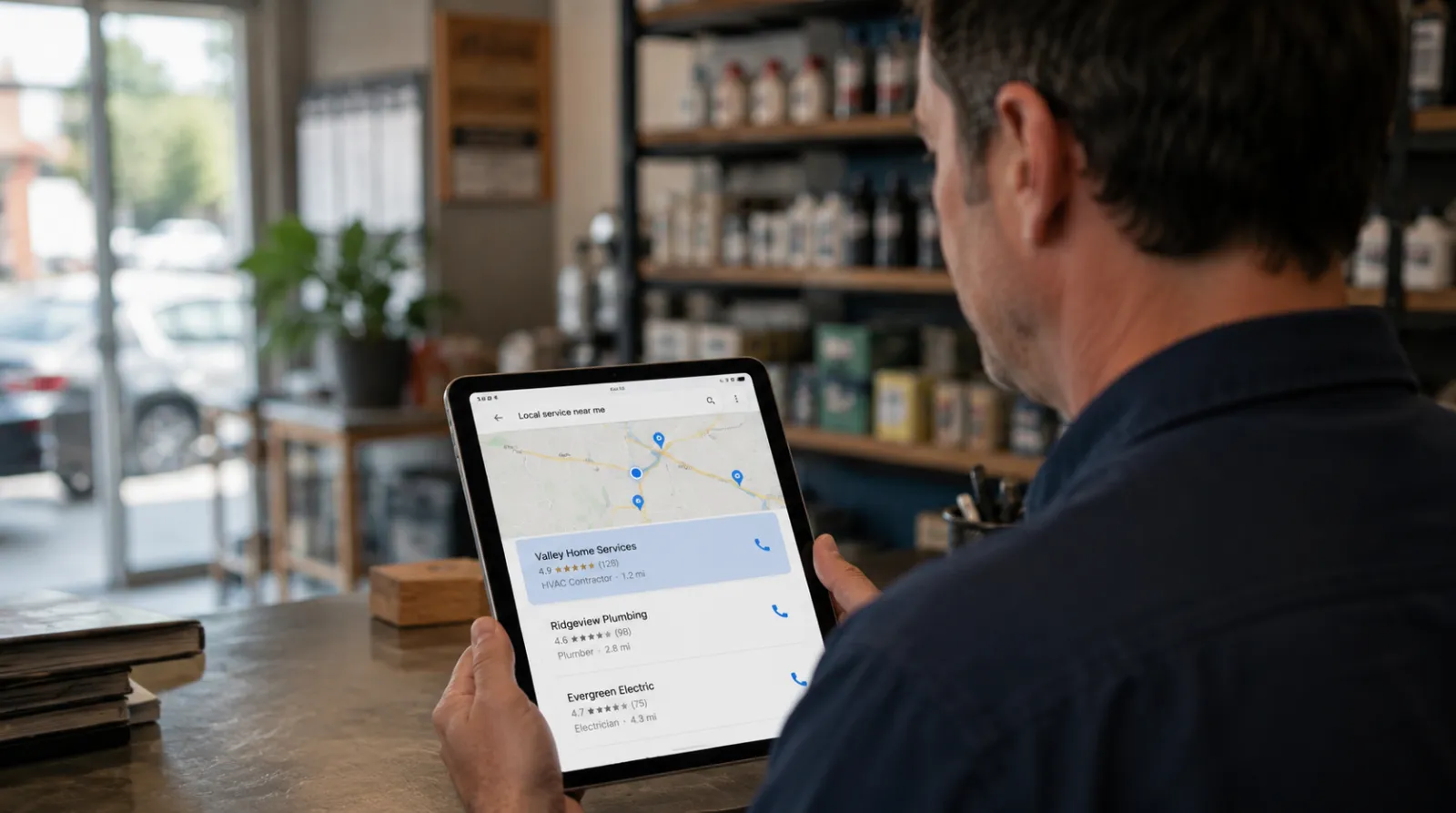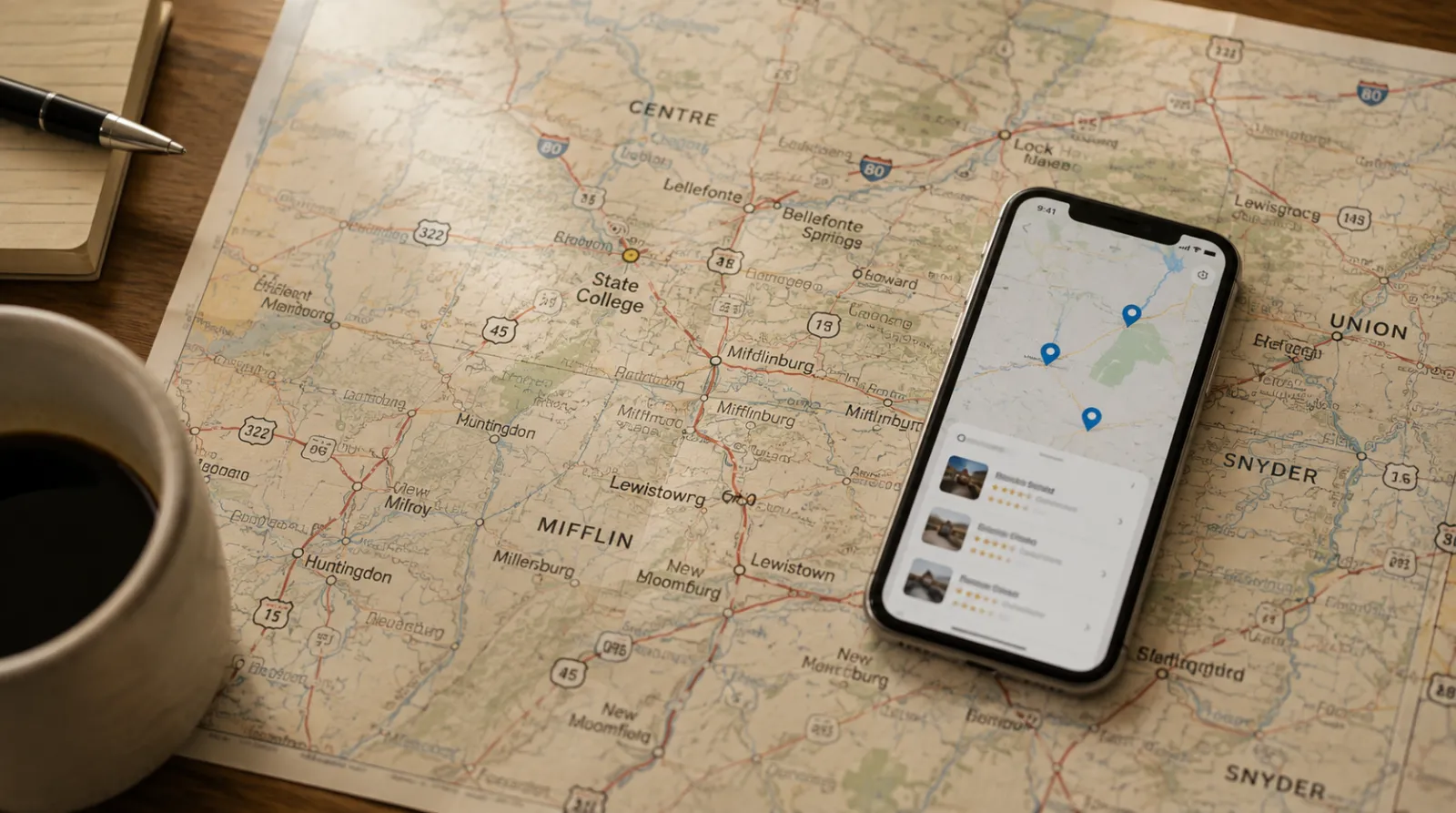
Local SEO across Lebanon, Lancaster and Dauphin counties is unusual because the population is spread across dozens of small boroughs rather than concentrated in one city. Proximity dominates the map pack, so a business in Annville does not automatically show up in Hershey, Elizabethtown or Harrisburg. Winning here means earning each town separately.
That is the whole problem in one paragraph, and it is why the standard advice fails locally. National guides assume you are competing inside one metro. Here you are competing across roughly forty small markets, most of them within a 30-minute drive of each other, none of them big enough to build a whole strategy around.
Why Central PA Geography Breaks Standard Local SEO
Proximity to the searcher is the dominant local pack signal, and you cannot change where your office is. A homeowner in Lititz searching for a plumber sees Lititz plumbers first, even if the Palmyra company is better and closer to the job they need doing.
There is no way to fake proximity that survives contact with Google. Fake addresses, virtual offices and family members' houses used as second locations all get caught, and the penalty costs more than the ranking was worth. So the strategy has to be built on the two things you can influence: relevance and prominence.
What that means in practice
You will win the map pack near your actual location and in adjacent boroughs. Further out, you win through organic results rather than the map, which means real pages on your own site doing the work. Both matter, they just need different content.
Location Pages That Are Not Template Spam
Every agency in the region sells location pages, and most of them produce the same page forty times with the town name swapped. Google has been discounting that pattern for years, and readers spot it instantly, which kills conversion even when the page ranks.
A location page earns its place when it contains things that could only be written about that town:
- Actual jobs you have done there, described specifically. A furnace replacement on a 1920s twin in Lebanon is a different job from a new build in Palmyra, and saying so proves you have been there.
- Local conditions that change the work. Well water and its effect on fixtures in rural Lebanon County. Older housing stock and knob-and-tube in parts of Lancaster city. Township permit quirks.
- Real service specifics: travel time, whether you charge a trip fee out there, which crews cover it.
- Recognisable landmarks and neighbourhoods, used naturally rather than stuffed.
The practical test: if you could swap the town name and the page would still be accurate, it is not a location page, it is a template. Build four excellent ones for the towns that actually produce revenue before you build twenty thin ones.
The Google Business Profile Work That Matters Here
Set your service areas honestly. Listing every county in central Pennsylvania when you realistically drive 25 minutes dilutes relevance and produces leads you will decline. Two or three counties, or a list of the townships you genuinely cover, works better.
Get the primary category exactly right, since it ranks first out of 187 factors, and set hours to when you actually answer rather than office hours, because hours are now a top-five factor and Google checks whether you are open at search time. The full list is in Google Business Profile ranking factors 2026.
Reviews that name the town
Reviews now carry roughly 20% of local pack weight, and reviews that mention where the work happened help relevance for that area. You cannot script this, and you should not try. What you can do is ask at the right moment, right after a completed job, and let customers naturally write "showed up in Cornwall on a Sunday" because that is what happened.
Citations, Which Matter Less Than You Have Been Told
Consistent name, address and phone across the major data sources still matters, but the effort curve flattens fast. Get the core set right, Google, Apple Maps, Bing Places, Facebook, Yelp, and the main industry directories for your trade. Then stop.
The genuinely valuable local links are not directories at all. They are the Lebanon Valley Chamber, the local little league you sponsor, the township contractor list, the supplier who features you as a dealer, and the community organisation whose event you turned up to. Those are hard for a competitor to replicate and they are real.
What to Measure
Do not check your rankings from your own office. You are standing at the point of maximum proximity advantage, so everything looks fine from there. Check from multiple points across the service area, or use a tool that does grid-based tracking, and you will see the honest picture: strong at home, fading with distance.
Then track the things that turn into money. Calls from the profile, direction requests, form fills by page, and which town pages produce inquiries. If a page has been up for six months with traffic and no inquiries, the problem is the page, not the ranking.
Our Central PA page is how we apply this to our own business, and SEO services covers the wider programme.
Frequently Asked Questions
How many location pages should we build?
Start with the three to five towns that already produce the most revenue, and write those properly. Add more only when you can say something genuinely specific about each. Twenty thin pages perform worse than four strong ones, because the thin ones drag down the perceived quality of the whole site.
Can we rank in Harrisburg from Lebanon County?
In the map pack, rarely, because proximity dominates and Harrisburg has plenty of local competitors. In organic results, absolutely, with a genuinely useful Harrisburg page and enough authority behind it. Plan to win Harrisburg through the blue links and your own content, not the map.
Is a second office worth it for the rankings?
Only if it is a real office with real staff, because Google verifies and neighbours report. If you are opening a location for business reasons anyway, the local ranking benefit is a genuine bonus. Opening one purely for SEO rarely pays back once you count rent and the suspension risk.
How long does local SEO take to show results?
Profile fixes such as category and hours can move within two to four weeks. New location pages typically take two to four months to settle. Review velocity is cumulative and needs a quarter before the trend is readable. Anyone promising the map pack in 30 days is selling something.
Do we need a separate profile for each town?
No, and creating them is a suspension risk. One profile per real physical location, with service areas listed for the places you travel to. Multiple profiles at addresses you do not staff is the single most common way local businesses lose their listing entirely.
Want results like these for your brand?
Book a free 30-minute revenue audit with PA Digital Growthand we'll map your fastest path to growth.
Book a free audit