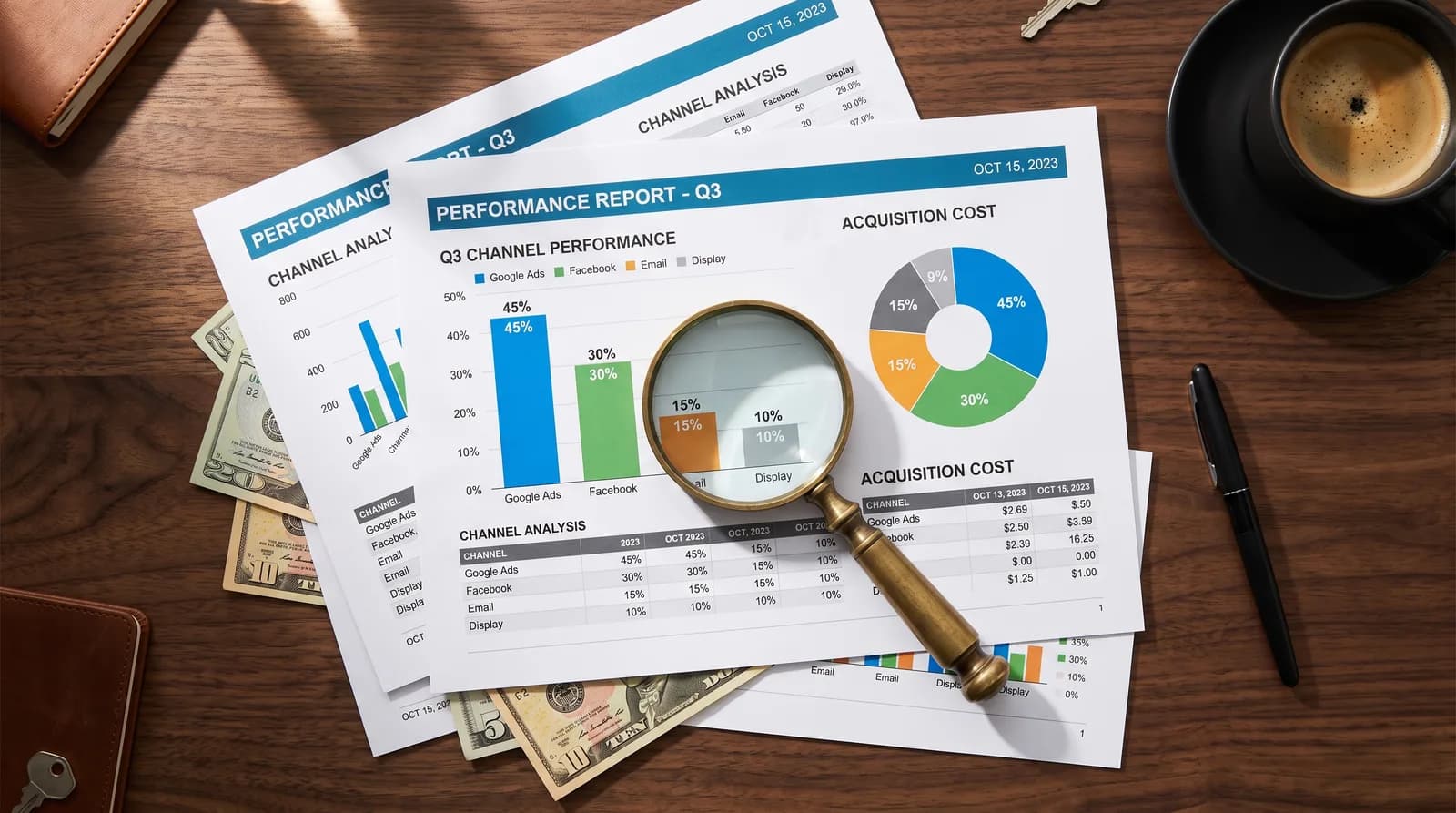
Here is a question worth asking at your next leadership meeting: what did our AI do last month?
Not what it is supposed to do. What it actually did. How many calls it handled. How many of those became booked appointments. How many leads it captured that your team would otherwise have missed. How much revenue is sitting behind those numbers.
Most owners cannot answer. They can tell you what they pay per month, and they have a general sense that things feel smoother, but the connection between the invoice and the outcome is a feeling rather than a number. Survey after survey finds the same thing: roughly three quarters of businesses adopting AI report real difficulty measuring its return.
That gap is dangerous in both directions. It means underperforming systems keep getting paid for, and it means systems that are quietly producing excellent returns get cut in the next budget review because nobody could prove their value.
Why AI ROI Is So Hard to See
This is not laziness on the part of business owners. There are structural reasons the numbers stay hidden.
Most of the value is in what did not happen
The core benefit of an AI receptionist is the call that did not go to voicemail. The benefit of an automated follow-up is the lead that did not go cold. Absence of loss is genuinely harder to measure than presence of gain, and it never appears on a bank statement.
This is solvable, but only if you established a baseline before deployment. Most businesses did not, which is why the first step in measurement is usually reconstructing one.
Vendor dashboards measure activity, not outcomes
Your AI platform will happily show you conversations handled, messages sent, minutes used, and response time. These are activity metrics. They tell you the machine is running. They say nothing about whether it produced revenue.
Ten thousand conversations that book nothing is a very busy failure. The vendor dashboard will present it as a great month.
The evidence is split across systems
Proving AI ROI requires connecting a conversation to an appointment to a completed job to a paid invoice. Those four facts usually live in four different tools that do not share identifiers. Without that chain, you can count calls and you can count revenue, but you cannot link them, which is precisely the disconnected stack problem showing up as a reporting failure.
Nobody defined success before launch
Most AI deployments begin with a goal like "stop missing calls" rather than a target like "answer 95 percent of inbound calls within 15 seconds and convert 30 percent of after-hours calls into booked appointments." Without a number agreed in advance, every result is arguable.
The Metrics That Actually Matter
A useful AI dashboard has four tiers, and each one answers a different question. Skipping tiers is why most reporting feels unsatisfying.
Tier 1: Coverage. Is anything being missed?
- Interactions handled, split by channel: calls, chats, forms, texts.
- Answer rate, meaning the percentage of inbound contacts that received a response at all.
- Average response time, measured to first meaningful reply, not to auto-acknowledgement.
- After-hours share, which is usually the number that justifies the entire investment on its own.
Tier 2: Quality. Are the interactions any good?
- Resolution rate: conversations that reached a satisfactory end without human help.
- Escalation rate, and more importantly, the reasons behind escalations.
- Abandonment: where in the conversation people drop out.
- Customer satisfaction where you can capture it, even as a simple post-interaction rating.
Tier 2 is where you catch a system that is busy but giving customers wrong or unhelpful answers. High volume with low resolution is the classic signature.
Tier 3: Conversion. Does it produce commercial outcomes?
- Leads captured, meaning contactable prospects with enough information to follow up.
- Appointments booked directly by the AI.
- Show rate for those appointments, since a booking that does not show is not revenue.
- Booking rate: appointments as a percentage of qualified conversations.
Tier 4: Revenue. What is it worth?
- Revenue attributed to AI-sourced appointments, traced through to paid invoices.
- Recovered revenue from interactions that historically would have been missed, such as after-hours and overflow calls.
- Hours returned to staff, valued at fully loaded cost.
- Cost per booked appointment, which is the number that lets you compare AI against advertising, staffing, and every other growth lever.
If you can only build one metric, build that last one. Cost per booked appointment converts an abstract technology decision into a comparison any owner can make in seconds.
How to Calculate AI ROI Without Fooling Yourself
The formula is straightforward. The discipline is in being honest about the inputs.
Return = revenue gained plus cost avoided. Investment = subscriptions plus implementation plus internal time.
Counting revenue gained
Take appointments the AI booked, apply your actual show rate, apply your actual close rate, and multiply by average job value. Count only the ones your team would plausibly have missed. If a customer called during business hours and would have reached your front desk anyway, that is not incremental revenue, it is efficiency, and it belongs in the cost-avoided column instead.
Being strict here matters. An inflated ROI number gets dismantled by the first skeptical person who reviews it, and you lose credibility for the whole program.
Counting cost avoided
Hours no longer spent answering repetitive calls, re-entering data, chasing confirmations, and playing phone tag. Multiply by fully loaded hourly cost, which is roughly 1.3 times wage once you include payroll taxes and benefits. Add avoided overtime and avoided temporary staffing.
Be careful with a common trap: hours saved are only real money if the time was redeployed into something valuable or a position genuinely went unfilled. Otherwise you have improved quality of life, which is worth having, but it is not cash.
Counting the full investment
Include subscriptions, implementation fees, integration work, and the internal hours your team spends maintaining the knowledge base and reviewing conversations. That maintenance time is real and routinely omitted, which is how businesses end up with ROI figures that look wonderful and feel wrong.
A worked example
A home services company with an average job value of 900 dollars and a 45 percent close rate deploys an AI receptionist. In a month it handles 240 calls, 90 of them outside business hours. It books 38 appointments, of which 30 show. Applying the close rate gives roughly 13 jobs, or about 12,000 dollars in revenue. Assume half of those would have been reached anyway during business hours: incremental revenue is about 6,000 dollars.
Add 22 staff hours returned at 28 dollars fully loaded, roughly 600 dollars. Total return is about 6,600 dollars. Against a combined cost of 1,200 dollars in subscription and amortized setup plus 4 hours of internal maintenance, the return is comfortably above four to one, and the cost per booked appointment is well under what the same company pays for a lead from paid search.
Those are illustrative numbers, not a promise. The point is that once the chain from conversation to invoice exists, this calculation takes minutes rather than being impossible.
Building a Dashboard You Will Actually Use
Step 1: Establish a baseline, even retroactively
Pull the three months before deployment: call volume, missed call count, average response time, appointments booked, revenue. If the data is incomplete, reconstruct what you can from phone records and your calendar. An imperfect baseline beats no baseline, because without one every improvement is deniable.
Step 2: connect the identity chain
The technical heart of AI measurement is making sure the same customer can be followed from first contact through to payment. That means a shared identifier, usually phone number or email, propagated from the AI system into the CRM, the scheduler, and the invoicing system. Without this, everything else is estimation.
Step 3: tag the source at the point of capture
Every record should carry how it arrived: AI voice, website chat, form, human answered, referral, walk-in. Applied at capture rather than reconstructed later, this single field is what makes attribution possible, and it is the same discipline behind knowing which marketing dollars actually work.
Step 4: one view, one cadence
Put the four tiers on a single screen with month-over-month comparison, and review it on a fixed schedule with a named owner. A dashboard reviewed monthly in a 20-minute meeting changes decisions. A dashboard nobody opens is decoration.
Step 5: pair every number with a recommendation
Numbers describe. Recommendations act. "Booking rate dropped from 31 to 24 percent, driven by callers asking about a service we no longer list in the knowledge base" is a report that produces a fix. "Booking rate: 24 percent" produces a frown and nothing else.
What Good Looks Like
Once measurement is in place, the conversation about AI changes completely. Instead of debating whether it is worth it, you are deciding where to extend it. Businesses with real AI reporting typically end up with:
- A defensible cost per booked appointment they can compare against every other channel.
- Clear evidence of which conversation types convert and which waste everyone's time.
- Early warning when quality drifts, before customers start noticing.
- Confidence to expand automation into the next workflow, backed by results rather than optimism.
- The ability to cut or renegotiate tools that cannot demonstrate a return.
That last point pays for the measurement work by itself in a surprising number of cases. And if you are still deciding what to automate next, our guide on choosing the three highest-return automations explains how to prioritize by dollars rather than by novelty.
Why Businesses Bring This to PA Digital Growth
We build the measurement layer as part of every deployment, not as an afterthought, because a system nobody can evaluate is a system that eventually gets cancelled regardless of how well it performs.
That means connecting your AI systems to your CRM and invoicing so the chain from conversation to revenue is unbroken, setting baselines before launch, and delivering a monthly review that includes what changed, why, and what we recommend doing about it. We would rather show you an honest number than a flattering one, because the honest number is what lets you make the next decision correctly.
If you already have AI running and no reporting behind it, that is a fixable gap, and it is usually the fastest way to find out whether what you own is worth keeping. Our AI consulting engagements frequently start exactly here.
You Cannot Improve What You Cannot See
AI is not magic and it is not a leap of faith. It is an operational investment, and it should be held to the same standard as a new hire, a new truck, or a new advertising channel: what did it cost, what did it produce, and what should we do next?
If you cannot answer those three questions about your AI today, the problem is not the AI. It is the missing instrumentation, and it is a shorter project than you think.
Book a free AI Business Efficiency Assessment and we will show you exactly what your current systems are producing, what they are costing, and what a proper measurement layer would look like for your business.
Frequently Asked Questions
How do you measure ROI on AI for a small business?
Compare return against total investment. Return is incremental revenue from AI-sourced appointments that actually closed, plus staff hours genuinely avoided at fully loaded cost. Investment is subscriptions, setup, integration, and internal maintenance time. The most useful single figure to track is cost per booked appointment, because it can be compared directly against your other acquisition channels.
What should an AI performance dashboard include?
Four tiers: coverage such as interactions handled and response times, quality such as resolution and escalation rates, conversion such as leads captured and appointments booked, and revenue such as attributed revenue and cost per booked appointment. Activity metrics alone show that the system is running, not that it is working.
We never set a baseline before deploying AI. Can we still measure it?
Yes. Reconstruct one from historical phone records, calendar history, and past revenue for the three months before launch. It will not be perfect, but a documented approximation is enough to show direction and magnitude, and it can be refined as clean data accumulates going forward.
How long before AI shows a measurable return?
Coverage improvements such as answered calls and response times appear immediately. Conversion effects usually stabilize within 30 to 60 days as the knowledge base matures. Revenue attribution needs at least one full sales cycle, so for businesses with longer cycles a fair evaluation is 90 days rather than 30.
Is time saved really worth counting as ROI?
Only when it converts into something. If saved hours let you avoid a hire, cut overtime, or redirect staff into revenue-generating work, count them at fully loaded cost. If the hours simply made a stressful week less stressful, that is a genuine benefit but it should be reported separately rather than presented as financial return.
Can we attribute revenue to AI when a human closed the deal?
Yes, using source attribution rather than sole credit. The AI captured and qualified the opportunity, the human closed it. Tagging the origin of each record lets you report AI-sourced revenue honestly without claiming the AI did the selling, which is the framing most leadership teams find credible.
What is a good cost per booked appointment from AI?
There is no universal benchmark, because it depends on your job value and margins. The meaningful comparison is internal: what does a booked appointment cost you through paid search, through your existing staff, and through AI? Whichever channel produces qualified appointments at the lowest cost per booking is where the next dollar should go.
Our AI vendor provides reports. Why is that not enough?
Vendor reporting stops at the edge of the vendor's system. It can show conversations and response times but cannot see whether those conversations became jobs or revenue, because it has no access to your invoicing. Meaningful ROI reporting requires joining vendor data to your CRM and financial records, which is work that has to happen on your side.
Want results like these for your brand?
Book a free 30-minute revenue audit with PA Digital Growthand we'll map your fastest path to growth.
Book a free audit