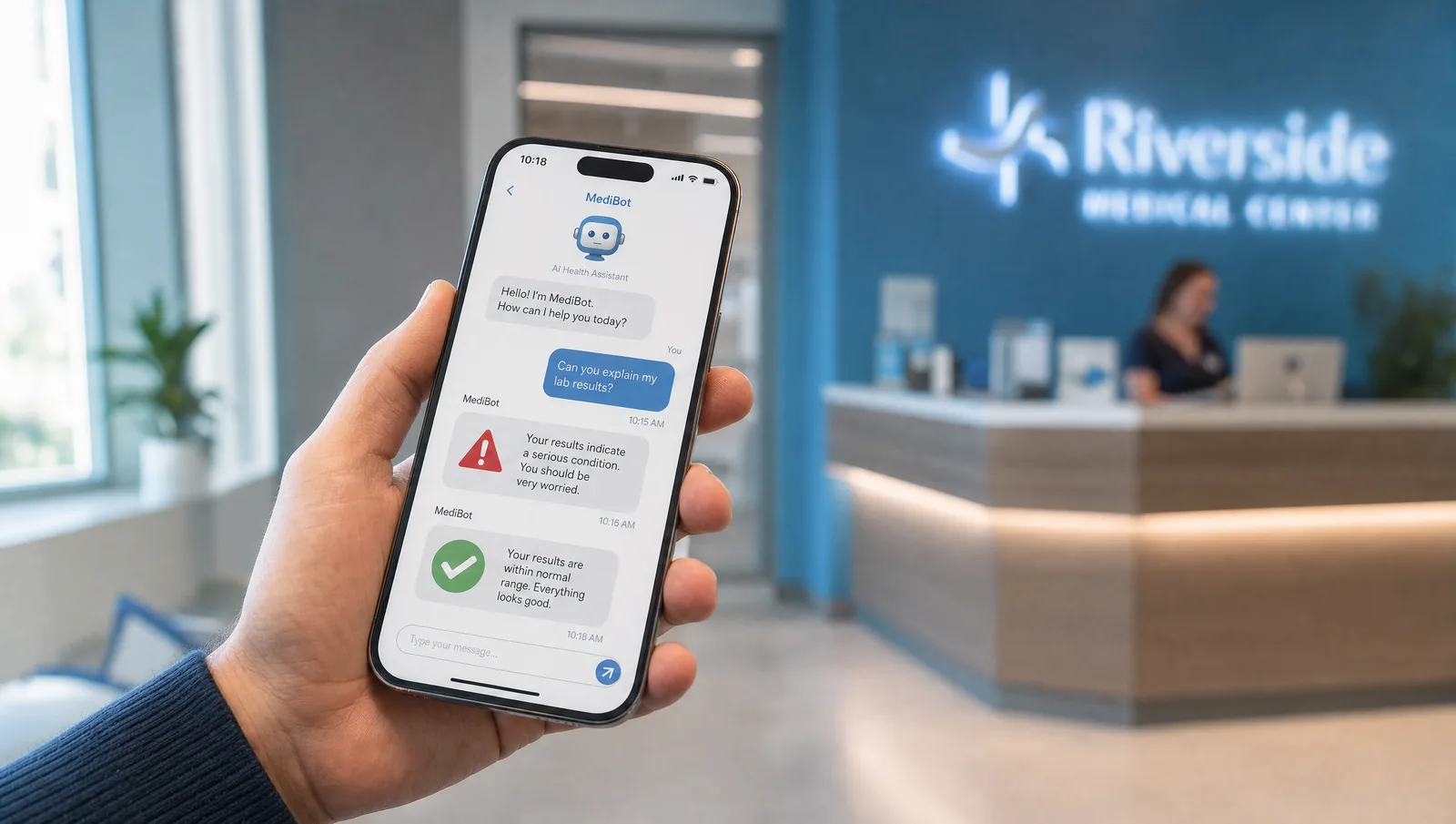
Your AI answers hundreds of customer questions a month. Nobody in your business has read a single one of those answers.
That is the uncomfortable part. You installed a chatbot or a voice agent because it promised to handle the repetitive questions, and it does. It answers instantly, at 2am, on a Sunday, without complaining. The dashboard says conversations are up. Everything looks like it is working.
Then a customer arrives for an appointment you do not have. Someone quotes a price you stopped offering in March. A caller is told you serve a county you left two years ago. A patient is given an answer about a procedure that is not just outdated but wrong in a way that matters.
You only found out because the customer complained. For every one who complains, several simply left and told nobody. An AI that is wrong 5 percent of the time is not 95 percent helpful. It is a liability that runs unsupervised, at scale, in your company's voice.
Why AI Gives Wrong Answers in the First Place
Understanding the cause matters, because the fix is different for each one. In practice, bad AI answers come from four places, and only one of them is the model's fault.
The knowledge base went stale
This is by far the most common cause. The AI was trained on your service list, pricing, hours, and policies as they existed on setup day. Then you raised prices, dropped a service, changed your after-hours policy, added a location, and hired a new provider. Nobody updated the AI, because updating the AI is not on anyone's job description.
The AI is not malfunctioning. It is faithfully repeating a version of your business that no longer exists.
The gaps get filled with invention
When a customer asks something the AI was never given information about, a poorly configured system will generate a plausible-sounding answer rather than admit it does not know. This is the failure mode that causes real damage, because the invented answer sounds exactly as confident as the correct ones.
A properly configured system does the opposite. It recognizes the boundary of what it knows, says so plainly, and hands the conversation to a human. That behavior is a configuration choice, not a limitation of the technology.
Your own source material contradicts itself
Point an AI at your website, your PDFs, your old brochures, and your intake forms, and it will find three different answers to the same question. Your site says 24-hour emergency service, your voicemail says next business day, and your intake form says something else again. The AI picks one. Sometimes it picks the wrong one.
Businesses are often surprised to learn the AI did not invent the wrong answer. It read it somewhere on their own website.
Nobody defined the edge cases
The setup covered the happy path: hours, services, booking. It did not cover the caller who is angry, the one describing a medical emergency, the one asking a question with legal implications, the one who wants to cancel, or the one asking about something you are legally not allowed to discuss over chat.
Those conversations are exactly the ones where a wrong answer costs the most, and they are almost never tested before launch.
What Wrong Answers Actually Cost
The damage compounds quietly, in four directions at once.
Lost customers you never hear from
Most people who get a wrong answer do not correct you. They conclude you are disorganized and call the next business on the list. There is no ticket, no complaint, and no line in your reporting. The only trace is a conversation log nobody reads.
Operational chaos downstream
Wrong answers create work. A double-booked slot, a technician dispatched to a job outside the service area, a quoted price your team now has to honor or awkwardly retract, a patient scheduled with the wrong provider. Each one consumes staff time and often costs more than the job was worth.
Reputation damage in public
Some of these conversations end up in reviews, and AI-related complaints are unusually memorable. "Their robot told me one price and then they charged me another" is a review that keeps costing you money for years, long after the underlying issue was fixed.
Real liability if you are regulated
If you are a dental practice, a medical clinic, a law firm, an insurance agency, or a financial services business, an AI stating something incorrect on your behalf is not merely embarrassing. Statements made by your automated systems are statements made by your business. Guardrails around what the AI must never discuss are not optional in these industries.
The Symptoms of an Unmonitored AI
You have an AI quality problem, whether or not you have caught it yet, if any of these apply:
- Nobody has read a full conversation transcript in the last 30 days.
- You cannot say what percentage of conversations ended without a resolution.
- Your prices, services, or hours have changed since the AI was set up, and nobody updated it.
- There is no defined process for what happens when the AI does not know something.
- You have no list of topics the AI is forbidden to discuss.
- Staff have started apologizing to customers for "what the chatbot said."
- The AI has never been tested with a deliberately difficult or hostile question.
- You do not know who owns AI accuracy inside your business.
That last point is the root of most of the others. Almost every business that installs AI assigns nobody to own its accuracy, which means the accuracy decays from launch day onward with nobody watching.
Why the Usual Responses Fail
Turning it off
The panic reaction after a bad incident is to disable the AI entirely. Now every call goes to voicemail again, after-hours inquiries go unanswered, and your response times collapse. You have traded an accuracy problem for a coverage problem, and the coverage problem was the reason you bought the AI.
Switching vendors
Owners often assume they picked the wrong product. Sometimes true, usually not. If the underlying cause is a stale knowledge base and no guardrails, a new vendor will produce the same failures in about four months, because you will have rebuilt the same unmaintained setup on a different platform.
Asking a staff member to spot check it
Better than nothing, but it does not scale and it does not survive a busy week. Random spot checks also tend to sample the easy conversations. The dangerous ones are rare by definition, which is exactly why random sampling misses them.
Assuming your vendor handles it
Your AI vendor maintains the platform. They do not know that you stopped offering same-day service, changed your cancellation policy, or hired a new provider. Only you know your business, which means content accuracy is always your responsibility, no matter what the platform does.
What AI Quality Assurance Actually Involves
Treat your AI the way you would treat a new front-desk employee: trained properly, given clear limits, supervised at first, reviewed regularly, and retrained when the business changes. In practice that means five ongoing disciplines.
1. A knowledge base with an owner and a review date
Everything the AI knows should live in one maintained source, not scattered across a website, a PDF, and someone's memory. That source needs a named owner and a scheduled review, typically monthly, plus a rule that any pricing, staffing, hours, or policy change triggers an immediate update.
This is also where the contradictions get resolved. One correct answer per question, everywhere.
2. Guardrails and escalation rules
Define explicitly what the AI may never do: quote outside an approved range, give clinical or legal advice, promise a timeline it cannot verify, discuss a competitor, or continue with a caller describing an emergency. Pair each restriction with an escalation path, so the boundary produces a handoff rather than a dead end.
A confident "let me get a specialist on this for you right now" beats a confident wrong answer every single time.
3. Structured transcript review
Somebody reads conversations every week, and not at random. Prioritize the ones that ended without a booking, ran unusually long, contained words like "no", "wrong", "actually", or "speak to someone", or triggered an escalation. Those are where the failures hide.
Every failure found becomes either a knowledge base update or a new guardrail. That loop is the entire discipline.
4. Deliberate edge-case testing
Build a test set of the hard questions: the angry caller, the emergency, the price haggler, the person asking about something you do not offer, the compliance-sensitive question, the caller with a heavy accent or bad connection. Run it against your AI before launch and after every significant change.
This takes an afternoon to build and prevents the incidents that cost the most.
5. Accuracy reporting you actually see
Track resolution rate, escalation rate, containment, and the specific questions that most often precede a dropped conversation. Reviewed monthly, these numbers turn AI quality from a vague worry into something you manage. Without them you are guessing, which is the same underlying problem as not being able to measure whether your AI is working at all.
A 30-Day Plan to Fix an AI That Has Drifted
Week 1: find out what is actually happening. Pull every conversation from the last 60 days and read the ones that did not end in a booking. Sort what you find into wrong answers, missing answers, and answers that should have escalated. Most businesses find their top five failure types account for the large majority of bad outcomes.
Week 2: rebuild the knowledge base. Consolidate every source of truth into one document. Reconcile every contradiction, including the ones on your public website. Assign an owner and a review cadence.
Week 3: install guardrails and escalation. Write the "never do this" list, define the handoff for each boundary, and make sure a human actually receives escalations in real time rather than in an inbox nobody watches.
Week 4: test, then set the routine. Run your edge-case set, fix what breaks, and put a recurring weekly transcript review and monthly knowledge refresh on the calendar with a named owner. The system only stays accurate if maintenance is scheduled rather than remembered.
Outcomes You Should Expect
- Higher containment, where more conversations reach a correct resolution without a human, because the AI knows more and guesses less.
- Cleaner escalations, where the conversations that do reach staff arrive with context instead of a confused customer starting over.
- Fewer operational fires, as double bookings, bad quotes, and misrouted jobs stop appearing.
- Better reviews, because the most common cause of AI-related complaints has been removed.
- Confidence to expand automation, since you can finally prove what the AI says before you let it handle more.
That last outcome is the strategic one. Businesses stall their automation programs because they do not trust what they have already deployed. Quality assurance is what unlocks the next step, whether that step is expanding coverage or finally solving a front desk staffing problem that recruiting has not fixed.
Why Businesses Bring This to PA Digital Growth
We treat AI accuracy as an operations discipline, not a software feature. When we take over a deployed system, we start by reading conversations, because the transcripts always tell the truth about what your customers are experiencing.
From there we rebuild the knowledge base, install guardrails appropriate to your industry, and put a monitoring routine in place with a named owner and a monthly report you actually read. We manage AI front desk operations as a service precisely because accuracy is not a launch task, it is an ongoing responsibility.
If your AI is already deployed and you have never audited it, that audit is the highest-return hour you will spend this quarter.
Your AI Speaks for Your Business Whether You Are Watching or Not
Every conversation it handles is a conversation your business is having. You would never let a new employee talk to hundreds of customers a month without training, limits, or a single performance review. Your AI deserves the same standard, and your customers are already assuming you apply it.
Book a free AI Business Efficiency Assessment and we will audit what your AI is telling your customers right now, show you exactly where it is going wrong, and give you the fix list. You keep the findings either way.
Frequently Asked Questions
Why does my AI chatbot give wrong answers?
In most cases the information it was given is out of date, incomplete, or contradicted somewhere else in your own material. Less often, the system is configured to always produce an answer rather than admitting uncertainty, so it fills gaps with plausible invention. Both are fixable through knowledge base maintenance and configuration, not by replacing the product.
How often should an AI knowledge base be updated?
Review it monthly as a baseline, and update it immediately whenever pricing, services, hours, staffing, service area, or policies change. Treating a price change as an AI update trigger is the single habit that prevents most accuracy incidents.
How do I stop my AI from making things up?
Configure it to answer only from an approved source and to escalate anything outside that source, rather than generating a response from general knowledge. Then define explicit restricted topics with matching escalation paths. Saying "I will get someone who can answer that" should always be an acceptable outcome for the system.
How many conversations should we review each week?
Volume matters less than selection. Reviewing 20 well-chosen conversations, filtered for unresolved outcomes, escalations, and unusual length, surfaces more problems than reading 200 at random. The point is to sample where failures concentrate, not to achieve coverage.
Is AI safe to use in a dental practice, law firm, or medical clinic?
Yes, with appropriate scope and guardrails. In regulated settings the AI should handle logistics such as scheduling, directions, hours, insurance basics, and intake, while clinical, legal, and case-specific questions escalate to qualified staff by design. The restriction list and escalation rules matter more than the underlying technology.
Should we turn the AI off until it is fixed?
Rarely. A better interim step is to narrow its scope: let it handle the questions you are certain it answers correctly and escalate everything else while you rebuild. That preserves your after-hours coverage and response times during the fix instead of reintroducing the problem you originally solved.
Who should own AI accuracy inside a small business?
Ideally the person who already owns customer-facing operations, such as an office manager or operations lead, with a defined monthly time commitment. What fails is leaving it unassigned. If nobody owns it, accuracy decays from the day the system launches, and nobody notices until a customer does.
How do we test an AI before customers see it?
Build a fixed set of realistic hard cases: emergencies, complaints, price pressure, out-of-scope requests, compliance-sensitive questions, and unclear phrasing. Run the same set before launch and after every significant change, and record the results. A repeatable test set turns AI quality into something you can verify rather than hope for.
Want results like these for your brand?
Book a free 30-minute revenue audit with PA Digital Growthand we'll map your fastest path to growth.
Book a free audit