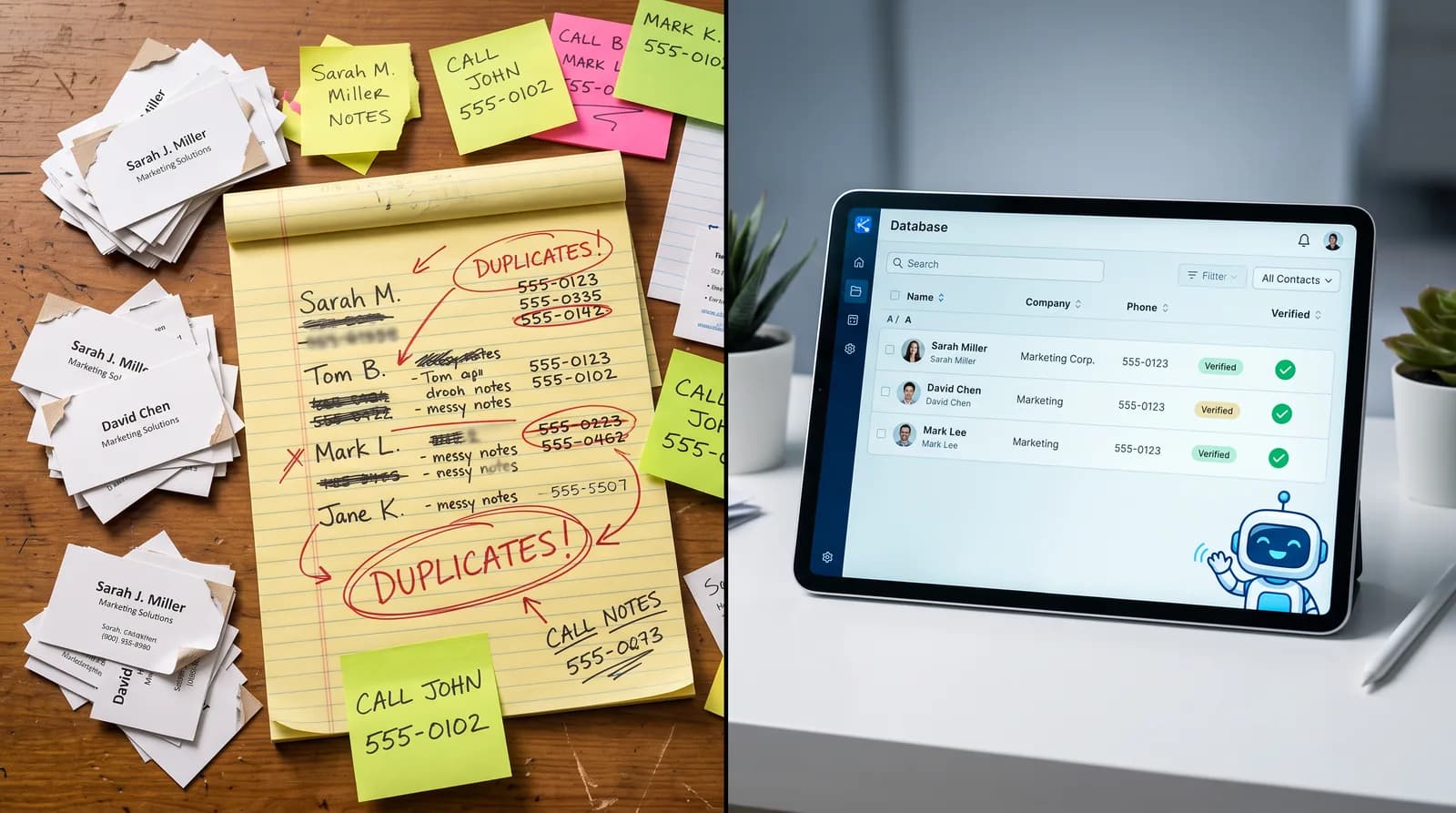
You bought the ChatGPT subscription eight months ago. You have used it to write a few emails. That is where your AI strategy currently stands.
Meanwhile the competitor across town answers every call at 9pm. Their quotes go out the same afternoon. Their review count keeps climbing. You are not imagining it, and you are not behind because you are slow or unwilling. You are behind because every piece of advice aimed at you assumes you have spare time and a technical team, and you have neither.
The internet is full of AI courses, AI newsletters, AI webinars, and AI consultants who will assess your readiness for a fee. Almost none of it produces a working system in your business. You do not need to learn AI. You need three specific things automated, built properly, and maintained by someone who will answer the phone when they break.
Why Most Businesses Stall Before They Start
There is a wide middle group of businesses right now: past the point of denying AI matters, nowhere near having implemented anything operationally. Understanding why that gap persists is what makes it possible to cross it.
Everything on offer is education, not implementation
Search for help and you will find training. Courses on prompting, workshops on AI strategy, frameworks for AI adoption. Training is valuable if the constraint is knowledge. For most owners the constraint is capacity. You are not stuck because you do not understand automation. You are stuck because it is Tuesday, you are short-staffed, and the person who would build it is you.
The scope feels infinite
Every article lists forty things AI can do for your business. Faced with forty options and no way to rank them, the rational response is to do none of them. Paralysis here is not indecision, it is a sensible reaction to an unprioritized list.
An early attempt went badly
Many owners did try. A chatbot that annoyed customers, an automation that broke silently, a tool that nobody adopted. One bad experience reasonably makes you cautious, especially when nobody could explain what went wrong or what it cost.
Nobody inside the business owns it
Automation projects need an owner with authority and time. In a business of 5 to 200 people, everyone with authority is fully committed to running the business. So the project stays permanently on the list of things to do after the busy season, which never arrives.
What Falling Behind Actually Costs
The cost is not abstract and it is not in the future. It shows up in four places you can measure this month.
The response time gap
Customers contact several businesses. The first credible response usually wins the job. If a competitor replies in 60 seconds at any hour and you reply the next morning, you are losing deals you never knew you were in. This is not a sales skill problem, it is a clock problem, and no amount of sales training fixes it.
Margin pressure they no longer have
A competitor handling intake, scheduling, reminders, and follow-up automatically is running a lower cost structure than you are. That gap eventually shows up in what they can charge, how quickly they can grow, and how they weather a slow quarter.
Customer expectations moved without asking you
Instant confirmation, text reminders, and 24-hour answers are now baseline expectations set by every other business your customer deals with. Falling short does not generate complaints, it generates comparison.
The gap compounds
This is the part owners underestimate. A competitor who automated last year is not one step ahead, they are on their second and third improvement, running on data you do not have. Every quarter you wait makes the catch-up longer, not the same length.
Why the Standard Advice Fails Businesses Like Yours
"Learn AI and do it yourself"
You could. It would take months of evenings, and at the end you would have a fragile system with a single point of failure, which is you. The opportunity cost of an owner's attention is the most expensive resource in any small business.
"Hire someone technical"
A capable automation hire is expensive, hard to find, hard to evaluate if you are not technical yourself, and often underemployed once the initial build is done. Most businesses of this size need a few weeks of expert build followed by ongoing maintenance, which is a terrible fit for a full-time role.
"Start with an AI strategy engagement"
Traditional consulting produces a roadmap, a maturity assessment, and a recommendation to hire someone to execute it. You paid for a document. Nothing in your business works differently on Monday. For a company under 200 people, this is almost always the wrong shape of help.
"Buy the all-in-one platform"
Software vendors sell capability, not outcomes. The platform arrives, the trial period passes, adoption stalls because nobody configured it around how your business actually works, and twelve months later you are paying for shelfware. Unused software is the most common form of AI investment failure we encounter.
The Three Automations That Should Move First
In service businesses of this size, the highest-return automations are remarkably consistent. You do not need forty. You need these three, working reliably.
1. Never miss an inbound contact
Every call answered, every chat responded to, every form acknowledged, at any hour, in your business's voice. The AI answers common questions, captures details, and books directly into your calendar when it can. Anything outside its scope escalates cleanly to a human with the context attached.
This is first for a simple reason: it produces revenue that already existed and was being lost. Nothing else in the list has a shorter path to a measurable return. It is the core of AI front desk operations.
2. Close the loop on every lead automatically
Instant response, structured follow-up over the next several days, appointment reminders that cut no-shows, and escalation to a human when a lead has been sitting untouched. Most businesses lose more revenue to inconsistent follow-up than to weak pitching, and follow-up is exactly the kind of reliable, repetitive work automation handles better than people.
3. Eliminate your single largest manual workflow
Every business has one process that eats hours and produces nothing but administration: quote preparation, intake paperwork, scheduling coordination, invoice chasing, review requests, or data re-entry between systems. Find the largest one and automate it end to end.
Which one it is differs by business, which is why this cannot be prescribed from a blog post. It can be identified in about an hour by watching where the time goes. That is the work of proper workflow automation.
How to Go From Nothing to Working in 60 Days
Week 1: find the leaks. Count missed calls, measure real average response time to new inquiries, and total the hours spent on repetitive admin. Do not plan anything yet. Almost every business is shocked by at least one of these three numbers, and that shock is what creates the will to fix it.
Week 2: pick exactly one. Whichever leak is largest in dollars becomes the first project. Not three projects. One. The goal in the first month is a working system with a visible result, because momentum from one clear win is what carries the rest of the program.
Weeks 3 and 4: build it around how you actually operate. This means real service knowledge, real pricing rules, real escalation paths, and integration with the systems you already use. Generic configuration is the reason most deployments underperform. Test it against difficult cases before customers see it.
Weeks 5 and 6: measure and correct. Watch it, read the transcripts, fix what is wrong. Compare against your week 1 baseline. This is when you find out what it is genuinely worth, which is why the baseline mattered.
Weeks 7 and 8: add the second automation. Only now, and only because the first one is proven. Businesses that try to launch everything simultaneously usually end up with several half-working systems and no confidence in any of them.
What to Expect Once It Is Running
- Response times measured in seconds rather than hours, including nights and weekends.
- Fewer lost opportunities, because nothing depends on someone noticing.
- Hours back for the people you already employ, spent on customers rather than data entry.
- Consistency, because the system does not have bad days or take vacations.
- A real baseline for deciding what to automate next, based on your numbers rather than a vendor's pitch.
The strategic outcome is more important than any individual metric: you stop being a business that has heard about AI and become one that operates with it. From there, every subsequent improvement is incremental rather than intimidating.
Why Businesses Bring This to PA Digital Growth
We are built for done-for-you rather than teach-me-how. We identify the highest-return automations for your specific operation, build them, integrate them with what you already own, and manage them afterward. You do not learn a platform, and you do not become the person who maintains it.
We start with your numbers, not a product catalog. If the answer is that one automation is worth doing and the rest can wait a year, that is what we will tell you, because a small system that works beats a large one that nobody trusts.
For businesses ready to move on more than one front at once, The Complete Growth System covers intake, follow-up, and the operational workflows behind them as a managed program. For those who want to start smaller, one automation is a perfectly good place to begin.
The Gap Is Closable, and It Is Smaller Than It Looks
Being behind on AI is not a permanent condition, and it does not require you to become technical. It requires identifying the three places your business leaks money, fixing the biggest one properly, and then repeating.
The businesses that pulled ahead did not do something clever. They did something specific, and they did it before you did. That advantage disappears the moment you act.
Book a free AI Business Efficiency Assessment and we will identify your three highest-return automations, estimate what each is worth in your business, and tell you which one to do first. No course, no homework, no obligation.
Frequently Asked Questions
Where should a small business start with AI?
Start where money is already leaking, which for most service businesses is inbound contacts that go unanswered outside business hours. Fixing that first produces revenue from demand you already generated, which makes it the fastest route to a measurable return and the easiest project to justify internally.
Do I need technical staff to implement AI automation?
No, if the work is done for you and managed afterward. What you do need internally is someone who can answer questions about how your business actually operates, such as pricing rules, scheduling constraints, and escalation preferences. That is business knowledge, not technical skill.
How much does it cost to automate a small business process?
Cost varies with complexity and how many systems must be connected, but the more useful question is what the process currently costs you. Quantify the missed contacts, the delayed responses, and the staff hours consumed. In most cases one well-chosen automation pays for itself well before a full-time hire would finish onboarding.
Is it too late to adopt AI if competitors started already?
No. Being second has a real advantage: the highest-return use cases are now well established, so you can skip the experimentation phase entirely and implement what is proven. The risk is not starting late, it is continuing to wait while the operational gap compounds quarter over quarter.
Should I do AI training for my team first?
Training helps most after something is running, when it is anchored to systems your team actually uses. Leading with training in a business that has automated nothing tends to produce interest without change. Build one working automation, then train the team on operating and improving it.
What if we already tried AI and it did not work?
That is common and usually diagnosable. The typical causes are generic configuration that did not reflect how the business runs, no integration with existing systems, and no ongoing maintenance after launch. Reviewing what failed is worthwhile before starting again, because the same gaps will otherwise repeat on a new platform.
How long until we see results from the first automation?
Coverage improvements such as answered calls and faster responses are visible immediately. Booking and revenue effects generally become clear within 30 to 60 days once the system has been tuned against real conversations. Businesses with longer sales cycles should plan on a 90-day evaluation window.
Will automation replace our employees?
In practice it replaces tasks, not people. The work that automates well is repetitive intake, reminders, follow-up, and data entry, which is rarely what you hired anyone to do. Most businesses use the recovered capacity to handle more volume with the same team rather than to reduce headcount.
Want results like these for your brand?
Book a free 30-minute revenue audit with PA Digital Growthand we'll map your fastest path to growth.
Book a free audit