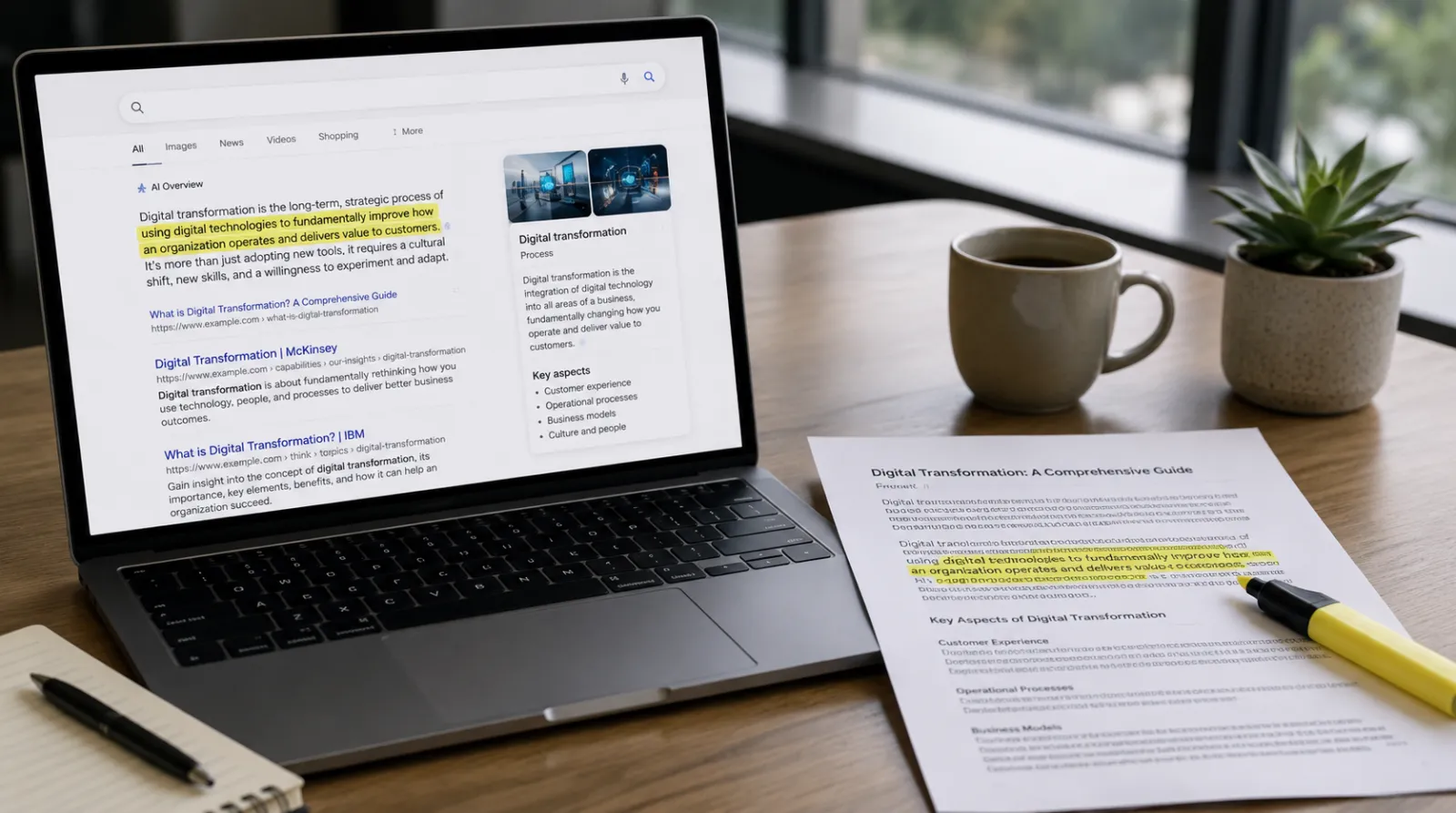
To get cited by ChatGPT and Google AI Overviews, you need two things: enough conventional search authority that the systems trust you, and content formatted so a passage can be lifted cleanly. Research suggests roughly 72% of pages ChatGPT quotes contain self-contained 40 to 60 word answers sitting directly under a clear heading.
There is no separate AI ranking algorithm to game. AI search is largely built on top of conventional search results, which means the foundation is the same one you have been ignoring or maintaining for years.
What is new is the format. Traditional SEO rewards a page that ranks. AI citation rewards a passage that answers, and those are different things.
The Foundation Nobody Can Skip
If Google does not trust your site, ChatGPT and AI Overviews mostly will not either. That means the unglamorous work still comes first: a technically sound site that loads quickly, a complete Google Business Profile if you are local, genuine reviews, and a page for each service you actually offer.
Domains with strong link profiles get cited more often, which is not a coincidence. AI systems are inferring authority from broadly the same signals search engines do. There is no shortcut past this, and any tactic sold as one is a tactic that will stop working.
Write Answers That Can Be Lifted
This is the highest-leverage format change available, and it costs nothing but discipline. Under every heading, put a self-contained 40 to 60 word answer to the question that heading implies. Self-contained means it makes sense quoted alone, with no "as mentioned above" and no pronouns pointing at the previous paragraph.
Then elaborate underneath for the human reader. You are writing two things at once: a passage a machine can extract, and a section a person can read. Done properly the reader never notices, because a direct answer followed by detail is simply good writing.
Make headings match real questions
"Pricing Considerations" tells an extraction system nothing. "How Much Does an AI Receptionist Cost?" matches how somebody actually asks, and it makes the following paragraph unambiguously the answer. You do not need to phrase every heading as a question, but each one should map to a question a real person would type or say.
Give Them Something Only You Have
A Princeton study found that adding original statistics and direct quotations increased AI visibility by 30% to 40%. That makes intuitive sense: a system choosing between five pages that say the same thing will favour the one carrying a specific number or a named source.
For a small business, original material is more available than it sounds. Your own data across jobs completed. A price range you can state plainly when competitors are coy. A named person with credentials saying something specific. Your actual timelines rather than industry averages.
The corollary is that content assembled from what everyone else already published has almost no chance of being cited, because there is no reason to pick it.
Structure and Schema
Structured data does not force a citation, but it makes your content unambiguous, which helps. The ones worth implementing are FAQPage for your question blocks, LocalBusiness with consistent name, address and phone if you are local, Article with a real author, and Organization tying it together.
Keep your FAQ answers short, factual and complete in themselves. An FAQ block is close to an ideal citation target: an explicit question with a bounded answer, already marked up as exactly that.
Mentions Off Your Own Site
AI systems build a picture of your business from everywhere it appears, not just your website. Consistent details across directories, chamber listings, industry associations and local press all reinforce the same entity. Inconsistent details create doubt, which shows up as your business simply not being mentioned.
Reviews matter here too, both for their content and their recency. A steady stream of recent reviews describing specific work is source material an AI can summarise when someone asks who to call.
Check They Can Actually Read You
None of this matters if your robots.txt blocks the crawlers. Training crawlers such as GPTBot and ClaudeBot are now separate from search crawlers such as OAI-SearchBot and Claude-SearchBot, so you can decline training while remaining eligible for citation in AI search. Blocking the search crawlers outright is close to de-indexing yourself from that surface.
Check your robots.txt today. Many sites blocked everything with an AI-sounding name in 2023 on legal advice and never revisited it. The detail is in the 20-minute AI crawler check.
How to Tell If It Is Working
There is no console for this yet, so measurement is manual and that is fine. Once a month, ask ChatGPT, Perplexity and Google the ten questions your customers actually ask, in the words they would use, and record whether you appear. Watch referral traffic from AI domains in your analytics. Track branded search volume, which tends to rise when AI systems start naming you.
Expect three to six months. This is authority-building, not a switch. Our approach is SEO services, and the format detail is in answer capsules.
Frequently Asked Questions
Do I need an llms.txt file?
It costs little and is not yet a real control mechanism. As of 2026 no major AI company has committed to reading llms.txt, and Google ignores it entirely. Robots.txt is the only mechanism with stated support from the major labs. Publish an llms.txt if it is cheap for you, but do not treat it as the work.
Should I block AI crawlers to protect my content?
Separate the two decisions. Blocking training crawlers keeps your content out of training data and costs you little visibility. Blocking search crawlers removes you from AI search results, which for most businesses is a real loss. Studies also suggest a majority of AI crawlers ignore robots.txt anyway, so treat it as a stated preference rather than a lock.
Does this hurt my traditional SEO?
No, it helps it. Clear question-shaped headings with direct answers underneath is also what wins featured snippets and what readers prefer. There is no trade-off to manage here, which is unusual and worth taking advantage of.
Which platform should we prioritise?
Google AI Overviews, because volume there dwarfs everything else and it is fed by the search authority you are building anyway. Perplexity and ChatGPT search follow. The good news is that the work overlaps almost entirely, so prioritisation matters less than it would if the tactics differed.
Can I pay to appear in AI answers?
Not for the cited results themselves at present, though advertising is appearing around them. Anyone selling guaranteed placement in AI answers is selling something they cannot deliver. Treat that pitch the way you would treat a guaranteed number one ranking.
Want results like these for your brand?
Book a free 30-minute revenue audit with PA Digital Growthand we'll map your fastest path to growth.
Book a free audit