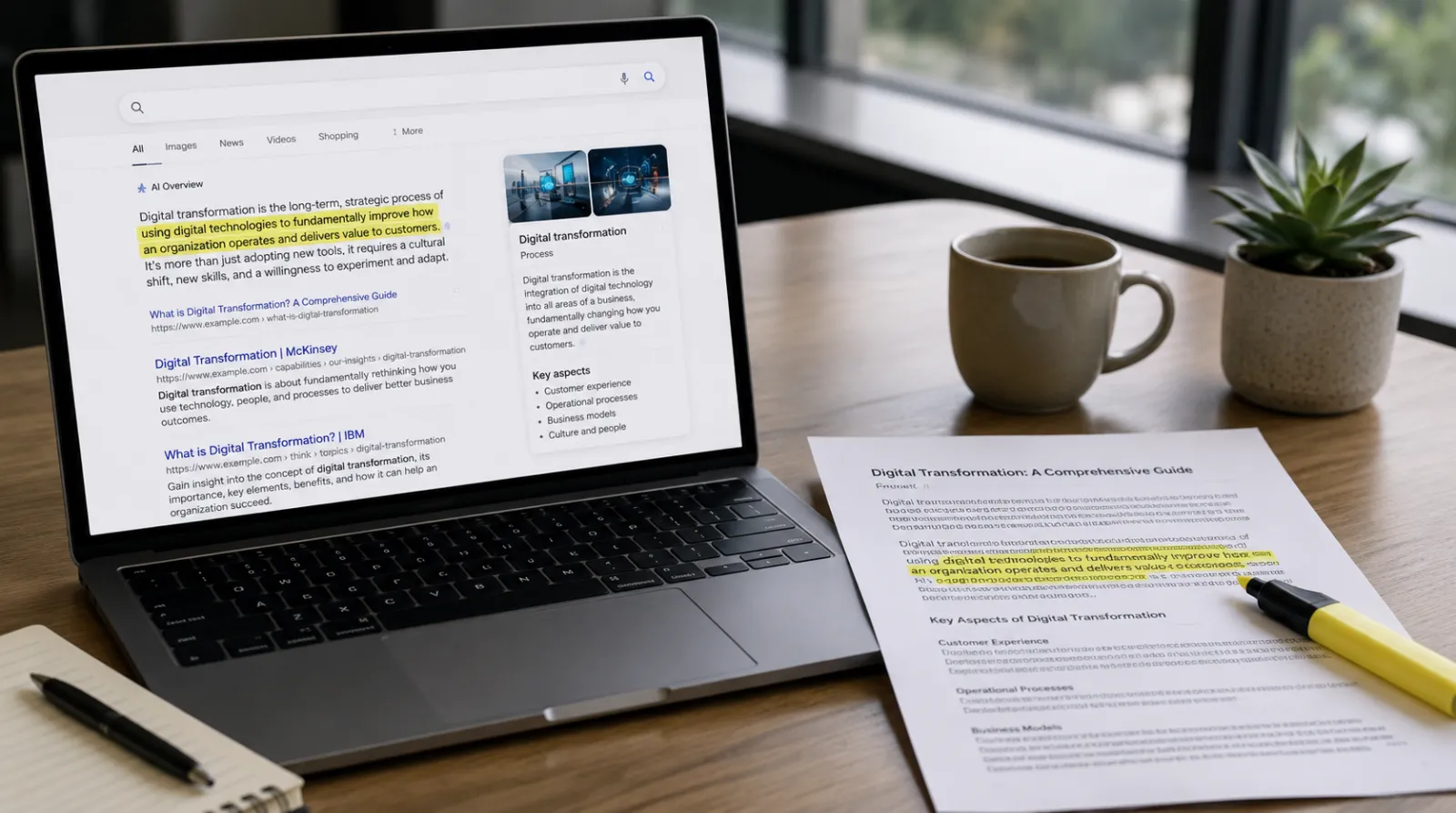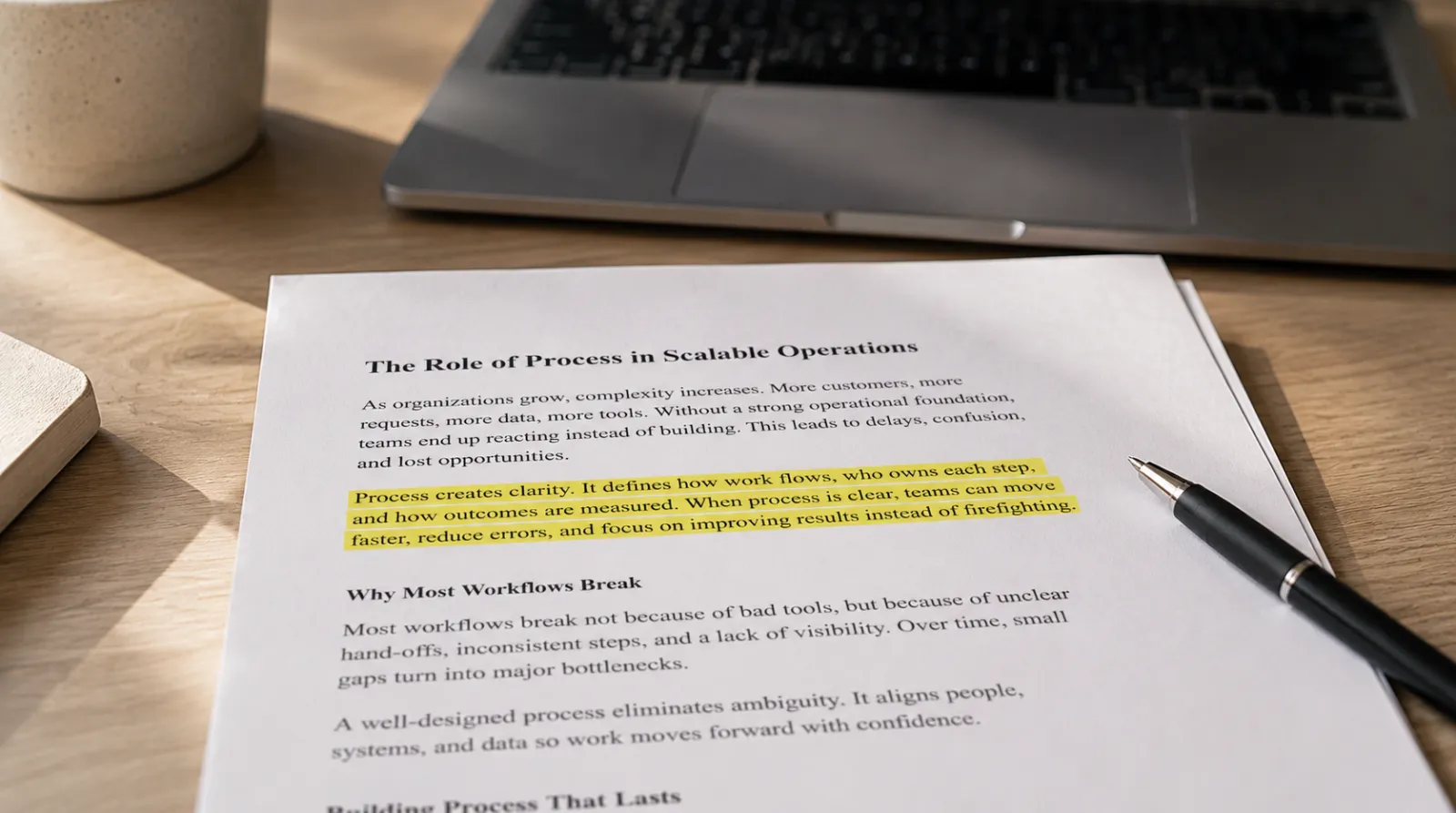
An answer capsule is a self-contained 40 to 60 word answer placed directly under a heading, written so it makes complete sense when quoted alone. Research on AI citations suggests roughly 72% of the pages ChatGPT quotes contain this pattern, which makes it the single cheapest format change available to any site.
The paragraph above is one. It answers the question in the title, it depends on nothing before it, and it could be lifted into an AI answer without editing. That is the entire technique.
What follows is how to write them well, where they go, and the mistakes that make them useless.
Why This Format Gets Quoted
AI search systems do not quote pages, they quote passages. When a system assembles an answer, it looks for a chunk of text that responds to the question completely and can stand on its own. A paragraph beginning "This is why it matters" fails immediately, because there is no way to know what "this" refers to without the paragraph above.
Most web writing is built to flow. Each paragraph leans on the one before it, which is good prose and bad extraction material. Answer capsules break that dependency at the points where an answer lives.
The Four Rules
1. It must survive being quoted alone
No "as we discussed", no "this approach", no pronoun pointing backwards. Name the subject inside the capsule. The test is simple: copy the paragraph into a blank document and read it. If it needs context you did not paste, rewrite it.
2. Forty to sixty words
Shorter than 40 and it usually answers only part of the question. Longer than 60 and it stops being a discrete unit an extraction system can lift cleanly. This is a guideline rather than a law, but it is a useful constraint because it forces you to answer rather than warm up.
3. Answer in the first sentence
No throat-clearing. "When considering the cost of an AI receptionist, there are several factors" answers nothing. "An AI receptionist costs $25 to $300 a month for most small businesses" answers immediately, and everything after it is supporting detail.
4. Carry something specific
A number, a range, a timeframe, a named thing. Specificity is what makes one page's answer preferable to five identical ones. Adding original statistics and direct quotations has been found to increase AI visibility by 30% to 40%, and a capsule is exactly where that specificity earns its keep.
Where They Go on the Page
Directly under the H1, answering the question the title implies. Then directly under each H2, answering the question that heading implies. Then in FAQ answers, which are already capsule-shaped by design and which schema marks up explicitly as questions and answers.
This is why the heading matters as much as the paragraph. "Considerations" is not a question. "How Much Does It Cost?" is. If the heading does not imply a question, the paragraph beneath it has nothing to be the answer to.
Does This Make Writing Worse?
It should not, and if it does you are doing it mechanically. Answer first, then elaborate, is a well-established structure that journalists have used for a century. Readers scanning a page get their answer immediately and decide whether to continue. That is a better experience than making them read three paragraphs of context first.
Where it does go wrong is repetition. If every capsule restates the same sentence in different words, the page reads like a machine wrote it, and readers bounce. Each capsule should answer a different question, which means your headings need to cover genuinely different ground.
The Common Mistakes
- Bold the capsule and stop there. Formatting is not the technique. A bolded paragraph that still says nothing specific is still not quotable.
- Vague hedging. "Costs vary depending on your needs" is unquotable because it is uninformative. Give a range and name what moves it.
- Rewriting old posts capsule-first and nothing else. Format helps a page that has authority behind it. It does not rescue thin content with no links, and that foundation is covered in how to get cited by ChatGPT and AI Overviews.
- Contradicting yourself across pages. If three pages state different prices for the same service, none of them is a reliable source. Consistency across the site is part of being quotable.
Retrofitting Existing Content
You do not need to rewrite everything, and you should not. Take your ten pages that already get traffic, and for each one add a capsule under the H1 and under each H2. It is roughly 30 minutes a page and it leaves the existing content intact, which matters because rewriting a page that ranks resets it.
Do the same for new posts as a default. After a few pieces it stops feeling like a technique and starts being how you structure an argument. Our wider approach is at SEO services, and the crawler-side prerequisites are in the 20-minute AI crawler check.
Frequently Asked Questions
Is this the same as optimising for featured snippets?
Very close, which is the good news. Featured snippet optimisation taught people to answer a question concisely near a matching heading, and AI extraction rewards the same structure. If you already write for snippets, you are most of the way there and mainly need to tighten self-containment.
How many capsules should one page have?
One under the H1, one under each H2, and one per FAQ answer. For a typical 1,500 word post that is six to ten. More than that usually means your headings are too granular and the page has fragmented into a list of one-line sections.
Will AI systems penalise content that is obviously optimised for them?
There is no evidence of a penalty for clear structure, because clear structure is genuinely useful to readers. What does get filtered is content with no substance behind the format. The capsule is a delivery mechanism for something specific you know, and with nothing specific to say it will not help.
Should the capsule be bold?
It helps human scanning and does no harm to extraction, so it is a reasonable convention. Just do not mistake it for the work. The formatting is decoration on a paragraph whose value comes from being complete, specific and independent of its neighbours.
Does this work for ecommerce product pages?
Yes, and it is underused there. A short self-contained paragraph stating what the product is, who it suits and what it costs gives an extraction system something to quote, where most product pages offer only marketing copy and a spec table. Product schema handles the structured facts; the capsule handles the sentence a person would say.
Want results like these for your brand?
Book a free 30-minute revenue audit with PA Digital Growthand we'll map your fastest path to growth.
Book a free audit