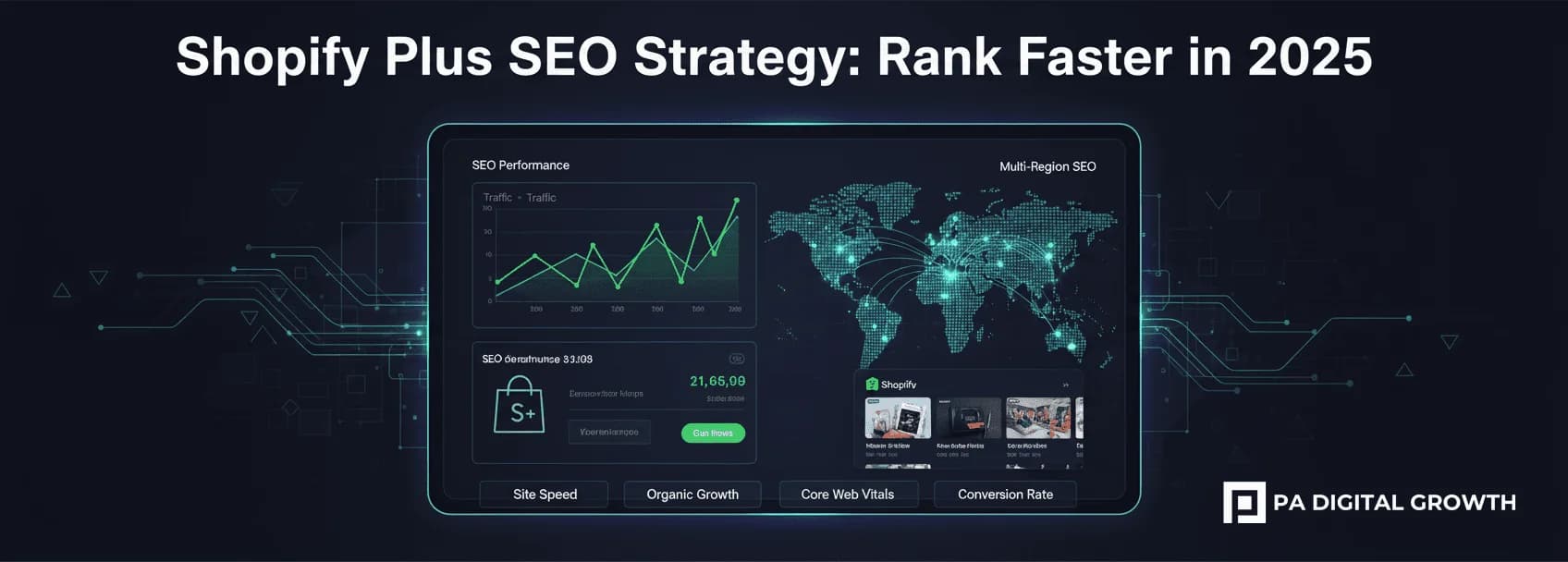
For fast-scaling enterprise brands, organic search isn’t just a traffic channel; it’s the engine that drives predictable long-term revenue growth. Paid ads fluctuate, algorithms change, and ROAS becomes unreliable. But SEO, when executed correctly at scale, produces consistent conversions, lower acquisition costs, and long-term authority. To achieve this in 2025, enterprise brands need a precise Shopify Plus SEO Strategy: leveraging the platform's technical foundation and SEO-ready architecture to rank faster, maintain stronger visibility, and dominate competitive keywords.
However, the SEO game has changed. Google’s Helpful Content evolution, AI-powered search experiences, mobile-first indexing, and ecommerce SERP competition mean that executing a successful Shopify Plus SEO Strategy requires a far more strategic and technical playbook than ever before. Shopify Plus stores cannot rely on traditional product-page SEO, basic keyword optimization, or outdated tactics. They need a deep, scalable SEO infrastructure that handles large catalogs, multi-store architectures, high crawl demand, and international variations, all while providing the speed and user experience Google rewards.
This guide explores exactly how enterprise stores can use Shopify Plus to rank faster in 2025, the strategies that matter most, and the technical frameworks required to build a future-proof organic growth system.
Why Enterprise SEO on Shopify Plus Needs a Different Approach
Enterprise stores face challenges that small Shopify shops never experience. Massive product catalogs, variant-heavy collections, complex filtering structures, multiple URLs, international storefronts, and deep internal linking requirements all create SEO hurdles. Search engines need clean architecture, fast performance, proper canonicalization, and optimized crawl paths to understand enterprise-scale Shopify stores.
Shopify Plus provides the technical foundation to solve these challenges, but only when combined with an enterprise SEO strategy built around speed, structure, and intent. Without this, large stores risk duplicate content issues, crawl inefficiencies, slow mobile performance, and fragmented ranking signals.
Enterprise SEO isn't about simply optimizing product titles or descriptions. It’s about creating a scalable architecture that Google can crawl, index, and trust. And in 2025, enterprise teams must think about SEO through the lens of technical performance, content depth, structured data, automation, and global consistency, all supported by the unique capabilities of Shopify Plus.
Technical SEO on Shopify Plus: The Foundation of Fast Rankings
The first step toward ranking faster in 2025 is establishing a strong technical foundation. Shopify Plus stores benefit from high-speed hosting, secure infrastructure, and mobile-ready themes, but enterprise websites must go further to remove friction and improve crawlability.
Site Performance and Core Web Vitals
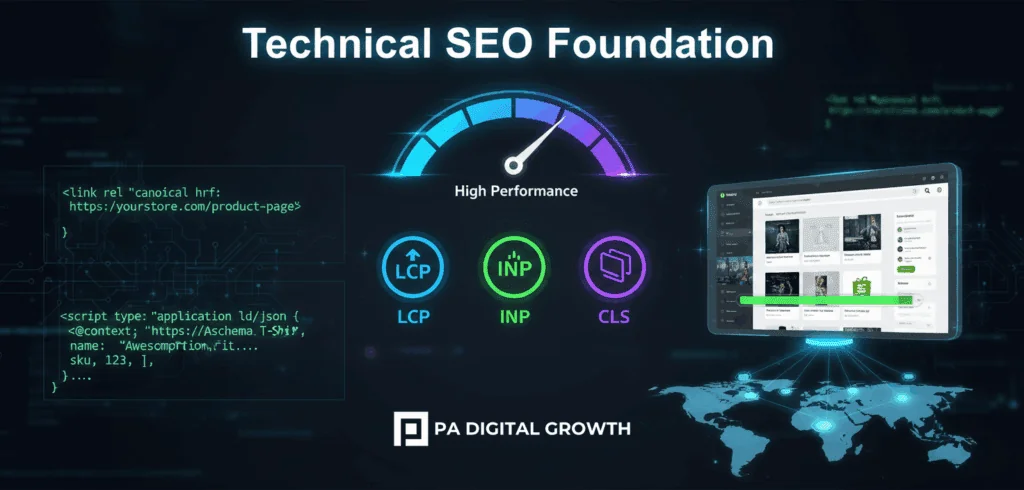
Site performance is one of the strongest ranking factors. Shopify Plus helps by providing robust CDN coverage, optimized checkout architecture, and fast server response times, but the real improvements come from minimizing theme bloat, reducing JavaScript dependencies, optimizing image delivery, and removing redundant apps that slow down page rendering. Enterprise brands should ensure their stores align with Core Web Vitals benchmarks, particularly in areas like Largest Contentful Paint and Interaction to Next Paint, where high SKU volume can impact load times.
Controlling Duplicate Content at Scale
Another essential element is controlling duplicate content. Shopify’s URL patterns can create multiple paths for the same product or collection, which dilutes SEO value. Shopify Plus merchants must implement a clean canonical strategy, ensure filtering and faceted navigation do not create infinite crawl paths, and use Shopify’s updated theme architecture to avoid multiple URLs for the same content.
Scalable Structured Data
Structured data also plays a major role in ranking faster. Shopify Plus allows brands to embed advanced schema markup, including product, review, FAQ, breadcrumb, and offer data. These enhancements help search engines better understand content while increasing click-through rates (CTR) from SERPs.
Finally, enterprise brands must integrate scalable SEO automation using Shopify Functions and custom logic to ensure ongoing SEO consistency across thousands of pages.
Powerful Site Architecture & Internal Linking for Enterprise SEO
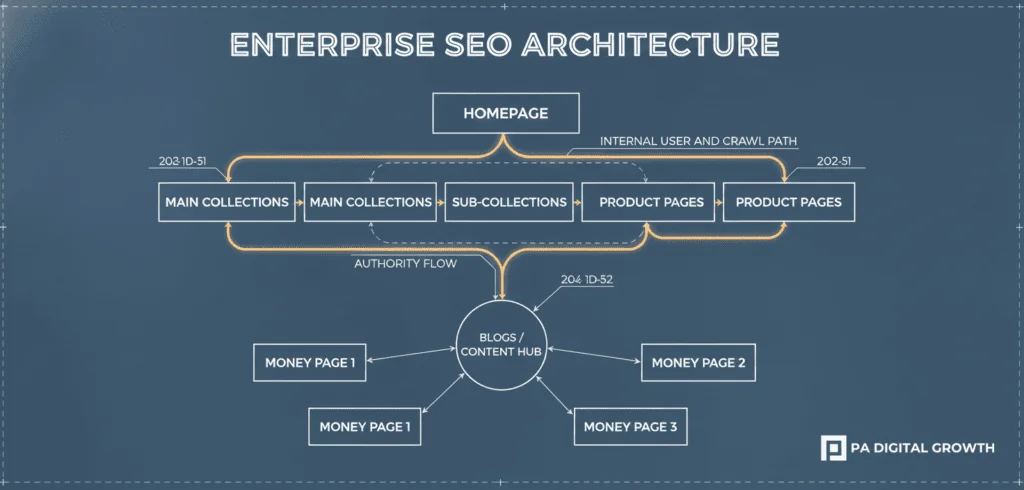
Successful enterprise SEO depends on scalable, logical, and Google-friendly site architecture. Shopify Plus enables brands to reorganize collections, sub-collections, product relationships, and content hubs in a way that improves both user experience and crawl efficiency.
Category Hierarchies and Collection Pages
Enterprise brands should create clear category hierarchies that guide both users and search engines toward high-intent commercial pages. Collection pages must be treated as major ranking assets, not simple product listings. These pages need rich content, internal linking strategies, FAQ sections, and contextual navigation that reinforces relevance.
Internal Linking Strategy
Internal linking is especially important for enterprise-scale Shopify stores. With thousands of URLs, internal links distribute authority, connect related products, and help Google understand topical relevance. Shopify Plus makes this easier by supporting automated linking frameworks, custom metafields, and the ability to create hub-and-spoke content systems that tie blog posts into commercial pages seamlessly.
A strong architecture reduces orphaned pages, improves crawl paths, and ensures that every high-value page receives the authority it needs to rank.
Content Strategy for Shopify Plus: Depth, Intent & Value
For enterprise stores, content is more than blog posts; it’s the fuel that builds topical authority. Shopify Plus brands must map their content against search intent categories: informational, commercial, transactional, and navigational. With AI-driven search becoming more prominent, brands must create deeper, more helpful content that answers real customer needs and connects directly to product discovery paths.
High-performing Shopify Plus content includes:
- In-depth buying guides, comparison pages, and product education pages.
- Collection page enhancements and long-form keyword-focused blogs.
- Localized content for global audiences.
Enterprise brands should build topic clusters around their main collections, supporting each "money page" with optimized content hubs that drive authority into the category. Shopify Plus allows these clusters to scale smoothly, especially with metafields and customizable templates that maintain consistency across hundreds of pages.
Another advantage is the ability to embed rich content elements like videos, reviews, UGC, and dynamic product data. These enhance both SEO and conversion performance, which creates a compound ranking advantage.
Off-Page SEO & Brand Authority for Enterprise Growth
Off-page SEO remains essential for enterprise brands aiming to dominate competitive keywords. Shopify Plus stores benefit from strong domain authority when supported by strategic backlink acquisition, PR exposure, influencer collaborations, and digital partnerships.
Enterprise stores must build backlinks to category pages, product hubs, and educational content, not just homepages and blogs. This deep-linking approach improves overall commercial ranking performance and strengthens the SEO value of high-impact pages.
Additionally, Shopify Plus brands should maintain consistent online citations, optimize for Google Business Profiles, and leverage user-generated content as a trust-building asset. Authority signals like reviews, social proof, and press coverage play an increasingly important role in SEO algorithms in 2025, especially as search engines reward brands with strong reputational value.
Why Shopify Plus Stores Rank Faster: The Strategic Advantage
Shopify Plus gives enterprise brands a measurable SEO advantage for several reasons.
- Infrastructure Excellence: It’s built for speed, one of Google's top ranking factors.
- Automation & Integration: It integrates seamlessly with advanced SEO tools, schema frameworks, and automation workflows (Flow/Functions).
- Superior UX Signals: Shopify Plus stores gain stronger user experience metrics due to improved checkout performance and faster load times, which reduces bounce rates and boosts engagement.
- Scalability: It provides cleaner architecture, better indexing, stable server performance during high-traffic periods, and the ability to manage multi-store and multi-market SEO strategies under one ecosystem.
The combination of speed, structure, automation, and global scalability makes Shopify Plus the most SEO-friendly enterprise platform available in 2025.
A 2025-Ready Shopify Plus SEO Roadmap
Enterprise SEO requires clear phases to unlock full ranking potential.
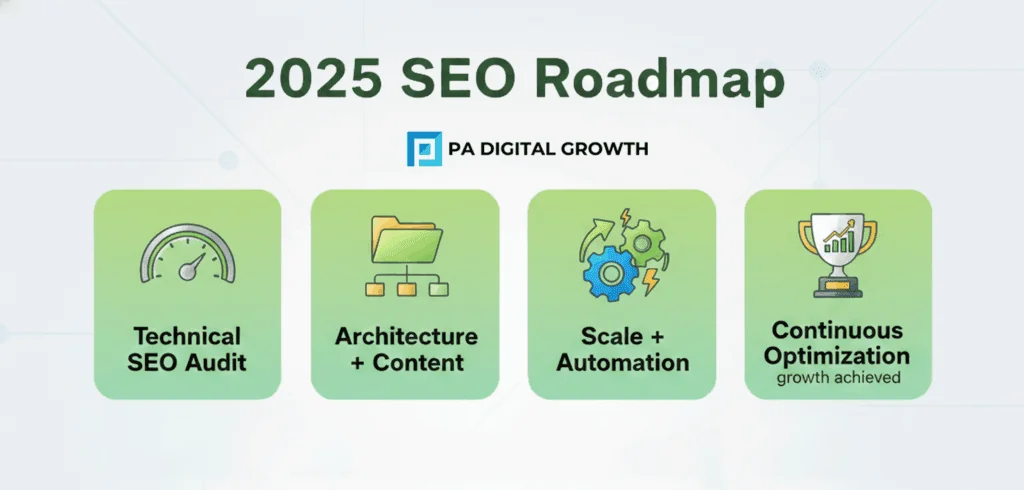
- Phase 1: Technical Foundation (Months 1-2): Complete technical SEO audit focused on site speed, duplicate content resolution, structured data improvements, and architecture cleanup.
- Phase 2: Architecture and Content (Months 3-4): Build out content hubs, optimize collection pages, integrate internal linking systems, and align product pages with high-intent keyword clusters.
- Phase 3: Scale and Automation (Months 5-6): Focus on scaling SEO with automation, improving global SEO signals, refining templated content, and enhancing UX signals.
- Phase 4: Optimization and Growth (Ongoing): Strengthen backlink profile, build digital PR assets, and continuously optimize conversion signals to maintain authority in competitive SERPs.
Conclusion: Shopify Plus Is the SEO Growth Engine for Enterprise Commerce
In 2025, Shopify Plus stands as the most powerful platform for enterprise SEO. With unmatched performance, deep customization, global scalability, and automation capabilities, Shopify Plus enables enterprise brands to build a strong, future-ready SEO foundation that accelerates rankings and strengthens long-term visibility.
When paired with a strategic technical framework, scalable architecture, deep content ecosystems, and authority-building initiatives, Shopify Plus becomes far more than an ecommerce platform; it becomes the engine behind sustainable organic growth and high-intent conversions. This is exactly where PA Digital Growth helps enterprise brands gain a competitive edge, ensuring every part of your Shopify Plus ecosystem is optimized for performance, speed, and search dominance.
Enterprise stores that invest in SEO now will be the ones leading their markets in the years ahead, achieving lower acquisition costs, stronger brand authority, and more predictable revenue. And if you're ready to transform your Shopify Plus store into a high-ranking, high-converting growth machine, PA Digital Growth can guide you with a tailored SEO roadmap built for enterprise-level scale.
Book Your FREE Strategy Call Today.
Frequently Asked Questions
What makes Shopify Plus SEO different from regular Shopify SEO?
While the core SEO principles remain the same, Shopify Plus provides enterprise-grade infrastructure, API access, and advanced features that enable more sophisticated optimization strategies. Enterprise stores benefit from better performance at scale, multi-store management capabilities, and the technical flexibility needed to implement complex international SEO and headless commerce architectures.
How long does it take to see results from a Shopify Plus SEO strategy?
Most enterprise stores see initial ranking improvements within 3-4 months, with significant traffic growth by months 6-9. However, SEO is a long-term investment that compounds over time. Stores that maintain consistent optimization efforts typically see continuous growth for years, with increasing returns as domain authority builds.
What are the most important technical SEO factors for Shopify Plus stores?
Core Web Vitals performance, proper canonicalization, structured data implementation, mobile optimization, and clean site architecture are critical. Enterprise stores must also manage crawl budget efficiently, implement proper international SEO signals with hreflang tags, and maintain fast page speeds across thousands of products.
How do I handle SEO during a Shopify Plus migration?
Successful migrations require comprehensive URL mapping, implementing 301 redirects for all changed URLs, preserving structured data, maintaining internal linking patterns, and submitting updated sitemaps immediately after launch. Work with an experienced agency to avoid traffic loss during transition.
Should I use a headless commerce approach for better SEO?
Headless commerce SEO offers benefits like faster page loads and greater customization, but requires significant technical resources. Most enterprise stores see excellent results with optimized Shopify Plus themes. Consider headless if you need extensive customization, have development resources available, or require advanced personalization features.
How many backlinks does an enterprise store need to rank competitively?
Quality matters more than quantity. Focus on earning authoritative links to commercial pages and collection categories, not just blog content. A well-executed strategy targeting 50-100 high-quality, relevant backlinks annually typically outperforms thousands of low-quality links.
What role does content marketing play in enterprise ecommerce SEO?
Content builds topical authority, attracts backlinks, and supports commercial pages with helpful resources that answer user questions. Enterprise stores should develop comprehensive topic clusters around main product categories, creating buying guides, comparison content, and educational resources that naturally drive organic traffic.
How do I optimize for international SEO across multiple markets?
Implement proper hreflang tags, create localized content beyond simple translation, conduct regional keyword research, optimize for local search patterns, and use appropriate URL structures (subdirectories, subdomains, or ccTLDs). Each market requires customized optimization based on competitive landscape and user behavior.
What Schema markup should Shopify Plus stores implement?
At minimum, implement Product, Review, Breadcrumb, Organization, and FAQ schema. Enterprise stores benefit from advanced implementations including Offer schema, Video schema for product demonstrations, HowTo schema for guides, and Article schema for blog content. Proper structured data increases SERP visibility and click-through rates.
How do I measure ROI from my Shopify Plus SEO investment?
Track organic traffic growth, keyword rankings for target terms, revenue from organic channels, customer acquisition cost compared to paid channels, and assisted conversions. Enterprise stores should monitor both short-term metrics (rankings, traffic) and long-term value (domain authority, brand search volume, returning customer rate from organic sources).
Want results like these for your brand?
Book a free 30-minute revenue audit with PA Digital Growthand we'll map your fastest path to growth.
Book a free audit