AI Keyword Research Tools Exposed: The Fastest Way to Find Money-Making Keywords

Why Manual Keyword Research Is Failing Growth-Focused Brands

Keyword research is no longer just a foundational SEO task; it’s your most potent growth lever. But the old way of doing it? It's fundamentally broken, actively stalling your growth and leaving revenue on the table.

If you’ve spent countless hours scrolling through spreadsheets, trying to reverse-engineer what your audience truly wants based on static volume and difficulty scores, you’re not alone. Many high-growth teams waste valuable time on manual keyword analysis, only to miss the one thing that matters most: true buyer intent.

According to HubSpot, marketers spend up to 40% of their SEO time on keyword research alone. That’s nearly half your resources spent combing through outdated data and fragmented insights, instead of building high-impact, revenue-generating content strategies.

And even after all that effort? You’re often still guessing. Which keyword will actually convert? Which cluster holds untapped potential for your niche? Which long-tail terms are gaining traction right now? Most traditional tools stop short at giving you raw data; they fail to deliver actionable strategy.

That’s precisely where AI keyword research tools flip the script. They don’t just automate grunt work; they unlock a forward-looking, predictive, intent-based, and scalable system that puts your brand consistently ahead of your competitors.

Instead of spending days manually filtering and analyzing data, AI keyword research tools scan billions of SERPs, cluster topics semantically, and highlight keywords with actual money-making potential all in minutes. And it gets smarter with every search, constantly learning and adapting.

The best part? AI doesn’t replace your strategic expertise; it supercharges it. Think of it as your always-on SEO assistant, meticulously trained on millions of data points and precisely tuned to surface opportunities you’d never spot manually.

In this comprehensive guide, we’ll break down exactly how AI keyword research tools uncover high-intent keywords faster and how your team can put them to work immediately to gain an undeniable competitive edge.

Let’s dive in.

Key Takeaways

AI keyword research vs traditional methods comparison”

What Is AI Keyword Research? (And Why It Matters Now)

AI keyword research tools aren't just a future trend; they're the immediate competitive edge for brands transforming SEO into a predictive, revenue-focused engine.

Traditional keyword research forces teams to reverse-engineer rankings using often isolated and backward-looking signals: static search volume, general keyword difficulty, or CPC. But that approach is fundamentally reactive, and often disconnected from what your audience actually wants in this dynamic search landscape. Worse, it significantly slows execution and leaves critical, costly blind spots in high-intent opportunities.

AI-powered keyword research flips the model from reactive data collection to proactive intelligence. Instead of just collecting disparate keywords, these tools leverage sophisticated machine learning to analyze the entire search journey, how people search, their underlying intent, what they’re trying to achieve, and which terms are driving conversions in real-time

This strategic shift is no longer optional for growth-focused brands aiming to scale visibility and revenue with unprecedented speed.

Here’s what sets AI keyword research tools apart:


Real-World Impact: How One Brand Gained an Edge. 


A leading Shopify Plus brand, frustrated by plateauing organic growth, integrated AI-powered keyword clustering and topical maps. The result? A staggering 47% increase in high-converting long-tail SEO traffic in just 30 days without publishing a single new piece of content. This wasn't about volume; it was about the profound difference a smarter, scalable AI strategy made in aligning content directly with real purchase paths and unanswered user intent.


Traditional vs. AI Keyword Research: What's the Real Difference?

Manual Keyword ResearchAI Keyword Research Tools
Focus on volume/difficultyFocus on buyer intent & context (deep intent)
One-dimensional keyword listsSemantic keyword clustering (ecosystem view)
Requires manual filteringAutomated prioritization of high-value terms
Static, backward-lookingPredictive, real-time, and scalable

Unlike traditional methods that provide mere data, AI keyword research tools deliver a clear, actionable direction. They empower your team to uncover ranking-ready, revenue-driving opportunities faster, enabling you to build precision search strategies that consistently drive qualified traffic and conversions, not just vanity impressions. If your brand is still mired in manual lists and guessing what to target next, you're not just behind; you're actively losing market share to competitors leveraging these advanced insights.

Up Next: In the next section, we’ll break down the top AI keyword research capabilities your team needs to stay competitive and how to use them to unlock real ROI.

The Strategic Advantages of AI Keyword Research Tools

Keyword research is no longer about hunting for high-volume terms and hoping something sticks. In today's hyper-competitive landscape, precision is paramount, and AI keyword research tools are built to deliver exactly that. These tools transcend mere automation; they unlock smarter, faster, and truly predictive strategies that don't just impact revenue, they fundamentally transform your market position.

Let’s break down how AI-driven tools give your brand a serious edge in today’s competitive search landscape.

1. AI Understands Searcher Psychology, Not Just Keywords:


Traditional keyword tools focus on surface-level metrics like volume and CPC. But that’s no longer enough. AI keyword research tools leverage Natural Language Processing (NLP) to uncover deep search intent, sentiment, and context. They decode why someone is searching, not just what they’re typing, which helps you target keywords that actually convert, not just attract clicks.

Example: A keyword like “email marketing” has thousands of monthly searches. But without understanding whether the user is in the awareness phase (looking for a 'guide'), the consideration phase (seeking a 'tool comparison'), or the decision phase (researching 'agency services'), you're flying blind, creating content that misses the mark.

AI, through advanced NLP, precisely resolves this ambiguity, enabling surgical content targeting. This deeper, funnel-aligned insight means your content meets users exactly where they are in their buying journey, from problem discovery to purchase, dramatically increasing engagement and conversions across the board.

2. Cut Keyword Research Time by 70% or More


Manual keyword research can easily take 10–20 hours per campaign. AI keyword research tools compress that into a fraction of the time.
By leveraging massive computational power to analyze billions of SERPs, automatically clustering related queries, and intelligently prioritizing based on real-time user behavior, these tools let your team compress weeks of manual effort into hours, shifting focus from tedious data collection to high-value strategic execution.

Real-world stat: According to HubSpot, marketers spend 40% of their SEO time on keyword research. AI keyword research tools give that time back to strategy and content creation. For a deeper breakdown on how this shift impacts ROI, explore our guide to the enterprise SEO strategy for scaling eCommerce brands in 2025.

For growth-focused teams juggling campaigns, content, and conversions, this speed-to-insight isn’t just helpful, it’s a competitive necessity.


3. Build Scalable Topical Authority With Smart Clustering: 

Search engines now rank topic depth over keyword stuffing. Google’s Helpful Content and E-E-A-T updates explicitly reward brands that demonstrate deep semantic authority across an entire niche.

AI keyword research tools help you cluster keywords contextually, organizing them into interconnected content hubs based on themes, entities, and user questions. This not only improves rankings across the board but also helps you rank for hundreds of long-tail variations without creating individual posts for each.

Our Take: We’ve audited 100+ SEO campaigns, and 80% of underperforming content lacked clustering. Without AI-powered keyword mapping, you're publishing in silos. Learn how to build a smarter, interconnected SEO strategy using our AI SEO solutions that scale rankings, traffic, and ROI for high-growth brands.

4. Predict What to Rank for - Before Your Competitors Do. 

The smartest AI keyword research tools are forward-looking. They identify trending queries and underserved content gaps before they become competitive. This allows you to publish ahead of demand and dominate SERPs before they’re saturated.

Pro Tip: To truly capitalize on this, prioritize AI keyword research tools that actively track SERP volatility, detect emerging intent clusters, and forecast seasonal spikes. These specific features are gold mines for agile SEO teams seeking a decisive first-mover advantage. This is where AI moves beyond automation, into true strategic foresight.


In the next section, we’ll break down the top AI keyword research tools (from affordable to enterprise) and exactly how to pick the one that fits your SEO goals.

Six tactical use cases of AI keyword research

AI Keyword Discovery Modes, 6 Tactical Use Cases That Transform SEO Strategy

AI keyword research is no longer just about collecting keywords; it’s about reverse-engineering how your customers think, what questions they’re asking, and exactly when their intent crystallizes.

Smart marketers and ecommerce teams aren’t using AI just to find keywords; they’re deploying it to outmaneuver slower competitors by aligning every piece of content to intent, timing, and demand.

Here are six tactical discovery modes transforming how high-growth teams plan, publish, and scale SEO content.

1. Long-Tail Keyword Generation: Dominate Niche Intent at Scale

AI tools don’t just suggest keywords; they surface hundreds of long-tail variations rooted in high-intent queries across the funnel. These are the phrases that convert, thanks to their specificity and precision targeting.

Examples:

“Best running shoes for flat feet under $100”

“eco-friendly laundry detergent for sensitive skin”

These long-tails are perfect for PDPs, category pages, and service landing pages targeting niche personas, driving qualified traffic with far less competition.

Strategic Tip: Use AI to extract long-tails across your entire catalog and map them directly to product pages, FAQs, and help guides. It’s the fastest path to building relevance, improving time-on-page, and boosting conversions at scale.

Natural-language search isn’t a future trend; it’s already dominating the SERP. With Google’s SGE rollouts and increasing zero-click results, voice-style queries like:

“What’s the best CRM for small law firms?”

“How does email segmentation improve ROI?”

are driving visibility in Answer Boxes, People Also Ask, and featured snippets.

Execution Tip: Integrate these voice-style questions into your H2s and content structure. Format answers using bullet points or brief, direct summaries to win Google’s AI-generated answers, especially for how-to and comparison content.

3. Real-Time Trend Detection: Publish Before the Surge Hits

AI tools with real-time trend detection pull live user data to identify rising search patterns, long before traditional keyword tools catch up.

Emerging queries like:

“AI website builders for Shopify Plus”

“Mother’s Day gift box 2025”

can be surfaced early, giving your brand a first-mover advantage.

Editorial Tip: Plug real-time insights directly into your content calendar. Publishing 2–4 weeks ahead of trend peaks gives your content time to rank before the SERP crowds in.

4. Automated Keyword Clustering: From Chaos to Cohesion

Instead of drowning in thousands of disconnected keywords, AI clustering tools group them into clean, intent-based content clusters mapped by funnel stage and semantic relationship.

You get:

10–12 core pillar topics

30–50 supporting blogs mapped with precision

Internal linking blueprints that reinforce SEO equity site-wide

Strategy Insight: Use these clusters to build content hubs that align with Google’s Helpful Content System, boosting your topical authority, simplifying editorial planning, and streamlining content production from day one.

5. Predictive Keyword Discovery: Anticipate Before the Market Moves

While traditional tools offer a snapshot of what has worked, predictive AI models look ahead, detecting micro-trends and surfacing future-focused keywords before they break into high-volume territory.

Examples:

“Best B2B influencer platforms”

“TikTok Shop SEO optimization”

Strategic Advantage: When you see where demand is going, you can own the space before your competitors catch on, capturing rankings, clicks, and authority while others are still reacting.

6. AI-Generated Content Briefs: Go From Keyword to Ready-to-Write in Minutes

Once keywords are selected and clustered, leading AI tools instantly generate content briefs, complete with:

Title variants based on SERP analysis

H2 suggestions aligned to user intent

Ideal word counts and formatting

Internal and external linking cues

This removes guesswork, shortens editorial feedback loops, and ensures every post is built for SEO performance, from the first draft.

Execution Tip: Bake AI-generated briefs into your editorial process to reduce revisions, accelerate production, and guarantee every piece aligns with search intent and commercial goals from day one.

Need help identifying the high-impact queries that your competitors are missing? Schedule your AI SEO Strategy Call with PA Digital Growth and get a tactical roadmap for organic growth.

How to Choose the Right AI Keyword Tool Without Wasting Budget

When it comes to AI-powered keyword research, the real challenge isn't merely discovering a tool; it's pinpointing the exact platform that aligns with your specific business model, SEO maturity, and intricate content workflow.

Opting for the wrong solution can quickly lead to bloated operational costs, fragmented workflows, or worse, misaligned SEO efforts that consume budget and look impressive on reports, but ultimately fail to move rankings or drive tangible revenue consistently.

So, how do experienced SEO leads and growth-focused content teams avoid that trap?

They start with a Tool Capability vs Business Need quadrant, aligning real-world marketing requirements to what each tool is actually built to deliver.

The Strategic Selection Framework: Tool Capability vs Business Need

Before you shortlist any platform, ask yourself these critical pre-buy questions:

Manual clustering doesn’t scale. If your platform can’t intelligently group keywords by funnel stage, topic depth, and user intent, you’ll hit a velocity wall by Q2.

Tools like Surfer or Frase are excellent for on-page content optimization and brief generation. However, if their keyword insights don't seamlessly plug into your existing CMS or internal briefing process, they become a source of friction, not accelerated velocity. Look for direct integrations or robust API access.

Data-blind keyword tools have no place in a 2025 SEO stack. Prioritize platforms that can actively ingest and analyze your Google Search Console data, dissect competitor SERP landscapes, integrate with Search Generative Experience features, or leverage broader link intelligence to refine opportunities within their true competitive context.

Especially for agencies or internal content teams, platforms that limit collaboration or lack proper export permissions slow everything down, often crippling efficiency or creating significant bottlenecks. At the enterprise level, scalable workflow matters as much as keyword quality.

Tool Maturity Levels: From Solopreneur to Enterprise SEO Stack

Whether you're a solo founder building out blog clusters or a content director overseeing 50+ landing pages, the right tool should match your current maturity level and scale with you.

Starter-Level Tools:

If you're a solopreneur, freelancer, or early-stage founder focused on building momentum without overwhelming complexity, start here.

These tools are lightweight, intuitive, and designed to help you publish faster without requiring deep SEO expertise.

Examples: Surfer SEO, NeuronWriter
Best For: Solopreneurs, freelancers, blog-first brands
Strengths:

Limitations:

Use it when: You're managing SEO solo and need to optimize blog content quickly with minimal tech setup.

Mid-Tier Tools

As your content strategy matures and your team expands, mid-tier platforms strike the balance between speed and sophistication.

They bring more advanced clustering, brief automation, and integration options, perfect for in-house marketers or growth-stage ecommerce brands ready to scale smarter.

Examples: Frase, Outranking
Best For: In-house SEO teams, ecommerce brands, marketing leads
Strengths:

Limitations:

Use it when: You’ve got a team, a publishing cadence, and now need smarter clustering, brief automation, and pipeline support.

Advanced & Enterprise-Grade Platforms

When you're running SEO at scale, across multiple domains, teams, or verticals, only enterprise-grade tools can truly keep up.

These solutions go beyond surface-level keyword suggestions to offer predictive modeling, content velocity tracking, and seamless integration across your entire marketing stack.

Examples: MarketMuse, Clearscope, WriterZen, or even custom-built AI solutions/GPT pipelines
Best For: Multi-domain brands, agencies, SEO ops teams
Strengths:

Limitations:

Use it when: You’re scaling SEO across regions, teams, or product lines — and need deep insight, high collaboration, and zero redundancy.

Human and AI collaboration in SEO keyword strategy

How to Build a Smart Human-AI Workflow for Keyword Research

In elite SEO teams, success doesn’t come from AI alone; it comes from masterful strategic orchestration between machines and marketers. Think of AI not as a replacement, but as an accelerant. The best results happen when automation handles the heavy lifting, and your team brings the insight, judgment, and business acumen that AI lacks.

What AI Excels At (The Automation Layer)

AI tools are engineered for scale and efficiency. Their superpowers include:

This is where AI shines, clearing the manual workload and surfacing opportunities with unmatched speed.

But here’s the reality: AI doesn’t understand your customer journey, conversion funnel, or business priorities. That’s your role.

AI-powered keyword research is powerful, but without human validation and business alignment, it often misses what matters most.

What Humans Must Own (The Strategy Layer)

Even the most advanced algorithm can’t replicate your strategic lens. Your team’s value lies in:

Need help mapping this to your site’s current structure? Our Technical SEO Services are designed to bridge the gap between data, crawlability, and business strategy.

Human-AI Collaboration in Action

Let’s look at a real-world example:

This is the difference between automated keyword data and strategic keyword execution that generates revenue.

Bonus Tip: Train Your Team to Validate, Not Copy

One of the biggest pitfalls we see in teams adopting AI? Blindly copying AI outputs without critical thinking or editorial validation.

Prevent content misfires and maximize ROI by:

Pro Tip: Assign a dedicated SEO strategist or editor to oversee AI-assisted workflows. Treat AI like a talented intern, fast, capable, but still needs supervision.

Common mistakes in AI keyword research and how to avoid them

Avoid These 5 Costly Mistakes with AI Keyword Research

AI can 10x your SEO efficiency or derail your strategy entirely. After auditing AI stacks across ecommerce, SaaS, and publishing brands, one thing is clear:

Most teams misuse AI tools without realizing it.

If you want AI to improve rankings, build authority, and drive ROI, these are five mistakes you can’t afford to make and what top-performing teams do instead.

Mistake 1: Blindly Trusting AI Without Human Context

Some teams hit “generate,” grab keyword clusters, and push content out, no validation, no prioritization. But AI doesn’t understand your customer journey, funnel stages, or what drives profitable clicks.

What Smart Teams Do:
Use AI outputs as a starting point, not a strategy. Align keywords with business objectives, funnel stages, and verified intent using data from Google Search Console or your CRM. Keyword lists become far more powerful when filtered through a revenue lens.


According to a 2024 HubSpot report, 60% of marketers say AI has already improved their SEO ROI — but only when paired with human validation and strategic oversight.

Mistake 2: Using Outdated or Scraped Data

Many AI tools rely on static models or scraped data, meaning you’re optimizing based on months-old SERPs. In an SGE-influenced world, that’s risky.

How Smart Teams Stay Current:
Prioritize platforms with real-time indexing, live SERP analysis, and direct integrations with GSC. Leading teams run weekly SERP audits and spot-check AI recommendations manually to stay aligned with algorithm shifts and live search behavior.

Mistake 3: Expecting One Tool to Do It All

There’s no “one-size-fits-all” AI platform. Tools that claim to handle ideation, clustering, briefing, and optimization often fall short in key areas, slowing teams down instead of speeding them up.

Smart Team Workflow Strategy:
Curate a purpose-built stack

Mistake 4: Prioritizing Features Over Outcomes

A sleek interface or AI writing wizard means nothing if the tool doesn’t solve real bottlenecks or improve your publishing ROI.

What to Ask Before You Buy:

If it doesn’t solve a measurable problem, it’s not strategic. Tools should amplify performance, not just output.

Mistake 5: Overlooking Strategic Topic Gaps

AI often surfaces valuable, overlooked terms: mid-funnel queries, emerging questions, or long-tail gems your competitors haven’t targeted. But many teams ignore these because they don’t match what’s “trending” or high-volume.

How Leaders Unlock Opportunity:
Run monthly Topic Gap Sprints with your SEO lead, content team, and sales. Map AI-identified opportunities against customer pain points, competitor blind spots, and underperforming funnel segments. Your next breakout content asset likely lives here.

Turn AI Keyword Research Into Revenue, Not Just Rankings

The gap between average SEO and high-growth success is rapidly widening, with AI as the primary catalyst. If your team is still operating on guesswork, relying on outdated data, or producing content that fails to convert, you're not just missing traffic; you're leaving significant revenue on the table. At PA Digital Growth, we help brands build sophisticated keyword strategies that map directly to buying intent, leverage AI to eliminate workflow bottlenecks, and align SEO efforts with measurable business outcomes.

Ready to see where your strategy might be leaking revenue? 

Book your free AI SEO Strategy Call with PA Digital Growth today. We'll audit your AI tools and keyword workflows, pinpoint high-impact gaps, and show you how to transition from guesswork to scalable, revenue-focused execution. The brands dominating search today aren't doing more; they're doing it smarter. Let us help your content work harder, rank faster, and drive real, sustainable growth.

Frequently Asked Questions

What is AI keyword research, and how is it different from traditional methods?

AI keyword research uses machine learning to analyze user behavior, SERP features, and content gaps to uncover search intent patterns. Unlike traditional methods that rely on manual lookup and static keyword lists, AI tools dynamically cluster topics, predict emerging trends, and personalize results based on SERP data at scale.

Which AI keyword research tools are best for enterprise SEO?

Top AI keyword research tools for enterprise SEO include Semrush’s Keyword Wizard AI, Surfer’s Grow Flow, and MarketMuse. These platforms offer predictive keyword modeling, real-time SERP analysis, and topic clustering aligned to large-scale content strategies.

How does AI help discover long-tail keywords that convert?

AI identifies long-tail keywords by analyzing massive datasets of conversational queries, question-based searches, and intent modifiers. These tools uncover niche opportunities by clustering related search phrases, helping brands target high-conversion keywords that traditional tools often miss.

Can AI keyword research predict future search trends?

Yes. Advanced AI tools use real-time data streams and predictive modeling to forecast search demand spikes. By analyzing query velocity, SERP volatility, and seasonality, they surface keywords that are likely to trend before your competitors even notice.

How accurate are AI-powered keyword clusters compared to manual grouping?

AI-generated keyword clusters are significantly faster and often more comprehensive. They group keywords based on semantic relationships, search intent, and content overlap. While human oversight is still needed, AI clustering reduces bias and ensures better topic authority coverage.

Does Google’s Search Generative Experience (SGE) change how keyword research works?

Absolutely. With SGE and Google’s MUM model, keyword research must now focus on multi-intent, contextual, and task-based queries. AI tools aligned with these shifts can help brands stay visible in zero-click SERPs and AI-driven answer boxes.

How can AI keyword research support zero-click SERP strategies?

AI tools help identify questions and query formats that trigger featured snippets, People Also Ask, and SGE results. They optimize for visibility rather than clicks by prioritizing structured data, answer formats, and content summaries that match Google’s generative outputs.

What are the common mistakes to avoid with AI keyword research tools?

Top mistakes include:

  • Relying on outdated or scraped datasets
  • Ignoring human context or strategic intent
  • Expecting one tool to do it all
  • Prioritizing features over outcomes

Neglecting topic gaps or user journey mapping

Can AI keyword research be customized for different buyer journeys?

Yes. Many AI tools now support intent tagging and funnel mapping, allowing SEOs to tailor keyword clusters for TOFU, MOFU, and BOFU stages. This ensures content aligns with user psychology at every step, improving both rankings and conversions.

How do I build an AI-human workflow for keyword strategy?

Start by letting AI handle the discovery and clustering layer, then validate with a human strategy. Use AI to:

  • Generate long-tail ideas
  • Identify trending topics

Build outlines and briefs
Then layer in human insights to align content with business goals, brand tone, and buyer journey logic.
Unlock AI for SEO Optimization: Your Tactical Guide to Skyrocketing ROI

The battle for search visibility is no longer about who works hardest - it’s about who works smartest, armed with AI for SEO optimization.

While competitors are still bogged down in manual keyword analysis and slow content pipelines, leading brands are deploying artificial intelligence to anticipate market demand, generate optimized content briefs in minutes, and preempt technical SEO issues at scale. This shift is already redefining what’s possible, empowering agile companies to secure dominant rankings faster, with fewer resources.

But here’s the truth: AI tools alone won’t drive exponential SEO growth. Exponential SEO growth demands a strategic blend of automation and human expertise. To see how top brands achieve this holistic approach, explore our guide on AI SEO solutions that scale rankings, traffic, and ROI.

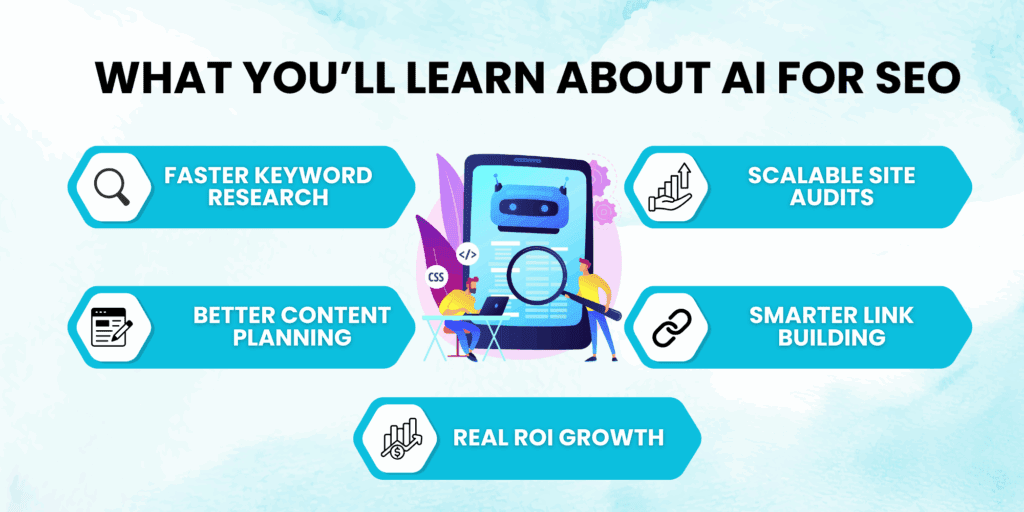
In this tactical guide, you’ll discover how fast-scaling businesses are integrating AI across keyword discovery, intelligent content planning, technical audits, and link building, all while improving rankings, traffic, and ROI."

Whether you're an eCommerce founder, a digital marketer, or a growth-focused leader ready to dominate in today’s evolving search landscape, this guide will show you how to win smarter and faster.


Key Takeaways:


Short on time? Here’s what you’ll learn in this tactical AI SEO guide:

Key benefits of AI for SEO Optimization visualized as icons


What Is AI for SEO Optimization (And Why It’s More Than a Tool)?

AI for SEO Optimization means using artificial intelligence to improve and scale every part of your SEO process faster, smarter, and more strategically than humans can alone. It’s not about replacing your marketing team. It’s about giving them superpowers.

Instead of guessing which keywords will rank, or manually digging through competitor content for hours, AI helps you:

And that’s just the beginning.

AI identifies patterns and optimization gaps that would take teams weeks or go completely unnoticed, without automation. It works behind the scenes to clean your data, process SERPs, and suggest improvements that move the needle.

But here’s the truth: AI alone won’t make your rankings soar. The smartest brands combine AI’s speed with human strategy. You still need expert oversight to make the right decisions, align with your brand voice, and keep content high-quality.

"Think of it like this: AI provides the engine's power; your SEO strategist is the skilled driver. Without both working in harmony, you won't win the race."

At PA Digital Growth, we use AI tools to streamline keyword discovery, generate SEO-friendly content plans, and run site-wide technical audits, then layer in expert guidance to make sure every move drives growth. Discover all 6 proven AI SEO strategies we leverage for our clients. Let’s now explore why this matters more than ever in today’s SEO landscape…

Why AI Matters in SEO (and Why It’s Changing the Game)

The Search Experience Has Been Rewritten.

Just a few years ago, ranking on Google meant targeting the right keywords and building backlinks. Today, it’s about adapting to how users search, and AI is transforming that experience in real time.

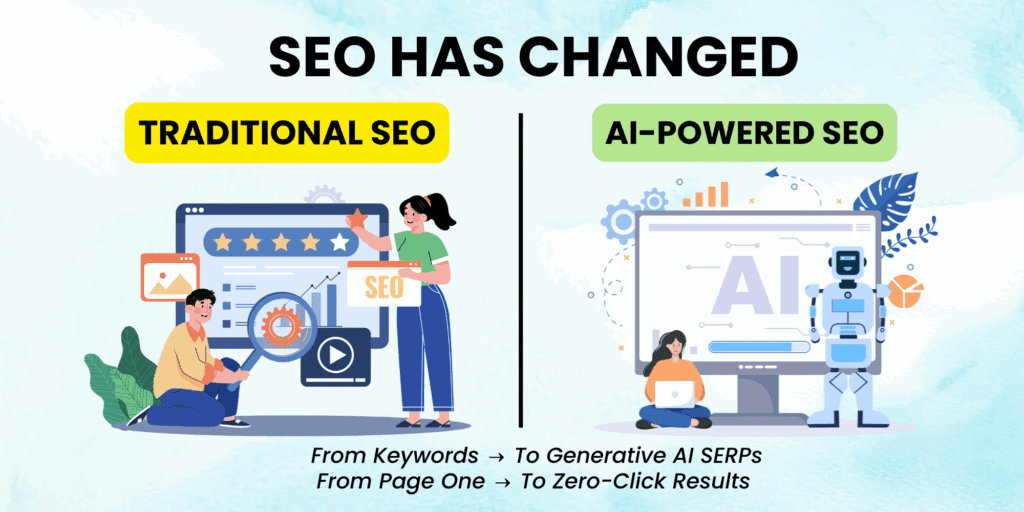
Google’s SGE (Search Generative Experience) now delivers AI-generated summaries, interactive carousels, and cited sources, all before the first organic result appears. In this new landscape, you’re not just competing for Page One, you’re competing for zero-click visibility.

Visual comparison of traditional SEO vs AI-driven search experience

Semrush reports that AI-assisted content ranks 27% faster when paired with an expert strategy. And according to HubSpot, 65% of marketers using AI tools now produce higher-quality content at scale.

But it’s not just about production speed. AI optimization wins because it aligns with Google’s current priorities:

Smart brands are already deploying tools like Frase, Clearscope, and Surfer SEO. These tools help optimize for user intent, structure for featured snippets, and enhance topical authority. If you’re still publishing manually optimized content once a week, competitors using AI are auditing and scaling 100+ pages at once.

Here’s why adapting to AI-driven user behavior matters more than ever.

The User Journey Is No Longer Linear

Modern SEO user journey with AI touch points and conversion path

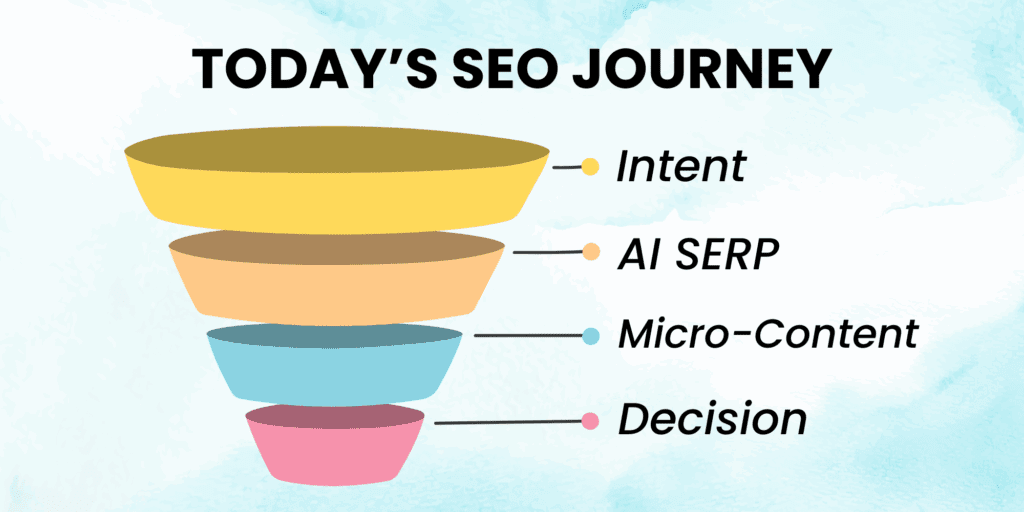
Today’s buyer might start with a long-tail query, scroll past an AI-generated summary, click into a short-form video, and bounce, never reaching a traditional blog post.

If your brand doesn’t show up in those emerging formats or moments, you’ve already lost the click.

AI enables SEO teams to meet users where they are at every stage of the journey:

AI in SEO isn’t just an enhancement; it’s now a competitive edge. And brands that understand how to optimize for that split-second moment of discovery are dominating search and revenue.

Now that we’ve covered why AI is rewriting the rules of SEO, let’s break down exactly how today’s smartest brands are using it to scale results. From smarter keyword research to AI-enhanced technical audits and link building, these aren’t hypothetical ideas; they’re real-world workflows that drive visibility, traffic, and ROI.

How Smart Brands Use AI to Win at SEO

The smartest brands aren’t just experimenting with AI; they’re operationalizing it across their entire SEO workflow. From pinpointing keyword clusters to delivering human-quality content briefs at speed, here’s how top-performing teams are using AI to outrank competitors and scale faster.

AI for Smarter Keyword Research

Instead of chasing high-volume keywords, smart SEOs are using AI to identify intent-rich clusters with strong commercial potential and predict when those topics will trend or decay.

Tools powering this shift include Surfer SEO, MarketMuse, Semrush AI, and Frase. For a deeper dive into these powerful platforms, check out our guide on AI keyword research tools that find high-intent opportunities. These platforms go beyond basic volume metrics by applying natural language processing and machine learning to:

Real-World Win: For example, in a recent campaign, we used AI to discover 9 high-intent content opportunities a manual audit completely missed, resulting in a 32% traffic uplift in just 45 days. This level of precision and speed is simply unattainable with traditional methods."

AI for Content Briefs & On-Page Optimization

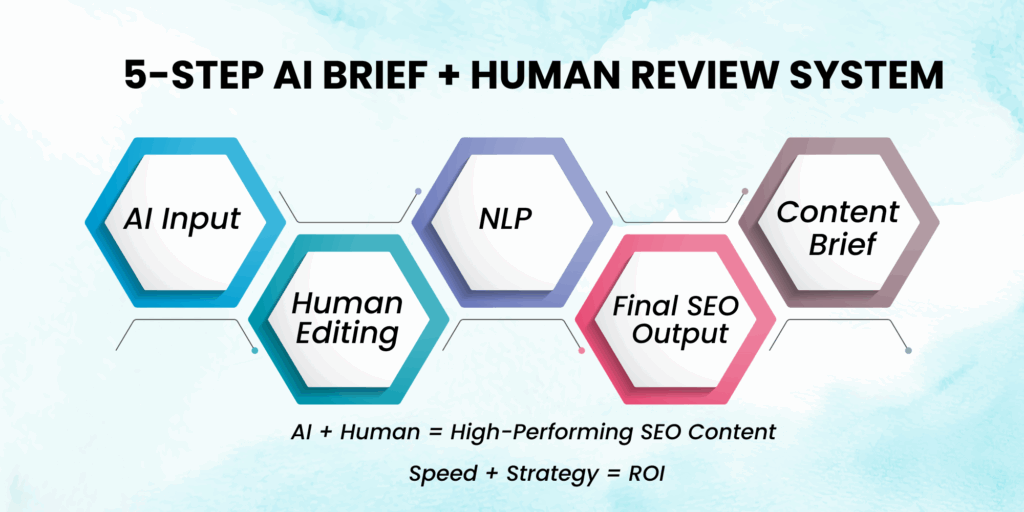
At PA Digital Growth, we use a 5-step hybrid process that combines AI’s speed with expert human refinement to deliver world-class content briefs. Learn more about how AI content optimization helps create SEO content faster and more effectively.

Our 5-Step AI Brief + Human Review System:

  1. NLP-Powered Outline Creation – Instantly generate content structure aligned with semantic relevance
  2. Entity & Intent Mapping – Ensure the brief matches searcher expectations, not just keywords
  3. Competitor Overlay – Benchmark top-ranking pages to inform differentiation
  4. Content Formatting Prompts – Guide tone, format, and structure (FAQs, CTAs, tables)
  5. Human Editing Layer – Strategically add brand voice, creativity, and audience resonance

Pro Tip: AI delivers structure and speed, but it’s the human touch that transforms briefs into conversion-driving content.

“AI won’t replace SEO strategists, but SEO strategists who use AI will replace those who don’t.” Rand Fishkin, Co-Founder of SparkToro & Moz

AI-powered content optimization workflow with review loop


AI for Technical SEO Audits & Enhancements

AI tools like Screaming Frog AI-integrated crawlers, JetOctopus, and ContentKing now make it possible to automate technical audits at scale, across thousands of URLs. For a comprehensive look, read our guide on how AI in technical SEO fixes site issues and improves speed automatically.

They can:

We used AI to detect and fix 27 duplicate meta tag issues in 2 minutes, before any rankings were impacted.

AI-powered platforms like Respona and Buzzstream now use NLP to:

We’ve also trained GPT prompts to assist with pitch creation, but final messages always go through a human strategist to ensure alignment and authenticity.

Smart use of AI in PR: “Let AI handle prospecting and data… so your team can focus on building real relationships.”

Need help implementing this? Our AI SEO strategists can identify automation opportunities in under 48 hours.

How Does AI Help With SEO Optimization?

AI is transforming every phase of the SEO lifecycle. Here are six high-impact areas where it delivers serious value:

Human + AI = The Winning Formula for Long-Term SEO Growth

The brands leading organic growth today aren’t replacing their teams with AI, they’re augmenting them. The winning formula isn’t human vs. machine. It’s human creativity + AI scalability, working in lockstep.

While AI unlocks speed and scale, it’s your strategist who turns that power into outcomes, aligning every action with growth metrics that matter.

Why You Still Need a Strategic SEO Partner

Even the most advanced AI tools struggle to navigate business complexity on their own. While AI excels at pattern recognition, it lacks the context and nuance required to adapt to real-time shifts in market demand, consumer psychology, and brand tone.

While AI can execute with precision, it still can’t replace strategic judgment. Here’s where human expertise still dominates:

That’s where a strategic SEO partner becomes irreplaceable. We take what AI gives you and turn it into strategic execution that drives bottom-line results.

Debunking the “AI Will Replace SEOs” Myth

AI isn’t replacing SEO roles - it’s redefining them into strategic, tech-enabled leadership positions. AI doesn’t remove the need for SEO professionals; it reshapes the job description, requiring strategic thinkers who can orchestrate technology and outcomes.

What’s really happening is a skillset shift:

Think of your modern SEO as a growth architect, using AI as a tool, not a crutch.

“After implementing our AI-augmented brief system with human-led refinement, one client saw a 32% traffic increase in 45 days, without increasing content volume.”

How PA Digital Growth Does It Differently

Most agencies talk about tools. We talk transformation. Our approach doesn’t just plug AI into a workflow; we rewire your SEO engine to scale what matters: performance, not just content.

Here’s how our AI-powered SEO methodology stands apart:

Proprietary AI SEO Playbooks

Custom-built for different business models, eCommerce, local services, SaaS, and beyond. These playbooks align AI capabilities with specific industry growth levers.

AI Readiness Assessments

Before deploying tools, we audit your existing SEO stack to uncover untapped leverage points and remove workflow blockers.

Real-Time Performance Tracking

From rankings to revenue, we focus on tracking what truly impacts your bottom line, not vanity metrics. Transparent dashboards, always. Discover more about AI SEO reporting and tracking to prove ROI faster."

Strategic Human Oversight

AI delivers insight. Our strategists translate those insights into your brand voice, buyer psychology, and growth goals. That’s where results multiply.

Continuous Innovation Loop

Google evolves. AI evolves. So do we. Our team refines your SEO playbook in real time, with every algorithm update, AI model release, and market shift.

“Our clients don’t just scale content, they scale results. Because we pair AI precision with human strategy, every step of the way.”

“AI is the engine, but strategy is the driver. At PA Digital Growth, our role is to guide AI in the right direction, ensuring every action aligns with your revenue, not just your rankings.”

Let’s break down the most common (and costly) AI SEO mistakes and how to avoid them.

Pitfalls to Avoid When Using AI for SEO Optimization

Before scaling with AI, make sure you're not unknowingly sabotaging your SEO. These common mistakes can stall growth or, worse, trigger Google penalties.

Over-Automating Without Strategic Oversight

AI can generate hundreds of pages in minutes, but without human review, you risk publishing shallow, inaccurate, or brand-damaging content.

What Goes Wrong:

Why It Matters: Google’s Helpful Content Update prioritizes human-first content. Overuse of automation can lead to deindexing, lower dwell time, and trust erosion with both users and search engines.

Pro Tip: Always layer in human review. Use AI to draft, but rely on strategic editors to align with brand voice, search intent, and buyer psychology.

Using the Wrong Tool for the Wrong Job

AI SEO isn’t one-size-fits-all. Each task, keyword research, content scoring, and link building, requires purpose-built tools and workflows.

What Goes Wrong:

Why It Matters: Unfocused tool usage leads to siloed data, wasted time, and missed opportunities. Worse, it creates friction between strategy and execution, especially in fast-moving marketing teams.

Smart Stack Strategy: We recommend pairing tools based on function. For example:

Frase for briefs → Clearscope for optimization → Screaming Frog AI plugin for audits → Buzzstream AI for link outreach.

Prioritizing Speed Over Strategy

AI helps you scale, but velocity without direction leads to traffic that doesn’t convert.

What Goes Wrong:

Why It Matters: SEO isn't about churning content; it's about earning trust and guiding users to take action. Fast output without foundational SEO thinking can result in high bounce rates, weak rankings, and poor ROI.

Our Framework: We use AI to accelerate execution, not replace the strategic backbone. Every piece of content maps to a buyer stage, revenue goal, and internal linking structure.

Without strategic guidance, even the best AI tools fall short. It’s expert-led integration that turns automation into ROI.

Want a second set of eyes on your AI SEO stack?

PA Digital Growth offers a complimentary AI SEO Audit to uncover risks, inefficiencies, and untapped growth opportunities in your current workflow.  Let’s future-proof your SEO with smarter AI integration.

Ready to Rank Smarter? Here’s Your Next Move

AI is reshaping how SEO operates, but without a focused strategy, brands risk chasing vanity metrics instead of real performance drivers. That’s why we focus on aligning AI with your growth goals, not just traffic. If you’re ready to rank smarter and grow faster, your next strategic move starts here.

Ready to uncover the hidden growth potential in your SEO strategy? Our Free AI SEO Audit dives deep to reveal exactly how AI can optimize your performance." We'll review:

No fluff. Just actionable insights you can use immediately.

Book Your Free Audit Now.

Frequently Asked Questions

What is AI SEO optimization?

AI SEO optimization is the process of using artificial intelligence tools to automate and enhance key SEO tasks, like keyword research, content creation, and technical audits, while improving scalability and precision. At PA Digital Growth, we combine AI insights with human strategy to ensure your SEO aligns with revenue, not just rankings.

Can AI tools replace an SEO expert?

No, AI tools are powerful assistants, but they lack the strategic thinking, emotional intelligence, and business context of an SEO expert. The winning formula is AI + human oversight, where tools accelerate execution and humans ensure alignment with brand goals and search intent.

Is AI-generated content penalized by Google?

Google does not penalize content just because it’s AI-generated, but it will penalize content that’s unhelpful, low-quality, or unedited. That’s why all AI content must go through a human-led QA process to meet Google's Helpful Content standards.

How do I use AI for keyword research?

You can use AI tools like Semrush AI or ChatGPT to cluster keywords by intent, uncover semantic relationships, and forecast topic decay. The key is to combine AI outputs with human judgment to build keyword maps that drive conversions, not just clicks.

What’s the best AI SEO tool in 2025?

There’s no one-size-fits-all answer; it depends on your goals. For content scoring, Surfer and MarketMuse stand out. For keyword strategy, Frase and Semrush AI are excellent. The smartest approach is building a lean, integrated tool stack aligned with your workflows.

How does AI improve technical SEO?

AI accelerates technical SEO by analyzing large-scale site data, flagging crawl issues, and suggesting schema enhancements in minutes. At PA Digital Growth, we layer GPT-4 into Screaming Frog to turn raw crawl data into strategic action items.

What are the risks of AI in SEO?

The biggest risks are publishing unedited AI content, using the wrong tool for the wrong task, and over-prioritizing speed. These can lead to factual errors, poor UX, and lower rankings. Human oversight and strategic alignment are critical safeguards.

Do I need a human editor for AI content?

Yes, editing is essential. AI can generate drafts quickly, but only a human can ensure accuracy, tone, brand alignment, and relevance to user intent. This editing layer is what separates scalable SEO content from spammy AI fluff.

Is AI SEO expensive?

AI SEO can actually lower costs by reducing manual work and increasing output speed. But without a strategy, it becomes costly due to wasted content, poor rankings, and lost revenue. The ROI lies in how you deploy AI, not just the tools you choose.

Can I get started with AI SEO as a small business?

Absolutely. AI SEO is highly accessible; even lean teams can automate research, improve content, and identify technical fixes using the right tools. The secret is starting with a clear strategy, not chasing tools without direction.

AI SEO Solutions: 6 Proven Strategies Smart Brands Use to Scale Rankings, Traffic & ROI with AI

Are You Still Doing SEO the Old Way? Here’s What Smart Brands Know

According to HubSpot, 61% of marketers say improving SEO is their top inbound priority, yet most are still relying on outdated methods that can't keep pace with today’s digital landscape. Slow content pipelines, clunky keyword research, and static reports have become barriers to growth, especially as algorithms shift and competition intensifies.

This is where AI SEO is changing the game. By blending automation, machine learning, and predictive analysis, brands are cutting the inefficiencies and unlocking faster, more strategic wins. From real-time keyword discovery to content optimization and ROI tracking, AI is redefining how SEO gets done, at scale and with greater impact.

How This Guide Helps You

Let’s explore what AI SEO really means, how it works in practice, and why it’s quickly becoming the standard for businesses ready to grow smarter through search.

What Are AI SEO Solutions? (And Why the Old Playbook Is Dead)

AI SEO solutions use artificial intelligence, tools like machine learning, natural language processing (NLP), and automation to improve how your website ranks in search engines. Rather than relying on manual effort, these systems are designed to adapt in real time, learn from data, and take action faster and more accurately than traditional methods.

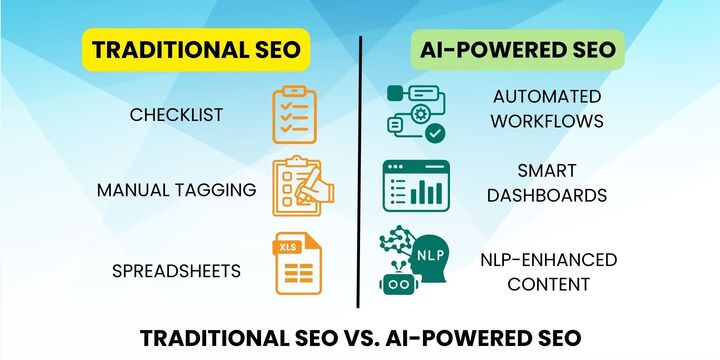
Comparison of Traditional SEO and AI SEO Solutions with automation, optimization, and real-time reporting

This shift isn’t theoretical. Brands are already using AI to discover better keywords, create more relevant content, and monitor SEO performance automatically. And they’re seeing stronger results with less time spent on repetitive tasks.

Here’s how AI SEO differs from the old playbook:

At PA Digital Growth, we view AI SEO as more than just automation; it’s a strategic system that helps businesses scale smarter. By combining the speed of AI with our human expertise, we help brands focus less on manual SEO checklists and more on driving meaningful growth.

To make this clearer, we break AI SEO into three core layers:

1. Insight

AI helps you uncover the right topics and keywords by analyzing live search trends, intent signals, and ranking gaps, giving you clarity on where to focus for maximum impact.

2. Action

These insights are then used to improve your site automatically. From optimizing headlines and meta descriptions to improving internal links and content structure, AI helps execute SEO updates at scale.

3. Impact

Finally, AI tracks what’s working, connecting keyword performance to traffic, engagement, and revenue. It turns SEO reporting into a forward-looking tool, not just a monthly check-in.

That said, AI doesn’t replace human strategy. It supports it. Creative thinking, brand storytelling, and interpreting data into actions still require human experience and expertise. That’s where PA Digital Growth comes in: we bring the balance of cutting-edge tools and real-world strategy to every campaign.

Now let’s take a look at what this looks like in practice and how smart brands are already seeing results.

Real Business Results from AI SEO

AI SEO isn't just a trend; it’s delivering measurable results for real businesses. Take one of our clients in the wellness space, for example. They were struggling with stagnant rankings and a slow content production process that couldn’t keep up with market demand.

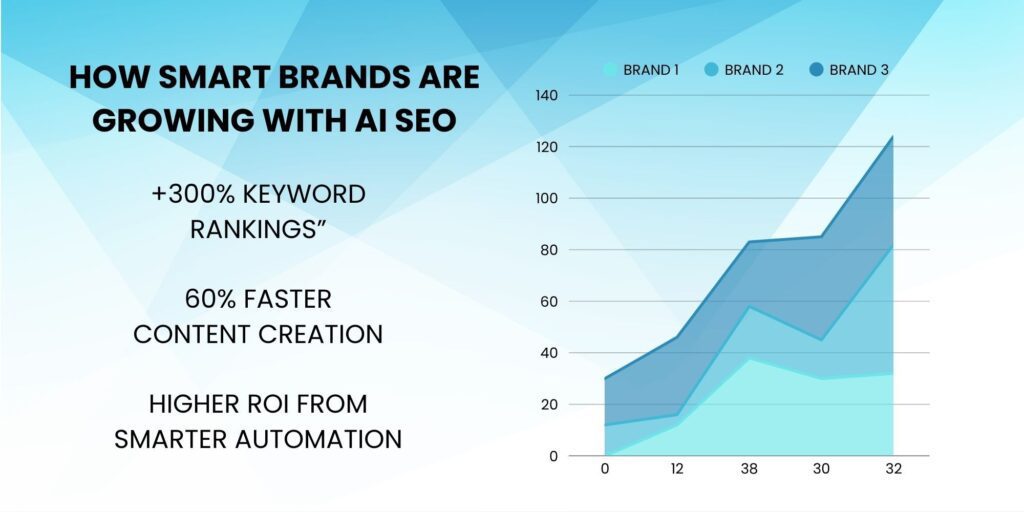
By integrating AI-powered keyword clustering and predictive content scoring into their SEO workflow, they saw significant improvements in less time. In just six months, they tripled their organic keyword rankings and reduced their time-to-publish by over 60%. What had previously taken weeks to research, write, and optimize could now be done in a few days, with greater accuracy and impact.

Case study of real business growth using AI SEO strategies and keyword automation

The gains weren’t just operational. With repetitive research and manual auditing handled by AI, their internal team could shift focus to more strategic work: creative planning, content ideation, and refining conversion paths. SEO became a lever for growth, not a bottleneck.

At PA Digital Growth, this approach is embedded in how we serve every client. We use AI tools to identify ranking opportunities, run continuous technical audits, and track performance at a granular level. This gives our strategists more time to focus on what truly drives results: positioning, storytelling, and high-converting user experiences.

Now that we’ve seen how AI SEO works in practice, let’s break down the specific building blocks that make it scalable and successful for growing brands.

The 4 Pillars of a High-Impact AI SEO Strategy

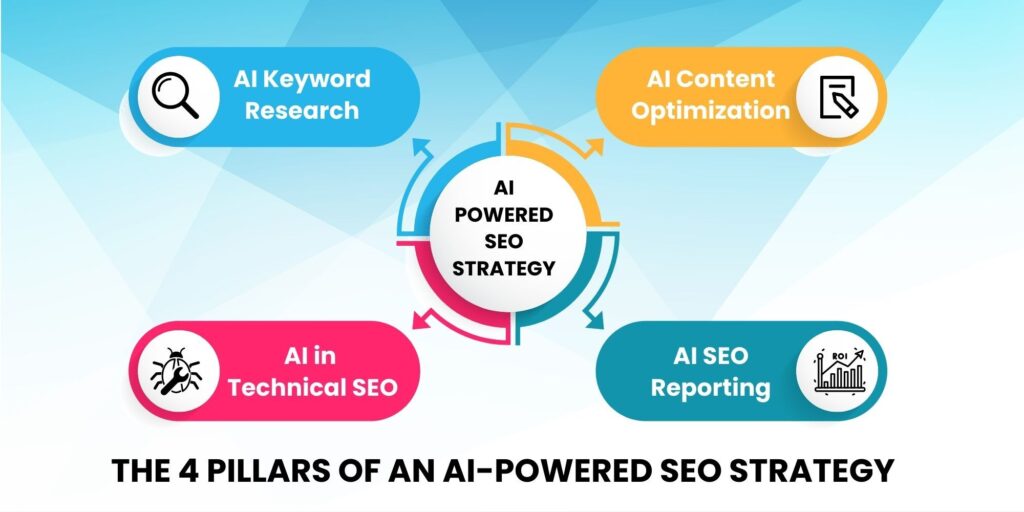
AI SEO becomes most effective when it's applied systematically, not as a one-off tool, but as a strategic framework. At PA Digital Growth, we help brands integrate AI across four key pillars that cover the full spectrum of SEO: from discovery to delivery to performance.

Each of these pillars solves a common bottleneck in traditional SEO and replaces it with smarter, scalable workflows that save time and drive results.

Infographic showing the 4 core pillars of effective AI SEO solutions for businesses

AI Keyword Research

Traditional keyword research is often slow, static, and disconnected from real user intent. AI changes that analyze thousands of search patterns in real time, then cluster keywords by theme, topic depth, and commercial value.

At PA Digital Growth, we use a combination of leading AI-powered research platforms to uncover topical opportunities, group keywords semantically, and build scalable content strategies that align with how modern search engines prioritize context and depth.

To dive deeper into how we leverage advanced AI, explore our guide on AI Keyword Research Tools that help discover high-intent keywords in half the time."

AI Content Optimization

AI doesn’t replace writers, but it does make them more effective. Using our internal optimization workflows and intent-driven scoring tools, we help brands create content that’s aligned with user behavior and search engine expectations.

From intelligent outline generation to real-time SEO content scoring, our AI-enhanced processes reduce production time and elevate content quality, without losing brand voice or authenticity.

Learn more about our approach to AI content optimization and how it helps create SEO content faster that actually ranks.

AI in Technical SEO

Technical SEO is critical to visibility, yet it’s often reactive and time-consuming. Our AI stack includes continuous monitoring and diagnostic systems that surface crawl issues, Core Web Vitals concerns, and structural bottlenecks automatically, before they impact rankings.

Instead of waiting for quarterly audits, our clients benefit from always-on site health oversight and intelligent recommendations delivered through a tailored technical workflow.

For a deeper dive into automating site health, read our guide on AI in technical SEO, and how it helps fix site issues, improve speed, and rank higher automatically.

AI SEO Reporting and ROI Tracking

SEO reporting should do more than show rankings; it should forecast performance and prove value. Our AI-assisted dashboards connect the dots between keyword movements, content performance, user behavior, and revenue impact.

We track the metrics that matter, like traffic quality, conversion projections, and keyword lifetime value, so clients see where their investment is working and where to scale next.

Discover how our AI SEO reporting and tracking solutions help prove ROI faster and smarter.

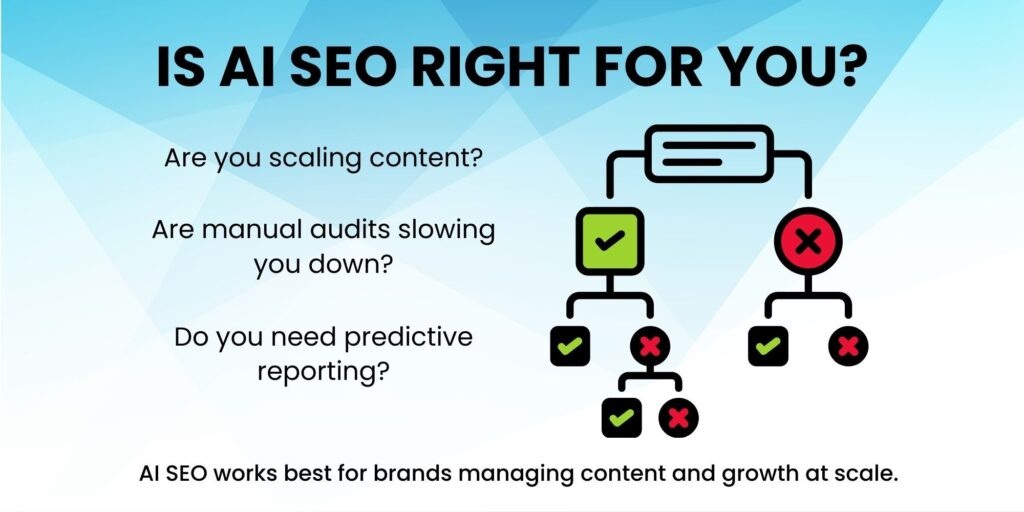
Is AI SEO Right for You? (The Truth Most Agencies Won’t Tell You)

AI SEO solutions aren’t just for large enterprises with deep pockets; they’re built for any business that needs to scale smarter and operate more efficiently. If you manage a content-rich website, oversee ongoing SEO campaigns, or need real-time visibility into ranking performance, AI can deliver both speed and strategy.

Decision tree graphic helping brands determine if AI SEO is the right solution for their growth

We see the strongest results from:

The common thread? These organizations benefit most when they can automate the technical work and free up bandwidth for creative execution, CRO planning, and growth strategy.

Yet many businesses hesitate to adopt AI SEO because of lingering myths, often reinforced by agencies that either don’t fully understand the tools or prefer to keep their processes opaque.

Let’s clear up two of the most common misconceptions:

Misinterpreting Google's "Helpful Content System" for AI Content

One significant pitfall we often see is a misinterpretation of Google’s 'Helpful Content System' as a blanket ban on AI. While Google aims to de-rank unhelpful, low-quality content (regardless of how it’s produced), some brands mistakenly believe any AI involvement will trigger penalties. This leads to them avoiding powerful tools that could genuinely enhance their SEO, purely out of fear, missing out on massive efficiencies and ranking opportunities when AI is used strategically to create truly valuable content.

“AI content leads to duplicate content penalties.”

Google has confirmed that AI-generated content isn’t penalized when it provides value and meets quality guidelines. The problem isn’t the AI, it’s low-effort content. At PA Digital Growth, every AI-assisted output is reviewed, refined, and aligned with user intent before it ever gets published.

“AI replaces human creativity”

While AI can handle structure, optimization, and speed, it can’t replicate your brand voice or decision-making. It doesn’t interpret nuance or adapt to shifting market demands. That’s why AI SEO works best when it’s paired with strategic oversight, something only experienced marketers can provide.

We believe in using AI ethically and responsibly.

At PA Digital Growth, we use AI to enhance, never replace, expert-led SEO. Every workflow we build aligns with Google’s Helpful Content guidelines and ethical AI practices.

We don’t automate for automation’s sake. Every AI action is strategic, secure, and user-first, designed to amplify what experienced humans do best: create value, relevance, and long-term impact.

Now that you understand where AI SEO delivers the most value and where it doesn’t let’s break down the tools that actually power these results.

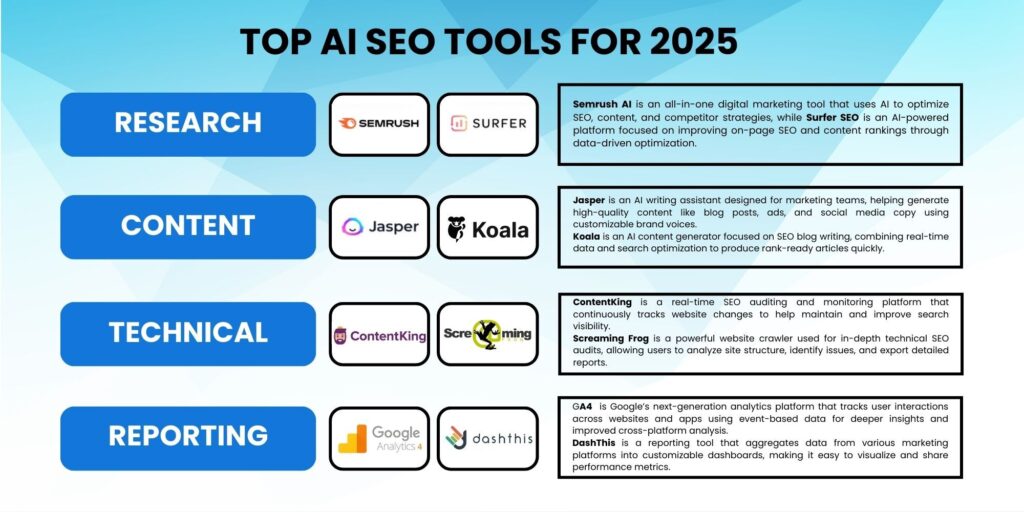
AI SEO isn’t about replacing your team; it’s about empowering them to work smarter, move faster, and make better decisions with less guesswork.

At PA Digital Growth, we don’t just plug in tools and hope for the best. We integrate a refined stack of AI technologies with an expert-led strategy to deliver SEO that’s both intelligent and intentional. Our approach pairs machine efficiency with human insight, ensuring every optimization aligns with your brand voice, revenue goals, and growth stage.

Visual breakdown of recommended AI SEO tools for keyword research, content, technical SEO, and reporting

Here’s a look at how we streamline workflows:

FunctionWhat We UseWhy It Matters
Keyword ResearchAI-enhanced platforms for semantic clustering + predictive search intentMap out scalable keyword opportunities with precision and speed - perfect for building topical authority.
Content CreationSEO-optimized AI drafting + human refinementAccelerate content delivery without sacrificing nuance, tone, or creativity. AI drafts - humans polish.
Technical SEOIntelligent crawlers + issue detection at scaleUncover and fix structural SEO problems before they impact rankings or UX.
SEO ReportingLive dashboards with AI-powered forecastingMonitor performance, spot trends early, and tie rankings to actual business impact.

Data Security Note: We only use AI systems that meet strict enterprise-grade compliance standards, including SOC 2, CCPA, and GDPR. Your data remains fully protected and confidential throughout every stage of your SEO journey.

According to Semrush, AI-powered SEO can cut manual tasks by up to 60%, freeing up your team to focus on strategy and creative execution.

And that’s where the real value lies.

While AI helps automate, prioritize, and accelerate, the strategic layer interpreting the data, setting direction, and shaping high-converting content remains firmly human. At PA Digital Growth, our SEO strategists don’t just monitor AI outputs; they guide, challenge, and refine them to drive real-world ROI.

Want a closer look at how we connect the dots from insights to impact? Explore our full guide: AI for SEO Optimization

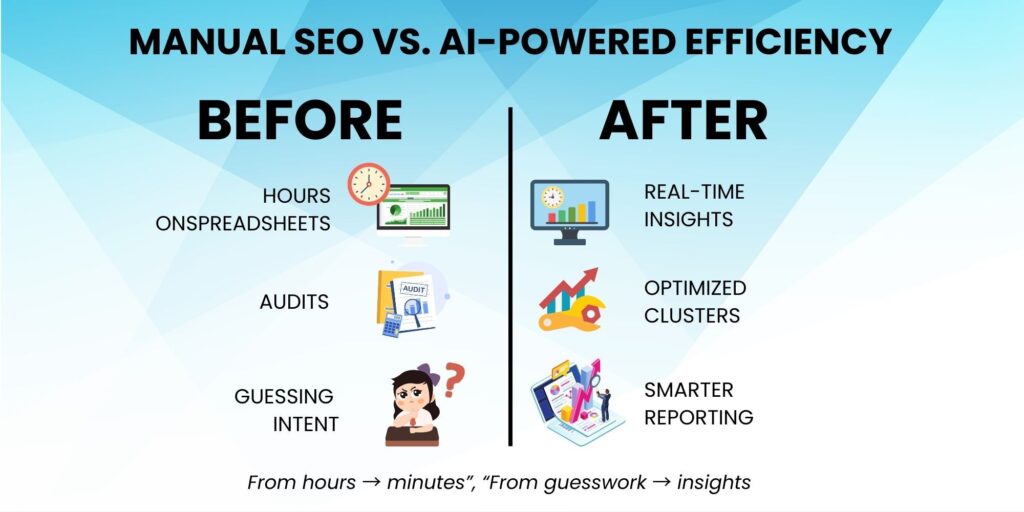
The Future of SEO Is Smarter, Not Harder

AI is already transforming how search engines rank content, how users interact with results, and how businesses manage SEO at scale. But here’s what hasn’t changed: Google still rewards brands that prioritize real value, relevance, and great user experience.

Before and after comparison of SEO workflows with and without AI-powered automation

AI SEO isn’t about shortcuts or black-box automation. It’s about enabling your team to move faster, make smarter decisions, and spend more time on what actually drives ROI: strategy, creativity, and performance.

What forward-thinking businesses are doing today:

And behind every AI-powered insight? There’s a strategist guiding it.

At PA Digital Growth, we believe AI should amplify, not replace, human expertise. That’s why we build every SEO strategy around a clear growth plan, then use automation and machine learning to deliver it faster, cleaner, and more predictably. Your business gets the speed of AI with the precision of senior-level guidance.

Because in the next era of SEO, success won’t go to the brand with the most content, it’ll go to the one who knows how to leverage intelligence to act faster and scale smarter.

Ready to bring smarter, faster SEO into your business? Let’s recap the key takeaways and help you decide what to do next.

Transform Your SEO Workflow, One Smarter Step at a Time

AI SEO isn’t just an emerging trend; it’s becoming the new standard for performance-driven brands. As organic search grows more competitive and unpredictable, the businesses gaining a measurable edge are those embracing AI to work smarter, move faster, and scale with precision.

Here’s how to move forward with clarity and confidence:

At PA Digital Growth, we integrate AI technologies across our SEO ecosystem,  not as a shortcut, but as a performance accelerator. Every insight is filtered through expert strategy, brand alignment, and ROI-focused execution.

If you're ready to explore how AI SEO can reshape your growth potential, we invite you to book a free strategy call. Let’s map a smarter, more scalable approach to your search performance, built for today’s algorithms and tomorrow’s opportunities.

Still have questions about AI SEO and how it can benefit your business? We've compiled answers to some of the most common inquiries:


Frequently Asked Questions

What is AI SEO?

AI SEO uses artificial intelligence, such as machine learning and natural language processing, to make search optimization smarter. Unlike manual methods, AI SEO tools can automate keyword research, optimize content, and predict outcomes in real time. This allows your team to work faster and focus on strategy, while AI handles repetitive tasks with precision.

Can AI-generated content hurt SEO?

No, when done correctly, AI-generated content can perform exceptionally well. Google penalizes low-quality or spammy output, not AI itself. Quality is key. At PA Digital Growth, we use AI to draft and optimize, but all content is vetted, enhanced, and aligned with your brand’s voice, trustworthiness (E‑E‑A‑T), and user intent.

Is AI replacing SEO specialists?

AI isn’t here to replace SEO professionals; it’s a supercharger. AI handles speed and analysis, while human experts interpret data, apply business sense, and ensure alignment with your brand strategy. Your team gets more bandwidth to focus on creative ideation, CRO, and growth, where AI simply can’t go.

How does AI SEO improve keyword research?

AI-based keyword research tools instantly analyze large volumes of search data, identify clusters of related terms, and detect user intent, something manual spreadsheets can’t scale. This means faster strategy execution and deeper topical relevance, helping your content rank for more high-value queries.

Is AI SEO safe for my data?

Absolutely. We only use enterprise-grade AI tools with SOC 2, GDPR, and CCPA compliance, meaning your site data and proprietary insights stay fully protected and confidential. We never expose client data to unsecured platforms.

How do we measure ROI from AI SEO?

AI-powered dashboards combine keyword performance, site analytics, and conversion tracking to show how each optimization translates into traffic and revenue. Instead of manual reporting, you get predictive insights, trending data, and clear attribution, turning SEO into a business driver.

Can small businesses benefit from AI SEO?

Yes, especially those with multiple pages, regular content needs, or eCommerce SKUs. AI helps small teams punch above their weight by automating research, performance analysis, and technical checks, letting them compete with larger enterprises more efficiently.

Which AI tools do you use for SEO?

We leverage a curated mix of enterprise-grade AI platforms, such as Semrush AI, Jasper, and GPT‑powered auditing tools, combined with proprietary processes. We focus on how they fit into your growth strategy, not just on having them.

How does AI help with technical SEO?

AI-powered crawling and monitoring tools detect issues like indexability errors, broken links, schema problems, and Core Web Vitals shifts often in real time. This means problems get resolved faster, reducing the risk of ranking drops or user friction.

What’s the future of SEO with AI?

SEO is evolving into a hybrid of Search Engine Optimization (SEO), Answer Engine Optimization (AEO), and Generative Engine Optimization (GEO). As AI chatbots become mainstream, optimizing for direct answers and AI visibility will grow in importance, positioning your content not just for search but for conversational discovery.

Best SEO Keyword Strategy: A Proven Roadmap to More Sales

You’ve done everything the SEO checklists told you to do. Your blog posts are ranking, traffic is up, and maybe you’re even getting compliments on your site. But let’s be honest that traffic isn’t turning into leads or sales, what’s the point? This is where so many e-commerce founders and service-based businesses get stuck. You’re visible, but not profitable. You’re showing up on Google, but not in your customers’ buying journey. The hard truth? Most keyword strategies are built for traffic, not revenue. They’re focused on impressions, not intent. And that disconnect is costing you more than visibility is costing you growth.

This guide changes that. We’re going to walk you through how to build the best SEO keyword strategy, one that doesn’t just drive visitors, but attracts the right people with real buying intent. You’ll learn how to map your keywords to actual sales goals, structure them by funnel stage, and use data, not guesswork, to grow smarter. If you're tired of empty clicks and ready for organic traffic that converts, you’re exactly where you need to be.

What Is an SEO Keyword Strategy, And Why Most Businesses Get It Wrong

An SEO keyword strategy is more than a list of search terms; it’s a roadmap for attracting the right traffic that turns into real business results. Done right, it aligns your content with what your ideal customers are actively searching for at every stage of their buying journey. It helps you choose the right keywords, create the right content, and rank in the right places—not just to get clicks, but to drive sales and leads.

Explore our SEO Services for Business Growth: 7 Proven Ways to Boost Leads & Revenue.

The problem? Most businesses approach keyword strategy like it’s a game of volume. They chase high-traffic terms that look good in reports but fail to attract qualified buyers. Instead of showing up when people are ready to buy, like “buy vegan protein powder subscription” or “emergency HVAC repair near me,” they rank for vague, top-of-funnel queries like “protein benefits” or “law advice.”

According to BrightEdge, organic search drives over 53% of all trackable website traffic, but if your strategy isn’t built around buyer intent and conversions, that traffic means little.

A winning SEO keyword strategy focuses on conversion-driven search behavior. That means mapping content to funnel stages, using tools like Semrush or Ahrefs for keyword intent filtering, and choosing phrases that connect search queries to sales goals.

Step 1: Define Revenue Goals and Reverse Engineer Your Keyword Targets

Before you touch a single keyword tool, start with this question:  “What does success look like in terms of revenue?”

Key insight: If your SEO strategy isn’t tied to business metrics like revenue, orders, or leads, it’s just content marketing, not growth marketing.

Say you're a Shopify store owner aiming for $50,000/month in sales. If your average order value is $50 and your conversion rate is 2%, you’ll need 1,000 orders, or 50,000 targeted visits. That’s not coming from one keyword. You’ll need keyword clusters that match buyer intent at every stage.

Here’s your revenue-first framework:

Pro tip: Use keyword intent filters in Semrush or Ahrefs to segment terms by transactional, commercial, and informational value.This step moves your SEO from “content creation” to pipeline creation, which is the difference between pageviews and profit.

Step 2: Identify Buyer Intent at Every Stage of the Funnel

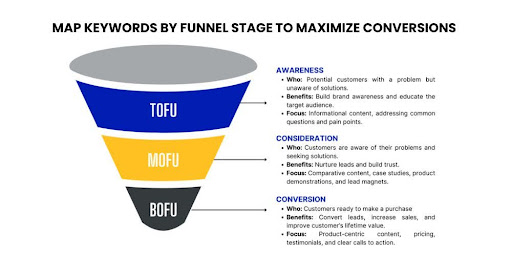
SEO keyword strategy funnel showing top, middle, and bottom of funnel keyword mapping

Most SEO keyword strategies fail not because they pick the wrong keywords, but because they pick the right keywords for the wrong stage of the customer journey.

Here’s the truth: Not every searcher is ready to buy. Some are just researching. Others are comparing options. And only a few are actually ready to click “buy now.” That’s why a winning SEO keyword strategy has to be built around buyer intent, the motivation behind each search query.

Let’s break it down with three core stages:

Top-of-Funnel (TOFU): Informational Intent

At this stage, people are looking to learn, not buy. They search using broad, educational queries like:

These are great for blog content, FAQs, and educational guides, but they don’t convert immediately. However, they do play a major role in brand awareness and trust-building.

“Explore our Shopify SEO services” or “Learn how to increase organic visibility.

Middle-of-Funnel (MOFU): Consideration Intent

Here, users are narrowing their options. They’re comparing products, reading reviews, or looking for solutions. Their searches often include:

These keywords signal that the user is problem-aware and considering specific options. This is where case studies, comparison posts, and demo pages should be optimized with buyer-intent keywords.

Bottom-of-Funnel (BOFU): Transactional Intent

This is where the conversions happen. Users at this stage search with urgency and specificity:

These are your money keywords, phrases tied directly to your products, services, or booking actions. They belong on product pages, local service pages, and conversion-optimized landing pages.

Key Takeaway:

If you treat all keywords equally, you’ll waste time ranking for terms that don’t drive sales. Instead, map keywords by funnel stage and align them with the user’s buying mindset.

According to Semrush’s Keyword Intent Guide, content aligned with high-intent queries outperforms broad content in both conversion rates and revenue impact.By understanding buyer intent, you can prioritize the keywords that don’t just bring traffic, but bring buyers.

Step 3: Build Keyword Clusters Around Topics That Convert

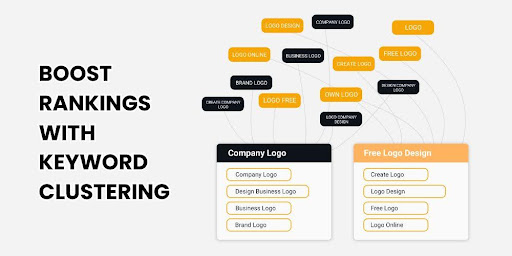
SEO keyword strategy cluster diagram grouping related long-tail keywords by topic and intent

Once you’ve identified keywords with the right intent, the next step is to organize them into keyword clusters, groups of related search terms that target a single topic.

Why? Because Google doesn’t rank pages based on one keyword anymore. It ranks based on topical relevance. That means one well-structured page can rank for dozens of variations, if it’s built around a strategic keyword cluster.

For example, if you're selling natural pet shampoo, your cluster might include:

These all share the same intent and can live on the same optimized product page or collection. This creates content depth, improves ranking potential, and gives users more reasons to convert.

The real power of keyword clustering? It helps you rank faster for more terms, while also reducing keyword cannibalization, where multiple pages compete for the same term.

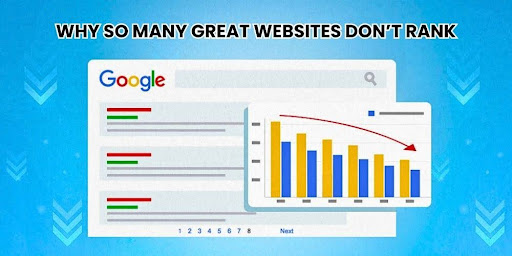
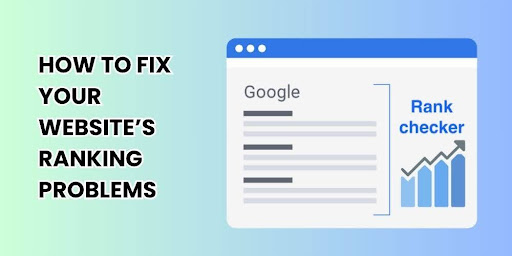
If your site struggles with keyword cannibalization or low-ranking pages, check out our guide: Why Your Website Isn’t Ranking and How to Fix It Fast. It walks through 7 actionable fixes to improve visibility, structure your SEO properly, and stop competing with your own content.

To get started, group your keywords by:

Tools like Semrush Keyword Manager, Frase, or LowFruits can help automate the clustering process.

Pro tip: Each cluster should have one pillar keyword as your primary focus and several supporting keywords woven throughout your content.

When you structure your site this way, you send clear topical signals to Google and make it easier for customers to find what they need.

Step 4: Use Real Search Data (Not Just Guesswork)

Too many businesses still build their SEO keyword strategy based on assumptions, what they think their customers are searching for. But without real search data, you're flying blind.

The most profitable keyword strategies start with data-driven insights, not hunches.

Tools like Google Search Console, Google Ads Keyword Planner, Semrush, and Ahrefs can show you exactly what your audience is already searching for, along with how often, how competitive it is, and what the intent behind the term is.

For example, let’s say you sell custom hats on Shopify. Instead of guessing whether people search for “custom baseball caps” or “embroidered hats,” use real tools to compare monthly search volume, keyword difficulty, and CPC value. This helps you identify buyer intent keywords that not only rank but actually convert.

Pro tip: Keywords with high CPC (cost per click) in Google Ads often signal commercial value. If advertisers are bidding aggressively on a term, there’s a good chance it converts.

You can also uncover hidden gems, long-tail keywords with lower competition and higher conversion potential. These are gold for newer websites or niche products.

Want an edge? Use your competitors' data. Tools like Semrush’s Domain Overview or Ahrefs’ Site Explorer let you analyze which keywords your top competitors rank for and how you can outrank them with more focused content.

At the end of the day, data removes the guesswork. It turns your SEO strategy from reactive to predictable, scalable, and aligned with ROI.

Step 5: Align Keywords with Content Types That Convert

Choosing the right keywords is only half the battle. What truly moves the needle is pairing those keywords with the right content format, the kind that drives engagement, builds trust, and leads directly to conversions.

Let’s say you’ve identified a high-intent keyword like “Shopify SEO agency for fashion brands.” That doesn’t belong in a blog post; it deserves a conversion-optimized service page with clear CTAs, case studies, and trust signals.

Here’s how to map keyword types to the best content formats:

Pro tip: Don’t bury commercial keywords in blog content. Give them dedicated landing pages with optimized title tags, schema markup, and clear CTAs.

If you run a local service business, make sure your bottom-funnel keywords like “emergency AC repair Tampa” are linked to your Google Business Profile and local service landing page.

For eCommerce stores, align product-specific keywords with collection pages that include filters, reviews, and content blocks. This not only boosts UX, but it also improves rankings by increasing content richness and time on page.

If your site traffic is high but conversions are low, it could be a content misalignment issue. When every keyword is paired with its best-performing content type, your SEO starts working like a sales funnel, attracting, engaging, and converting.

Step 6: Track Performance & Refine Based on ROI, Not Just Rankings

SEO isn't about ranking first. It’s about getting the right traffic that turns into revenue. That’s why the best SEO keyword strategy isn’t just built once; it’s tracked, tested, and refined continuously based on performance data that actually matters.

Most brands obsess over vanity metrics like impressions or ranking changes. But the question that truly matters is:  Is this keyword driving sales, leads, or booked calls?

To answer that, you need to set up conversion tracking. Whether you’re using Google Analytics 4, Shopify’s built-in reports, or tools like Hotjar, start measuring what happens after a user lands on your page.

Look at:

If a keyword ranks well but doesn’t convert, ask:

You might find that a long-tail keyword with 100 searches a month outperforms a short-tail one with 10,000 searches, simply because it brings in warmer leads.

If your content is getting traffic but not converting, we dive deeper into optimization techniques in Why Your Website Isn’t Ranking And How to Fix It Fast

This is also where A/B testing plays a role. Try optimizing your H1 tags, CTA buttons, or even meta titles around your top-converting keywords and track the results over time.

Pro Tip:
Use tools like Google Search Console to monitor which keywords are driving clicks, and compare that data against Google Analytics to see what’s leading to actual outcomes.

Bottom line? SEO success isn’t measured by how many keywords you rank for; it’s about how much profit those keywords generate. Smart businesses don’t just chase traffic. They build systems that turn keywords into income.

If you want to rank for competitive keywords, you need more than isolated blog posts; you need topical authority.

That starts with content hubs.

A content hub is a central, high-value page targeting a broad keyword like “Shopify SEO,” supported by subpages and blogs that target narrower, related topics like:

Each page is interlinked, reinforcing your relevance in Google’s eyes. This signals that you’re not just creating content, you’re owning a topic.

This blog is part of a content hub on SEO. Make sure to also explore: SEO Services for Business Growth: 7 Proven Ways to Boost Leads & Revenue

Internal linking plays a huge role here. Every new piece of content should strategically link to:

The goal is to keep users moving through your site and keep search engines recognizing the depth of your expertise.

As your hub grows, so does your authority. Google will begin to rank your site higher for broader and more competitive search terms, even if the specific page doesn’t have the exact keyword in its URL or title.

Pro Tip: Use tools like Frase, SurferSEO, or Internal Link Juicer to automate interlinking and audit gaps in your topical clusters.

In short: To scale your SEO keyword strategy, don’t publish in silos. Build out connected topics, earn topical trust, and use smart internal linking to drive both rankings and conversions.

Final Thoughts: Your SEO Keyword Strategy Should Drive Sales, Not Just Clicks

A traffic spike means nothing if it doesn’t lead to sales. The best SEO keyword strategy starts with business goals and reverse-engineers the journey, from intent-driven keywords to content that converts. When you align your search strategy with how real customers buy, SEO becomes your most profitable marketing channel.If you're serious about growth, stop chasing random rankings. Start targeting the words that bring revenue. Book your free SEO audit with PA Digital Growth and let’s map a clear, data-backed strategy to turn your organic search into consistent, scalable sales.

Frequently Asked Questions

What is an SEO keyword strategy, and why does it matter for e-commerce sales?

An SEO keyword strategy is a plan that aligns search terms with your content and sales goals. For eCommerce stores, it ensures you're ranking for keywords buyers use, like “buy vegan protein powder” or “Shopify SEO agency,” which helps turn clicks into purchases.

How do I use buyer-intent keywords at each stage of the funnel?

Identify the intent: Top-funnel keywords (e.g., “how to choose running shoes”) go in blog posts. Middle-funnel phrases (e.g., “best trail running shoes review”) are ideal for comparison pages. Bottom-funnel terms (e.g., “buy men’s trail shoes size 12”) belong on product or landing pages. Mapping intent improves engagement and conversions.

How can I find long-tail keywords that drive revenue?

Use tools like Semrush or Google Search Console to uncover long-tail phrases people already use, such as “organic desk lamp subscription.” These low-volume, high-intent queries tend to convert better and face less competition.

Should I consider CPC data when planning my keyword strategy?

Absolutely, high CPC terms often signal commercial intent. If advertisers bid on a term like “emergency plumber booking,” that means it drives sales. Incorporate these buyer-focused, high-value keywords into your strategy.

How do I cluster keywords to avoid cannibalization and improve rankings?

Group related terms that share the same intent. For example, combine “organic dog shampoo” and “best natural dog shampoo” on one product page. This sends a clear topic signal to Google, reduces keyword cannibalization, and often improves rankings across variations.

What content formats work best for different keyword types?

Informational queries belong in blog posts, educational guides, or FAQs. Comparison and consideration queries fit suit landing or comparison pages. Transactional, bottom-funnel keywords, like “hire local SEO consultant,” should go on conversion-optimized service or product pages.

How do I measure the ROI of my SEO keyword strategy?

Connect keyword-driven landing pages to revenue tracking through Google Analytics 4 or Shopify reports. Focus on conversion rate, average order value, and revenue per session, not just traffic. Keywords that drive dollars matter more than those that only drive clicks.

What metrics indicate whether my keywords are effective?

Look at page-level metrics: CTR, average position, bounce rate, and especially conversions. If a term ranks well but doesn’t convert, its page may need better alignment with searcher intent or stronger CTAs.

How can internal links boost topical authority for my keyword clusters?

Link related content from subpages to your pillar page and vice versa. For example, link blog posts like “Shopify SEO tips” to your main service page and product pages. This creates a content hub that signals expertise and depth to both users and Google.

How often should I update my keyword strategy?

Review and refine keyword performance monthly or quarterly. Search intent changes, user behavior shifts, and trends evolve. Regular audits let you add new keywords, refresh content, and optimize for ongoing ROI.

Why Is My Website Not Ranking? 7 Fixes to Boost Traffic & Visibility

You’ve built a stunning Shopify Plus site. You’ve invested in branding, written blogs, maybe even hired an SEO freelancer, or run paid ads. And yet… you’re still nowhere near page one. The clicks aren’t coming. The traffic feels like a trickle. And the worst part? You have no idea why.

If you’ve ever sat there refreshing Google, typing in your product names or service keywords and wondering, “Why is my website not ranking?”—you’re not alone. We talk to growing eCommerce brands every week who feel the same way: frustrated, confused, and frankly exhausted from guessing what Google wants. You know your business deserves to be seen, but the algorithm seems to think otherwise.

Here’s the truth most agencies won’t say out loud: great brands stay hidden all the time, not because they’re broken, but because the rules of SEO have changed. In this guide, we’re going to uncover exactly why your site isn’t showing up and, more importantly, how to fix it fast—using strategies that are working for real DTC and Shopify Plus brands right now.

You’re Not Alone—Why So Many Great Websites Don’t Rank?

If you’re wondering, “Why is my website not ranking?”, you’re facing a common but critical challenge, especially for growing eCommerce brands on platforms like Shopify Plus.

Today, ranking on Google isn’t just about having a good-looking website. It’s about whether your site checks dozens of technical and strategic SEO boxes. Google’s algorithm now prioritizes pages that solve specific search intent, load quickly on mobile, demonstrate topical authority, and meet user experience benchmarks like Core Web Vitals.

Many business owners assume their site is “SEO-ready” because they’ve optimized product pages or run ads. But visibility in search results depends on things like:

Even high-quality brands get buried if these elements aren’t aligned. The good news? These are all fixable. In the sections ahead, we’ll show you the exact reasons your site may not be ranking—and how to fix them fast.

Reason No.1 – Your Site Isn’t Being Indexed by Google

Before your site can rank, Google needs to find it, understand it, and store it in its index. If your pages aren’t indexed, they’re invisible—no matter how good your design, content, or products are.

This is one of the most overlooked reasons websites don’t show up in search results. And yet, for scaling eCommerce stores, especially those built on Shopify or Shopify Plus, indexing issues are surprisingly common.

So if you’re asking, “Why is my website not ranking?”, the first thing to check is this: Is Google even indexing your pages at all?

How Indexing Works (and Why It Breaks)

When you launch a new website or update existing pages, Google’s crawlers try to visit and evaluate your content. If your site passes the crawl, it gets stored in Google’s index, and only then can it appear in search results.

But a number of technical issues can block this process without you realizing it:

How to Check If Your Site Is Indexed

Here’s a quick way to test it:

  1. Go to Google and type: site:yourdomain.com
  2. If your key pages don’t show up, they’re not indexed.
  3. Use Google Search Console to dig deeper:
    • Go to the “Pages” report
    • Look for URLs marked as “Excluded” or “Discovered – currently not indexed
    • Review the reasons—Google often explains exactly what’s wrong

If you haven’t set up Google Search Console yet, do that immediately. It’s free and essential for monitoring crawl activity, indexing issues, and how your content is performing in organic search.

How to Fix Indexing Problems

If your site is relatively new, Google might just need more time. But if weeks have passed and nothing’s showing up, you need to dig into these areas fast.

We cover this in more detail in our Technical SEO Audit services, or you can book a free consultation, and we’ll help you identify the block.

Reason No.2 – Your Keywords Are Too Competitive (or Just Wrong)

If you're asking, “Why is my website not ranking?”, one likely reason is keyword strategy. Many e-commerce brands unknowingly target keywords that are either too competitive or don’t match what the user is really looking for.

For example, ranking for broad terms like “backpacks” or “skincare” pits you against massive brands with decades of domain authority. You’re better off targeting long-tail keywords like “vegan skincare routine for dry skin” or “leather backpack under $200.” These are easier to rank for and closer to a buyer’s intent.

The second issue? Search intent mismatch. Optimizing a blog post for a transactional keyword—or trying to rank a product page for an informational query—confuses Google and costs you rankings.

Use tools like Semrush or Ahrefs to evaluate keyword difficulty and align each page with the right intent. If your traffic is flat despite strong content, this is often the silent culprit.

→ Need help? Our SEO audit services can identify keyword gaps holding your site back.

Reason No.3 – Your Site Speed & Mobile UX Are Hurting You

If your website loads slowly or isn’t easy to use on mobile, it will struggle to rank, no matter how good your content or products are.

Google prioritizes websites that deliver a fast, seamless experience across all devices. Today, Core Web Vitals—metrics like Largest Contentful Paint (LCP) and Interaction to Next Paint (INP)—are direct ranking signals. If your Shopify store takes more than 3 seconds to load, that’s a problem.

Mobile experience matters just as much. Over 60% of searches come from mobile devices. If users pinch to zoom, wait for popups to close, or struggle to navigate your menus, they bounce—and that hurts your rankings.

Run your site through Google PageSpeed Insights or GTmetrix. Look for red flags like uncompressed images, bloated apps, or unused code from your theme. Shopify apps and custom scripts can silently slow things down.

Worried your site speed or mobile layout might be costing you rankings? Let us take a closer look. Our Technical SEO Audit services are designed to help you spot and fix performance issues—so your site runs faster, ranks better, and keeps visitors engaged.

Reason No.4 – Thin, Duplicate, or AI-Generated Content

If your pages aren’t offering unique, in-depth value, they won’t rank—period. One of the most overlooked SEO mistakes is assuming that any content is better than none.

Thin content (like short product pages or generic landing pages) doesn’t give Google enough to work with. Duplicate content—especially if copied across multiple pages or pulled from manufacturer descriptions—confuses search engines and reduces your authority. And with the rise of AI tools, low-quality, auto-generated content is flooding the web, making it even harder for average pages to compete.

Google’s Helpful Content System now evaluates expertise, originality, and depth. If your content doesn’t serve a clear purpose or answer a specific question, it’s likely being filtered out.

Audit your most important pages. Are they comprehensive? Unique? Helpful? If not, it’s time to upgrade.

Not sure if your content is helping or hurting your rankings? Our SEO Content Strategy Services can help you rewrite, restructure, and optimize your pages for real results.

You can have great content and solid technical SEO, but if your website lacks authority, Google may still not trust it enough to rank.

Google sees backlinks—links from other trustworthy sites to yours—as votes of confidence. The more relevant, high-quality links you have, the more authority your site builds. Without them, you’re often stuck below your competitors in search results, even if your pages are better.

If you're still asking, "Why is my website not ranking?" and you've ruled out technical SEO issues, this could be your missing piece.

For Shopify Plus stores and eCommerce brands, building links can be especially tough. Most product pages don’t naturally earn backlinks. That’s why strategies like creating valuable blog content, publishing data-backed resources, and getting featured in industry publications are key.

You don’t need thousands of links—you need the right ones from credible sources in your niche.

Want to build your site’s authority the right way? Our SEO link-building services focus on ethical, scalable strategies that help search engines trust and rank your site.

Reason No.6 – Technical SEO Errors You Can’t See (But Google Can)

Sometimes your website looks great on the surface, but behind the scenes, technical SEO issues are blocking your visibility. These are the problems that most business owners miss, but Google notices instantly.

If you’re still asking, “Why is my website not ranking?”, it's time to take a closer look under the hood.

Common hidden issues include:

These small errors add up and silently sabotage your rankings, especially if you haven’t run a full SEO audit in the past 6–12 months.

Not sure what’s breaking your SEO under the surface? Our Technical SEO Audit for Shopify Plus can identify and fix the issues hurting your visibility, fast.

Reason No.7 – Misaligned Search Intent & Ignoring SERP Features

One of the most frustrating SEO issues? When your page ranks, but doesn’t get clicks. Or worse, it never ranks at all because you misunderstood what searchers actually wanted.

Google’s algorithm is built around search intent. That means it prioritizes content that matches what the user is expecting to see when they type a query. If someone searches “best Shopify themes for fashion brands” and lands on your product category page instead of a comparison guide, they’ll bounce, and Google notices.

If you’re wondering, “Why is my website not ranking?”, check if your pages truly answer the searcher’s intent. Ask: Is this page educational, commercial, or transactional? Does it deserve to rank above what’s already on page one?

Also, don’t ignore SERP features—like featured snippets, “People Also Ask” boxes, and image carousels. You’re not just fighting for position anymore—you’re competing for attention.

Want to align your content with what Google and your customers want? Our SEO Content Strategy Services help you optimize for both intent and visibility, so you don’t just rank, you get clicked.

Why is my website not ranking and how to fix the ranking problems

How to Fix Your Website’s Ranking Problems—Starting Today

By now, you’ve likely identified a few reasons your website isn’t ranking. And that’s a good thing—because clarity is the first step toward progress. Whether it’s a crawl issue, poor keyword targeting, or slow performance, most SEO problems are fixable once you know where to look.

Start with the basics. Run a site-wide crawl using tools like Google Search Console or Ahrefs Webmaster Tools. Check for indexing issues, thin content, broken links, and slow-loading pages. Review your keyword strategy—are you targeting queries your site can realistically rank for? Are you matching search intent with the right type of page?

Then focus on small, meaningful wins:

You don’t need to fix everything at once. But you do need to start. Even one ranking improvement can drive more traffic, more sales, and more momentum for your brand.

Need help making these changes strategically? Our SEO Services for Business Growth are built specifically for Shopify Plus and scaling DTC brands. We don’t do guesswork—we deliver clarity, structure, and measurable results.

Let’s Fix What’s Holding Your Website Back—Together

You didn’t build your business to sit on page three of Google.

You’ve invested in your brand, your product, your customer experience—now it’s time to invest in being seen. Because if your website isn’t ranking, your customers aren’t finding you, and your competitors are reaping the rewards of traffic that should be yours.

The truth is, most SEO problems aren’t obvious. They hide in the code, in outdated content, in missed intent, and sometimes, in well-meaning strategies that just don’t work anymore. That’s why DIY fixes often fall short. What you need is a clear, strategic roadmap—and a partner who understands how to get you from invisible to unmissable.

At PA Digital Growth, we’ve helped eCommerce and DTC brands like yours uncover what’s blocking their rankings, fix it fast, and build long-term organic growth that actually drives ROI.

If you're ready to stop guessing and start growing, let’s talk.
Curious what’s really holding your rankings back? Let’s take a look together. Book a free, no-pressure SEO audit—tailored to your site’s unique needs.

Book Your Free SEO Audit Now. Let’s turn your traffic into traction—one smart fix at a time.

Frequently Asked Questions

Why is my website not ranking in Google search?

Many business owners overlook indexing. If your pages aren’t indexed—due to robots.txt or noindex tags—they’ll never rank. Check Google Search Console’s Pages report and use site:yourdomain.com. Fix any blockers and resubmit key pages for indexing.

How do I check if Google has indexed my Shopify Plus site?

Go to Google and type site:yourdomain.com. Compare it to Google Search Console’s Indexed Pages. Look for errors under “Excluded,” like “Discovered – currently not indexed.” Those issues need fixing before your site can rank.

Why is my website not ranking for the main keywords?

When your site lacks domain authority and targets broad terms, it can’t compete. Instead, choose long-tail phrases—like “leather travel backpacks for women under $200”—that match your buyers’ intent and are easier to rank for.

How do I align content with user intent in SEO?

Identify whether the search intent is informational, transactional, or commercial. Match the content type—blog post, product page, or guide—to that intent. It’s why content misalignment is a common SEO mistake holding back rankings.

Can slow page speed hurt my organic rankings?

Absolutely. Google’s Core Web Vitals are now ranking factors. A Shopify Plus page that takes longer than 3 seconds to load can significantly impact rankings. Optimize images, reduce script bloat, and improve mobile speed for better performance.

Does duplicate or thin content affect my rankings?

Yes. Google filters out low-depth or duplicated content. If pages reuse manufacturer descriptions or AI-generated text, they’ll underperform. Aim for original, helpful content with clear expertise and depth to boost your SEO.

Why is my website not ranking despite good content?

Content alone isn’t enough—Google needs trust signals. Backlinks from credible, niche-relevant websites act as votes of confidence. Even just a few high-quality links can shift rankings dramatically for mid-size eCommerce brands

What hidden tech issues might keep my Shopify Plus site from ranking?

Common blockers include broken canonical tags, duplicated URLs, missing schema markup, crawl errors, and mixed HTTP/HTTPS versions. These “invisible” errors silently hinder visibility and require a detailed technical SEO audit to uncover and fix.

How do I rank in Google’s People Also Ask (PAA) section?

Structure your content with clear, question-formatted headings and precise answers (40–60 words). Use schema markup and answer searchers’ common queries directly. This strategy boosts chances to appear in PAA and rich snippets.

How long does it take to improve my website rankings?

Ranking improvements often show within 3–6 months after fixing key SEO issues—indexing, speed, content quality, and backlinks. But precise timing depends on competition, site authority, and how well your updates align with search intent and user experience.

SEO Services for Business Growth: 7 Proven Ways to Boost Leads & Revenue

If you’ve ever typed your business name into Google, only to find yourself buried under competitors, directories, or outdated blog posts, you’re not alone. Many businesses, from local Pennsylvania-based companies to fast-growing e-commerce brands, struggle with online visibility. You’ve got the product. You’ve got the passion. But without a strategic SEO plan, you’re invisible to the people actively searching for what you offer.

That’s where SEO — search engine optimization — comes in. It’s not just a checkbox or a trendy acronym. It’s a critical growth lever that builds brand authority, drives qualified traffic, and scales your presence sustainably in a digital-first world. Still wondering if it’s worth it? You might ask: Does SEO really move the needle? How long until it pays off? Can it deliver real leads, not just clicks? You’re in the right place. This guide unpacks the most effective SEO services for business growth, based on real strategies we implement every day at PA Digital Growth.

So, what does a growth-focused SEO strategy look like? It’s not about guesswork or chasing trends — it’s about a systematic suite of services that brings in qualified visitors and turns them into customers. Let’s begin with the foundation: strategic keyword research.

Visual showing 7 SEO services for business growth as a funnel to leads and revenue

1. Strategic Keyword Research That Drives Sales, Not Just Clicks

Most keyword strategies chase volume, but volume doesn’t pay bills. Real business growth comes from targeting terms with high buyer intent. That means phrases your audience searches before they contact, purchase, or book.

At PA Digital Growth, we analyze local search patterns, intent signals, and competitor keywords to identify phrases that convert. A Pennsylvania HVAC company we worked with shifted focus from “AC repair” to “same-day AC repair in Harrisburg.” Within 60 days, qualified leads tripled, all without increased ad spend. SEO services for business growth begin with the right keywords.

The takeaway? SEO doesn’t work without a strategy. You need keywords that reflect how your buyers actually search.

Read our guide on finding keywords that drive sales to learn more.

2. Local SEO That Gets You Found by Customers in Your Area

If you're a local service provider, showing up on Google Maps and “near me” searches isn't optional — it's critical. Local SEO helps your business appear in the exact places customers look when they're ready to hire. That includes your Google Business Profile, map packs, mobile search, and localized landing pages.

At PA Digital Growth, we specialize in location-based SEO that connects small businesses to high-intent searchers in their service areas. For example, we worked with a home services company in Lancaster that wasn’t showing up in map listings, even though their reviews were excellent. After optimizing their local listings, adding service area pages, and improving NAP consistency across directories, they saw a 62% increase in calls from Google Maps in just 90 days.

Local SEO isn’t about getting seen — it’s about getting chosen. And when your profile looks stronger, loads faster, and ranks higher than your competitors, you become the clear choice.

Want to improve your local visibility? Explore our Local SEO for Small Businesses strategy.

3. Technical SEO That Keeps Your Site Fast and Searchable

Technical SEO is the foundation most businesses overlook — until their rankings plateau or their traffic tanks. It’s what ensures search engines can crawl your site, index your pages, and understand your content. That includes everything from URL structure and internal linking to page speed, mobile responsiveness, and schema markup.

A Pennsylvania retailer with a beautiful design was losing traffic due to slow load times and crawl errors. After a thorough technical audit and fixes, they saw a 40% drop in bounce rate and improved conversions within weeks. If Google can’t crawl your site, your audience can’t find you.

4. On-Page SEO That Matches Search Intent and Converts

On-page SEO is more than plugging in keywords — it’s about structuring your content to align with exactly what your audience is looking for. That means optimizing headlines, metadata, internal links, and body copy to reflect real user intent while guiding them toward conversion.

For one eCommerce brand selling handcrafted products in Pennsylvania, we optimized their product and category pages using semantic keywords, clean H1 structures, and better CTAs. The result? A 28% increase in organic sales without a single ad dollar spent. When every page is built to match how your ideal customer thinks and searches, SEO services for business growth begin to pay off in measurable revenue.

Backlinks remain one of Google’s most important ranking factors. But the quality of links matters more than volume. One authoritative backlink can outweigh dozens of low-tier links.

For a SaaS company in Pittsburgh, our outreach, guest posts, and local PR earned them high-value links that increased their domain authority from 22 to 39 in six months, landing them first-page rankings. SEO services for business growth leverage white-hat link building to boost credibility.

For a deeper dive into why backlinks matter, explore resources from industry leaders like Moz and Ahrefs

6. SEO Content That Builds Trust, Ranks, and Converts

Content is still king — but only if it's built for strategy, not just storytelling. SEO content should serve your audience, answer their questions, and guide them through the buying journey. It’s also one of the best ways to rank for long-tail and informational queries your competitors are ignoring.

Our team helped a legal services provider in Pennsylvania launch a content hub targeting “People Also Ask” questions specific to their niche. Within 3 months, they were ranking for 80+ new keywords and saw a 55% increase in organic leads. Content isn’t just about writing — it’s about solving problems. When done right, it pulls in traffic, builds authority, and creates trust before the sales pitch ever starts.

7. Transparent SEO Reporting That Tracks What Matters

The only way to know if SEO is working is through clear, consistent reporting — and not just on traffic or impressions. We focus on metrics that matter: keyword growth, lead volume, conversions, and cost per acquisition.

For every client, we build custom dashboards using GA4 and Looker Studio to visualize progress clearly. You’ll see what’s working, what needs adjustment, and how your investment is translating into business results. One Lancaster-based law firm we work with uses our monthly reports to guide all of their marketing decisions, because when you can measure it, you can scale it.

By now, it’s clear: SEO isn’t a single service — it’s a full ecosystem built to drive real, measurable business growth. While we've covered the seven key services in any top-tier SEO program, all the strategy in the world doesn't matter without the right execution. This leads us to the most important question: How do you choose the right SEO partner who truly delivers?


Visual comparison showing why businesses fail to rank versus optimized SEO setup

How to Choose the Right SEO Partner for Business Growth

Not all SEO agencies are created equal. Some sell sizzle. Others deliver substance. As a business owner, the partner you choose will either accelerate your growth or quietly drain your budget while showing you vanity metrics that mean nothing.

So, how do you separate the real from the risky?

Strategy Over Buzzwords

If an agency is promising “fast page-one rankings,” run. SEO is not a magic trick — it’s a compound-growth engine that rewards smart strategy, consistency, and alignment with your business model. You need a partner who starts by asking the right questions:

At PA Digital Growth, we don’t pitch keyword packages; we map SEO directly to your revenue goals. Every campaign we build is rooted in your buyer journey, your market position, and your growth objectives.

Demand Full Visibility Into the Process

You deserve to know what’s being done and why. A trustworthy SEO partner will walk you through their workflow — from technical audits and keyword planning to content strategy and link acquisition — with no jargon and no smoke screens.

We offer clients in Pennsylvania and across the U.S. full transparency. Every month, you’ll see what’s been implemented, how your rankings are evolving, and which actions directly impact your traffic, leads, and sales. No fluff. No hiding behind charts.

For best practices in goal tracking, visit Semrush.

Measure What Matters

Look for partners who focus on cost per lead, conversion volume, and SEO ROI — not just traffic and rankings. Our team creates custom dashboards so you always understand the impact. If your agency can’t speak to ROI, they’re missing the point.

Similarly, “To learn more about GA4 essentials, visit the official Google Analytics Help Center.

Choose Partnership Over Performance Promises

SEO takes time — you want a partner who holds you accountable and shares success. Our long-term relationships in Pennsylvania and beyond are built on delivering results, not locking clients in.

The takeaway is clear: if your SEO partner isn’t focused on ROI and aligned with your business model, they’re not doing SEO — they’re selling tactics.

Ready for an SEO team that aligns with your business goals? Book a discovery call with PA Digital Growth and let’s design your growth roadmap.

Final Thoughts: Turn SEO Into a Scalable Growth Engine

SEO isn’t just about ranking higher — it’s about reaching the right audience at the right time, driving qualified traffic, and turning that visibility into measurable revenue. From strategic keyword targeting and local SEO to technical audits and content that converts, every piece of your SEO strategy should be built to serve one purpose: sustainable business growth.

But the real results come when strategy meets execution. That’s where most businesses fall short — and where the right partner makes all the difference.

At PA Digital Growth, we specialize in helping businesses across Pennsylvania and beyond scale smarter through data-driven, ROI-focused SEO. Whether you're a local service provider or an e-commerce brand looking to dominate organic search, we’ll build a custom strategy that aligns with your goals and drives long-term performance.

Ready to turn your website into a lead-generating machine? Book your free discovery call today and let’s build a roadmap for SEO services for business growth that truly moves the needle.

Frequently Asked Questions

How can SEO help your business grow?

SEO improves your search visibility and attracts qualified prospects ready to act. It drives organic traffic, boosts engagement, and builds brand credibility.

Is SEO worth it for a small business?

Absolutely. SEO lets small businesses compete locally, build organic visibility, and attract customers ready to buy, often at a lower cost than paid ads

How much does SEO cost for a business?

Costs range from $1,000–$5,000/month depending on scale and competition. At PA Digital Growth, we match investment to goals, not just deliverables.

How does local SEO help grow your business?

Local SEO positions your business in “near me” searches and Google Maps, driving foot traffic, website visits, and calls from local customers.

How long does SEO take to work?

SEO is a long-term strategy—expect early gains in 3–6 months and strong ROI after 6–12 months, depending on competition and site readiness.

How can I use SEO to grow my business?

Combine keyword strategy, optimized content, technical optimization, and authority-building to increase visibility, traffic, and conversions over time.

What businesses benefit most from SEO?

Local services, eCommerce brands, SaaS, and professional firms benefit most, especially those with customers actively searching online.

How much should I pay someone for SEO?

Professional SEO ranges from $1,000–$3,000/month. Quality agencies deliver measurable ROI—avoid cheap services that promise quick wins.

How many small businesses use SEO today?

According to BrightLocal, over 60% of small businesses now invest in SEO to improve visibility and generate customer leads.

Is SEO still worth it in 2025?

Yes. As paid ads become more expensive and search evolves, SEO remains one of the most cost-effective, long-term strategies. Over 53% of website traffic comes from organic search

Proof That the Best B2B SEO Agency Can Double Your Revenue!

Why is B2B SEO a Game Changer?

SEO for B2B isn’t just about ranking higher on Google—it’s about getting in front of the right decision-makers at the right time. Unlike B2C, where customers make quick purchases, B2B buyers take their time, conduct in-depth research, and need multiple touchpoints before making a decision.

So, what does this mean for your business? You need the best B2B SEO agency to develop a strategy that goes beyond basic keyword stuffing and generic link building. That’s where PA Digital Growth stands out, offering specialized B2B SEO services that help companies not just grow traffic, but convert it into real revenue.

The right B2B SEO strategy can streamline lead generation, improve search visibility, and most importantly, increase your bottom line. But don’t just take our word for it—let’s break down exactly how the best B2B SEO agency can double your revenue with a data-driven approach.

What Makes B2B SEO Different?

Unlike B2C, B2B SEO requires a more strategic, data-driven approach. Here’s a quick comparison of the differences:

FactorB2C SEOB2B SEO
Sales CycleShort (impulse purchases)Long (weeks to months)
Target AudienceGeneral consumersDecision-makers (CEOs, CMOs, CTOs)
Keyword StrategyHigh-volume, broad keywordsLow-volume, high-intent keywords
Conversion FocusQuick transactionsLead nurturing & relationship-building
Content StrategyProduct pages, blog postsWhitepapers, case studies, industry reports
Success MetricsSales, website trafficLead quality, engagement, revenue impact

A generic SEO strategy won’t work for B2B. That’s why choosing the right B2B SEO agency is crucial to driving sustainable business growth.

How the Best B2B SEO Agency Can Double Your Revenue

Best B2B SEO Agency

1. High-Intent Keyword Targeting

Most businesses make the mistake of targeting high-volume keywords with low buying intent. A top B2B SEO agency focuses on:

Example: A Short Term Rental company we worked with shifted their focus to high-intent, low-competition keywords, leading to a 3X increase in qualified leads within six months.

2. Conversion-Focused Content Marketing

B2B buyers need educational, research-backed content before making a decision. That’s why PA Digital Growth develops content strategies that:

This approach not only attracts traffic but also guides potential customers through the decision-making process.

3. Technical SEO for Better Engagement

Your website may have great content, but if it loads slowly or isn’t optimized for mobile, you’ll lose potential leads. PA Digital Growth ensures:

A well-optimized website is not just for ranking—it directly impacts conversions.

Not all backlinks are created equal. In B2B, quality trumps quantity. A smart B2B SEO agency will:

This strategy boosts credibility, enhances trust, and improves search rankings—all crucial for high-value B2B conversions.

5. AI-Powered SEO Analytics & Performance Tracking

B2B SEO isn’t a one-time task—it requires ongoing optimization, real-time tracking, and strategic adjustments to stay ahead in competitive markets. The ability to analyze performance trends, understand user behavior, and measure ROI is what separates an effective SEO strategy from an underperforming one.

At PA Digital Growth, we leverage powerful AI-driven analytics tools to ensure that every SEO decision is backed by real data—not guesswork. Here’s how:

AI-Driven Keyword Performance Tracking – Search trends and algorithms evolve constantly. We use advanced AI-powered tools to monitor keyword rankings, analyze search intent shifts, and refine content strategies in real time. This proactive approach ensures your website continues to rank for high-value B2B keywords, even as industry trends change.

Heatmaps & User Behavior Analytics – Understanding how visitors interact with your website is crucial to increasing conversions. We implement heatmaps, scroll tracking, and session recordings to identify where users engage the most and where they drop off.

ROI Measurement & Revenue Attribution – SEO isn't just about ranking higher; it’s about driving measurable business growth. We provide detailed reports showing how each optimization impacts sales, ensuring every SEO dollar spent delivers maximum ROI.

By combining AI-driven insights, user behavior analysis, and revenue tracking, PA Digital Growth doesn’t just improve rankings—we turn SEO into a high-performing revenue engine for B2B businesses. 

If you're serious about scaling qualified lead volume through organic channels, our revenue-focused B2B SEO services are built to deliver pipeline, not just page views.

Proven Impact of B2B SEO: Real Data & Results

Here’s a look at how strategic B2B SEO impacts revenue growth:

SEO Strategy ImplementedImpact on Business Growth
High-intent keyword optimization3X increase in qualified leads
SEO-driven content strategy67% more leads compared to outbound tactics
Technical SEO & website speed improvements40% lower bounce rates, higher engagement
Strategic link-building & PRIncreased domain authority by 75%
Data-driven performance tracking2X conversion rate within 9 months

These results are not hypothetical—they reflect real businesses that leveraged SEO correctly.

Why PA Digital Growth is the Best B2B SEO Agency for Your Business

At PA Digital Growth, we don’t just optimize websites—we help businesses grow their revenue through a full-scale SEO strategy.

Here’s why we stand out:

Custom-Tailored SEO Strategies – No one-size-fits-all solutions. We analyze your industry and create strategies designed for real lead generation.
Expertise Across Competitive Markets – From SaaS to finance, manufacturing to legal services—we know B2B inside out.
Proven Track Record – Our clients see consistent growth in organic traffic, lead generation, and revenue.

Want to see how we can help your business scale? Let’s start with a free SEO audit today!

Are You Ready to Scale?

If your B2B business isn’t leveraging SEO as a lead generation and revenue driver, you’re leaving money on the table. The right B2B SEO agency doesn’t just bring traffic—it attracts, nurtures, and converts high-value clients.

SEO is more than a ranking game—it’s about long-term growth, trust-building, and revenue impact.

Want to double your revenue? Contact PA Digital Growth today and start your journey toward SEO-driven success! 

Frequently Asked Questions

Why is B2B SEO different from B2C SEO?

B2B SEO focuses on reaching decision-makers who require multiple touchpoints before making a purchase. It involves targeting niche industry-specific keywords, optimizing for long sales cycles, and creating valuable content that educates and converts business clients.

How can the right B2B SEO agency double my revenue?

The best B2B SEO agency, like PA Digital Growth, implements data-driven strategies such as AI-powered keyword tracking, technical SEO enhancements, and conversion optimization. These strategies attract high-quality leads and improve customer acquisition, leading to significant revenue growth.

What role does AI play in modern B2B SEO strategies?

AI enhances SEO by providing real-time keyword insights, analyzing user behavior, and automating performance tracking. It allows for continuous optimization and ensures that SEO efforts align with evolving industry trends and search algorithms.

How important is content marketing in B2B SEO?

Content marketing is crucial in B2B SEO as it establishes authority, educates potential clients, and nurtures leads. High-quality blog posts, case studies, and whitepapers help businesses rank higher on search engines and influence decision-making.

How long does it take to see results from B2B SEO?

B2B SEO is a long-term strategy that typically shows noticeable improvements within 3 to 6 months. However, the timeline depends on factors like competition, industry trends, and the effectiveness of the SEO implementation.

What makes PA Digital Growth the best B2B SEO agency?

PA Digital Growth specializes in data-driven SEO strategies tailored for B2B businesses. We focus on advanced keyword research, AI-powered analytics, and high-quality content marketing to generate leads and maximize revenue growth.

Does PA Digital Growth provide SEO solutions for different industries?

Yes! We cater to industries such as technology, SaaS, manufacturing, healthcare, and finance. Our customized SEO strategies ensure that businesses across various sectors achieve sustainable online growth.

How does PA Digital Growth track SEO performance?

We use AI-driven tools to monitor keyword rankings, analyze user behavior with heatmaps, and measure SEO impact on revenue. Our detailed reports provide actionable insights to optimize and refine SEO strategies continuously.

Can PA Digital Growth help with technical SEO and website optimization?

Absolutely! We enhance site speed, mobile responsiveness, and user experience while fixing SEO issues like broken links, duplicate content, and indexing problems to improve search rankings.

How can I get started with PA Digital Growth’s SEO services?

Getting started is simple! Contact us for a free SEO audit, and we’ll analyze your website’s current performance, identify growth opportunities, and develop a customized strategy to boost your online presence.

How Professional SEO Services Can 10X Your Website Traffic!

In today’s highly competitive digital landscape, website traffic isn’t just a metric—it’s the lifeblood of any online business. More traffic means more visibility, more leads, and ultimately, more revenue. However, ranking on Google’s first page isn’t as simple as stuffing keywords into your content and hoping for the best. With search engine algorithms evolving rapidly and competition growing fiercer by the day, businesses must adopt advanced Professional SEO Services in USA to stay ahead of the curve and achieve sustainable growth.

Consider this: 75% of users never scroll past the first page of search results, and nearly 93% of all online experiences begin with a search engine. If your business isn’t ranking at the top, you’re losing potential customers to competitors who have optimized their websites effectively. That’s why having a well-crafted SEO strategy is no longer optional—it’s essential.

At PA Digital Growth, we specialize in transforming underperforming websites into SEO powerhouses. Our team of experts helps businesses achieve 10X traffic growth through data-driven strategies, cutting-edge techniques, and a customized approach that aligns with your business goals. From keyword optimization and technical SEO to content marketing and link building, our Professional SEO Services ensure that your website not only ranks higher but also attracts the right audience who are ready to convert.

But how exactly do we help businesses achieve exponential growth? What strategies set PA Digital Growth apart from the competition? In this comprehensive guide, we’ll dive deep into the importance of Professional SEO Services, explore the key elements of a successful SEO strategy, and show you why partnering with PA Digital Growth can be the game-changer your business needs.

What Are Professional SEO Services?

Professional SEO Services

Absolutely! Here's an expanded and professionally structured version of your content that includes stronger flow, compelling language, and enhanced detail:

Professional SEO Services: Strategic Solutions That Deliver Results

Professional SEO services go far beyond basic optimizations. They involve a comprehensive, data-driven strategy designed to boost your visibility, drive qualified traffic, and ultimately grow your revenue. At PA Digital Growth, our approach to SEO is rooted in precision, performance, and proven tactics that adapt to the ever-changing landscape of search engines.

Here’s what our full-spectrum SEO service includes:

In-Depth Keyword Research

We uncover high-intent, low-competition keywords your audience is actively searching for. This includes analyzing search volume, user intent, competitor gaps, and long-tail opportunities to ensure we attract the most relevant traffic to your site.

Keywords that match buyer intent can increase conversion rates by up to 50%.

On-Page SEO Optimization

Every page on your site gets optimized for both users and search engines. This includes:

The result? A higher chance of ranking on page one and improved click-through rates.

Technical SEO Enhancements

We ensure your website's technical foundation supports your SEO goals by:

A 1-second delay in page load time can lead to a 7% loss in conversions.

Earning high-quality backlinks is essential for increasing your site's domain authority and trust with search engines. Our team secures links from relevant, high-authority websites, boosting your rankings and credibility over time.

Content Marketing That Converts

Our SEO-driven content strategy is designed to attract, educate, and convert. We create:

Content marketing generates 3x more leads than paid search, at a lower cost.

SEO Analytics & Continuous Optimization

We don’t set it and forget it. Through ongoing performance tracking and analytics tools like Google Analytics, Search Console, and SEO audit software, we:

Why Businesses Struggle with DIY SEO

Many business owners attempt to manage SEO internally but hit roadblocks due to:

How PA Digital Growth Helps Businesses Achieve 10X Traffic Growth

Team Discussing about Professional SEO Services

1. Advanced Keyword & Competitor Research

Finding the right keywords can be the difference between page 1 success and getting buried in search results. At PA Digital Growth, we use AI-powered tools to:

Case Study: One of our eCommerce clients saw a 275% increase in organic traffic after implementing a targeted keyword strategy focused on long-tail keywords with high conversion potential.

2. Technical SEO: Speed, Mobile Optimization & Core Web Vitals

Did you know that 53% of users leave a website if it takes longer than 3 seconds to load? Slow sites not only frustrate visitors but also get penalized by Google.

At PA Digital Growth, we optimize your website’s:

Example: After optimizing technical SEO for a Short Term Rental company, their bounce rate dropped by 40% and time on page increased by 2.5X, leading to higher engagement and conversions.

3. High-Quality Content & On-Page Optimization

Google prioritizes valuable, relevant content. That’s why we create:

Stat: Websites with consistent, high-quality content generate 67% more leads than those without a content strategy.

At PA Digital Growth, we don’t just create content—we create conversion-driven content that ranks AND brings in revenue.

Backlinks are a top-ranking factor in SEO. The more high-quality websites linking to you, the more authority your site gains in Google’s eyes.

Our link-building strategies include: 

Success Story: A local service provider increased their organic search rankings by 8X in just 6 months after implementing our link-building campaign.

5. Data-Driven SEO Adjustments & AI-Powered Insights

SEO isn’t a one-time effort—it requires constant refinement. At PA Digital Growth, we use cutting-edge analytics tools to:

Fact: Companies that leverage data-driven SEO strategies see 2.5X more revenue growth than those relying on outdated methods.

Why Choose PA Digital Growth for Professional SEO Services?

With PA Digital Growth, you don’t just get SEO services—you get a growth partner that’s committed to your success.

Ready to 10X Your Website Traffic with PA Digital Growth:

If you’re tired of guessing and want real SEO results, it’s time to invest in Professional SEO Services with PA Digital Growth.

 Let’s make it happen! Contact PA Digital Growth today for a FREE SEO audit.

Frequently Asked Questions

Why are Professional SEO Services important for businesses?

Professional SEO Services help businesses improve their search engine rankings, drive organic traffic, and increase online visibility. A well-optimized website attracts more potential customers and leads to higher conversion rates.

How long does it take to see results from SEO?

SEO is a long-term strategy, and results typically take 3-6 months to become noticeable. However, businesses may see early improvements within weeks, depending on competition, industry, and website optimization levels.

What is the difference between On-Page and Off-Page SEO?

On-Page SEO focuses on optimizing elements within your website, like content, meta tags, and internal linking. Off-Page SEO involves external factors, such as backlinks and social signals, that enhance website authority and rankings.

Can Professional SEO Services help local businesses?

Yes! Local SEO services help businesses rank in location-based searches, improve their Google My Business profiles, and attract local customers. This is essential for businesses targeting specific geographic areas.

How does PA Digital Growth approach SEO differently?

PA Digital Growth takes a data-driven approach, using AI-powered tools and analytics to refine SEO strategies continuously. Our tailored solutions ensure sustainable growth, higher rankings, and maximum ROI for businesses.

What industries does PA Digital Growth specialize in?

 PA Digital Growth provides SEO services for various industries, including eCommerce, SaaS, healthcare, real estate, and local businesses. We tailor our strategies to fit each industry’s unique needs and challenges.

How does PA Digital Growth measure SEO success?

We track essential metrics like organic traffic, keyword rankings, conversion rates, and user engagement. Our data-driven approach ensures continuous optimization and measurable results for your business.

Does PA Digital Growth offer local SEO services?

Yes! We specialize in local SEO to help businesses rank in their target areas, attract more local customers, and improve their visibility in location-based searches.

What makes PA Digital Growth different from other SEO agencies?

We stand out with our results-driven strategies, custom-tailored SEO plans, and focus on long-term growth. Our expertise in data analytics ensures we continuously refine our approach for maximum impact.

How can I start working with PA Digital Growth?

Getting started is easy! Contact us for a free SEO audit, and we’ll assess your website to develop a customized SEO strategy aligned with your business goals.

Master On-Page SEO to Rank Higher in Google

In 2025, On-Page SEO remains a cornerstone strategy for improving search engine rankings, enhancing user experience, and driving organic traffic to your website. Whether you're a business owner, digital marketer, or content creator, mastering on-site optimization techniques is crucial for long-term success.

This comprehensive guide covers essential On-Page SEO techniques, from keyword optimization to structured content, empowering you to enhance both search visibility and user engagement.

What is On-Page SEO?

On-Page SEO, also known as on-site SEO, refers to optimizing individual pages to improve their relevance and visibility on search engines like Google. Unlike Off-Page SEO, which focuses on link building and external factors, or Technical SEO, which deals with site performance and indexing, On-Page SEO focuses on:

Why On-Page SEO is Important?

Essential On-Page SEO Best Practices

1. Perform Strategic Keyword Research

Effective On-Page SEO optimization begins with thorough keyword research. Use tools like Google Keyword Planner, Ahrefs, or SEMrush to find terms that match user intent.

Prioritize:

2. Create High-Quality, Relevant Content

Google values Experience, Expertise, Authoritativeness, and Trustworthiness (E-E-A-T). High-quality content should:

3. Optimize Title Tags & Headings

Example:
H1: Master On-Page SEO Optimize & Rank Higher in Google Search
H2: What is On-Page SEO?
H2: Essential On-Page SEO Best Practices

4. Write Compelling Meta Descriptions

5. Use SEO-Friendly URLs

Example:
www.padigitalgrowth.com/on-page-seo-guide

6. Optimize Images & Multimedia

7. Implement Internal & External Linking

8. Improve Page Speed & Mobile Usability

9. Add Structured Data for Rich Snippets

10. Regularly Update & Refresh Content

Boost Your Search Rankings with Expert On-Page SEO

Mastering On-Page SEO techniques is essential for improving search engine rankings, enhancing user experience, and driving consistent organic traffic. By combining effective keyword strategies, optimized content structure, and technical enhancements, you can position your website for long-term SEO success in 2025 and beyond.

Ready to Unlock Your Website’s Full SEO Potential?

Contact us today for a Free SEO Audit and discover how our experts can help you rank higher, attract more organic traffic, and grow your business.

Boost Your Search Rankings with Expert On-Page SEO

Mastering On-Page SEO techniques is essential for improving search engine rankings, enhancing user experience, and driving consistent organic traffic. By combining effective keyword strategies, optimized content structure, and technical enhancements, you can position your website for long-term SEO success in 2025 and beyond.

Ready to Unlock Your Website’s Full SEO Potential?

At PA Digital Growth, we specialize in data-driven On-Page SEO optimization, technical SEO audits, and content strategies tailored to your business.

FAQ's:

What are the best practices for keyword optimization?

Incorporate primary keywords naturally into titles, headings, meta descriptions, and throughout the content, without overstuffing.

How do I find the best keywords for On-Page SEO?

Use tools like Ahrefs, Google Keyword Planner, or SEMrush to find high-volume, low-competition terms that match search intent.

Why is keyword placement so important?

Strategically placing keywords in key on-page elements helps search engines understand your content's relevance, improving your chances of ranking.

How often should I revisit my keywords?

Review and update your keyword strategy quarterly, especially after major algorithm updates or changes in search trends.

Off Page SEO Strategies To Build Authority and Rank Higher in 2025

In the competitive online world of 2025, Off Page SEO is essential for businesses looking to build website authority, enhance brand reputation, and improve search engine rankings. While On Page SEO focuses on optimizing content and internal elements, Off Page SEO strategies focus on external efforts that demonstrate to search engines that your website is credible and valuable.

This guide covers proven Off Page SEO techniques to help strengthen your online authority and boost organic visibility in Google search results.

What is Off Page SEO?

Off Page SEO refers to all actions taken outside your website to improve its search engine rankings. These activities aim to increase your trustworthiness and authority by earning high-quality backlinks, driving brand awareness, and improving your online reputation.

Google considers Off Page SEO factors to evaluate how reliable your website is within its industry. Websites with a strong external profile, validated by credible sources and trusted online references, are more likely to rank higher for competitive search terms.

Key Differences Between On Page and Off Page SEO

AspectOn Page SEOOff Page SEO
FocusContent optimization on your siteExternal signals influencing trust
ExamplesKeywords, headings, internal linksBacklinks, citations, social signals
ControlFully within your controlInfluenced by external sources
PurposeRelevance & user experienceBuilding authority & reputation

Why Off Page SEO is Important?

Builds Website Authority

Search engines assess your Domain Authority (DA) to determine your website’s overall credibility. Sites that earn quality backlinks from trusted and relevant websites consistently outperform those without strong off-site signals.

Enhances Trust and Relevance

Google favors websites referenced by other authoritative sources. Both linked and unlinked brand mentions act as trust signals, helping search engines understand your relevance within your niche.

Expands Brand Visibility

Strong Off Page SEO efforts also increase your exposure across digital platforms. When influencers, blogs, and industry sites mention your business, you benefit from increased awareness and referral traffic, both of which contribute to a stronger SEO profile.

Directly Impacts Organic Rankings

Even in 2025, high-quality backlinks remain one of Google’s top ranking factors. Earning natural links from relevant sites sends clear authority signals, giving your content a competitive edge in search results.

Effective Off Page SEO Strategies for 2025

Backlink building is the foundation of Off Page SEO. Focus on acquiring links from relevant, high-authority websites in your industry. Google values quality over quantity, so prioritize:

Avoid spammy link schemes, paid links, or bulk link-building tactics that violate Google’s guidelines.

2. Digital PR and Online Outreach

Digital PR campaigns combine brand promotion and link acquisition. Effective strategies include:

Even unlinked brand mentions from authoritative sources contribute to your off-site authority.

3. Leverage Social Media and Content Sharing

While social signals aren’t direct ranking factors, active engagement on social platforms helps in several ways:

Maintain up-to-date profiles on platforms like LinkedIn, Twitter, Facebook, and Instagram. Share valuable content, engage with your audience, and participate in relevant industry conversations.

4. Participate in Industry Communities and Forums

Industry-specific forums, Q&A sites, and online communities offer excellent opportunities to build topical authority. Effective approaches include:

Focus on delivering value instead of forcing links, as search engines (and users) favor genuine contributions.

5. Manage Online Reviews and Reputation

Online reviews are a crucial part of Off Page SEO, particularly for local businesses. Positive reviews enhance your credibility and contribute to your search rankings, especially in local search.

6. Submit to Local Citations and Directories

For businesses serving local markets, consistent citations play a critical role in local Off Page SEO. Ensure your NAP (Name, Address, Phone Number) is consistent across:

Inconsistent business information across these listings can confuse search engines, impacting your local rankings.

Strengthen Your Website Authority with Expert Off Page SEO

A successful SEO strategy goes beyond On Page SEO. By building high-quality backlinks, maintaining a positive brand reputation, and earning trust signals from credible sources, you create a strong off-site presence that supports higher organic rankings.

At PA Digital Growth, we specialize in comprehensive Off Page SEO services — from custom link building campaigns to reputation management strategies — tailored to boost your search visibility in 2025 and beyond.

Contact PA Digital Growth today for a personalized Off Page SEO strategy and start building your online authority.

Frequently Asked Questions

1. What’s the difference between backlinks and brand mentions?

Backlinks are clickable links pointing to your site, directly influencing authority. Brand mentions reference your brand or website without a link but still contribute to trust signals.

2. How many backlinks do I need to rank higher?

There’s no set number. The focus should always be on earning high-quality, relevant backlinks from credible sources rather than accumulating links in bulk.

3. Is social media part of Off Page SEO?

Yes, social media helps amplify your content and drive indirect SEO benefits like increased visibility, traffic, and brand awareness — all of which support a stronger SEO footprint.