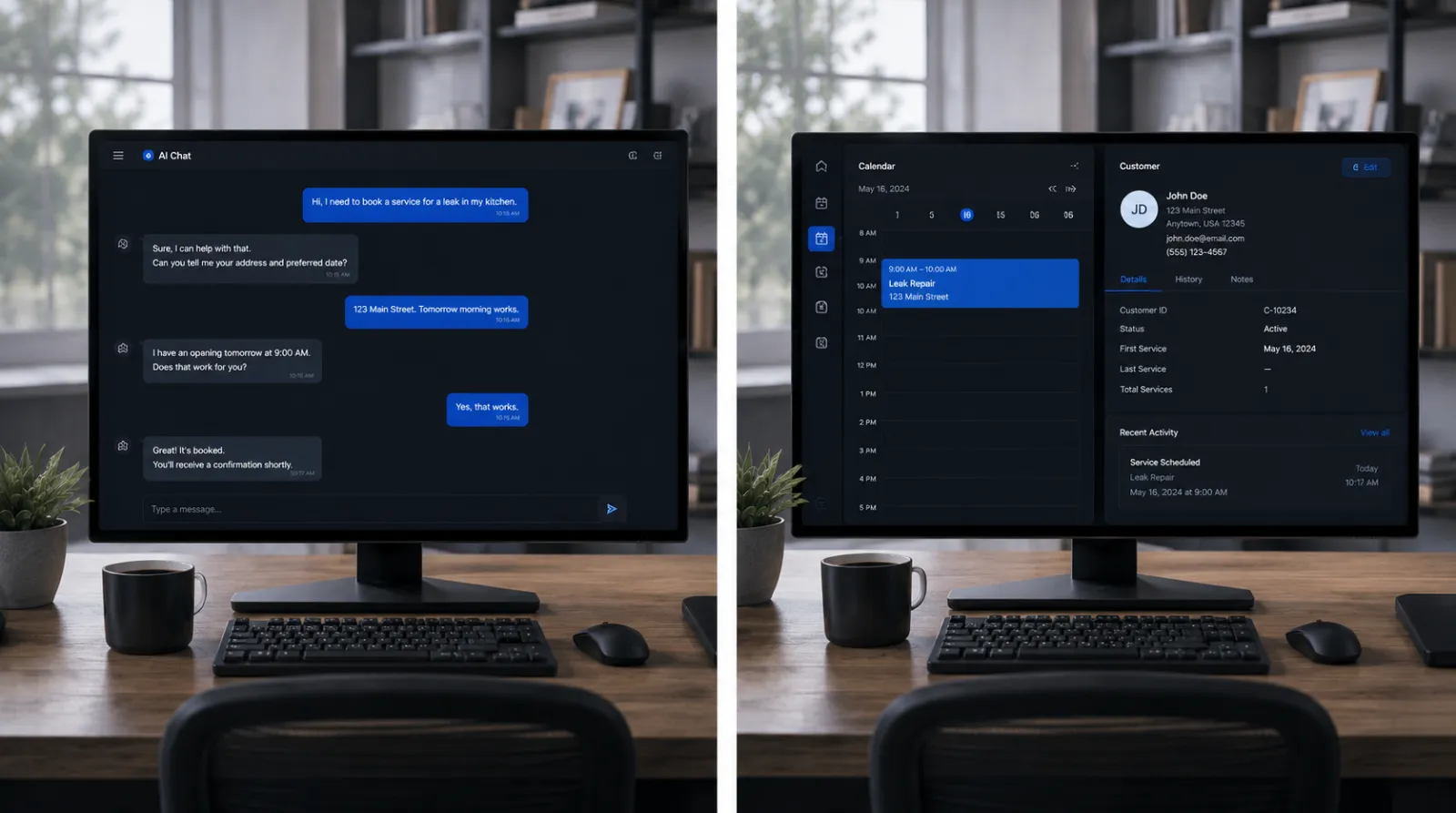
An AI agent takes actions in your systems to complete a task. A chatbot produces text and stops. The industry term for blurring the two is agent washing, and the practical test is simple: ask what the product changes in your business when it runs. If the answer is only words on a screen, it is a chatbot with new marketing.
This matters because the price gap between the two is large and the capability gap is larger. Businesses are paying agent prices for chatbot outcomes, then concluding AI does not work for them.
The Actual Difference
A chatbot receives a message and returns a message. It might be very good at that. It can answer questions, draft copy, summarise a document, explain your return policy. Everything it produces still requires a human to act on it.
An agent receives a goal and works toward it using tools. It can look up an order in Shopify, check availability in your calendar, create the CRM record, issue the return label, send the confirmation. It decides which steps are needed and takes them.
The dividing line is not intelligence, it is permission and plumbing. An agent has been given access to systems and the authority to change things in them. That is also why it needs guardrails a chatbot does not.
The Middle Ground Nobody Names
Most products sit between the two, and the honest description is assisted workflow. It drafts the reply and a human sends it. It suggests the reorder and a human approves it. It fills the form and a human submits it.
This is genuinely valuable and frequently the right choice, because it removes the mechanical work while keeping judgment where it belongs. It is just priced and pitched as autonomy when it is not. Buy it deliberately rather than by accident: if a person still has to touch every output, your saving is the drafting time, not the task.
Five Questions That Cut Through the Marketing
Ask these in the demo, in this order. Vague answers to any of them tell you what you need to know.
- What does it change in my systems? Name the systems and the records. "It integrates with your CRM" is not an answer. "It creates a contact and logs the call summary" is.
- What can it do without a human? The honest answer is a list, and a short list is fine. No list means assisted workflow.
- What happens when it does not know? Escalate and say so, or improvise? Improvising about pricing or availability creates a problem your team fixes later.
- Can I see what it did? An action log is non-negotiable once something can change your data. Without it you cannot audit a bad outcome.
- What are its limits, and who sets them? Refund ceilings, appointment types it may book, data it may never touch. If the vendor has not thought about limits, they have not deployed this anywhere serious.
Which One You Actually Need
A chatbot is right when the task ends in an answer. Website FAQs, internal policy lookup, drafting first versions of copy. Cheap, low risk, quick to deploy, and genuinely useful. Do not let anyone talk you out of it because it lacks a fashionable label.
An agent is right when the task ends in a change. Booking the appointment, processing the return, moving the record, sending the follow-up. The value is proportional to how mechanical and how frequent the task is.
Most small businesses need one agent doing one high-volume job well, plus perhaps a chatbot answering questions. What they are usually sold is a platform.
Why Agent Washing Is So Common
Partly pricing: agent capability commands a premium, so everything gets relabelled. Partly genuine difficulty. Building something that can safely change your data is much harder than building something that talks, because now failures have consequences. Duplicate records, wrong bookings, refunds that should not have been issued.
So many products stop at text and describe it ambitiously. That is not always cynical, but it does mean the burden of asking precise questions falls on you.
What to Do With This
Take the tool you are currently evaluating and write down the one task you want it to own end to end. Then ask the five questions above. You will usually find you need less than the platform offers and more than the cheap tier provides, which is the useful outcome of the exercise.
Related reading: AI agents for Shopify stores applies this to ecommerce, and our AI services covers how we scope this kind of work.
Frequently Asked Questions
Is an AI receptionist an agent or a chatbot?
It depends entirely on whether it can book. One that answers questions and takes a message is a voice chatbot. One that reads live availability and creates the appointment is an agent. This single distinction explains most of the price difference between tiers, and it is worth paying for.
Are agents riskier than chatbots?
Yes, necessarily, because they change things. A chatbot's worst case is a wrong answer, an agent's worst case is a wrong action recorded in your systems. That is managed with permission limits, action logs and escalation rules rather than avoided, but it does mean agents deserve more scrutiny before launch.
Do we need a multi-agent system?
Almost certainly not yet. Multi-agent orchestration is a real enterprise pattern for complex workflows, and for a business under a hundred people it usually adds coordination failure modes without adding value. One agent doing one job reliably beats three agents negotiating with each other.
How can I tell what a vendor really built?
Ask for a live demo against a test account of your own system rather than their sandbox, then check whether the record actually changed. Vendors with real integrations agree readily. Vendors without them offer a recorded video, which is your answer.
Is a chatbot a waste of money?
Not at all, when it is priced as one and pointed at questions rather than tasks. A well-grounded FAQ chatbot deflects real volume cheaply. The waste happens when a chatbot is bought at agent pricing to solve a problem that needed an action taken.
Want results like these for your brand?
Book a free 30-minute revenue audit with PA Digital Growthand we'll map your fastest path to growth.
Book a free audit